Hacktivism in Cyber Security: How Motives Shape Attacks
Hacktivism blends political protest with technical intrusion, creating threats that bypass standard commercial threat models and require specific detection strategies.

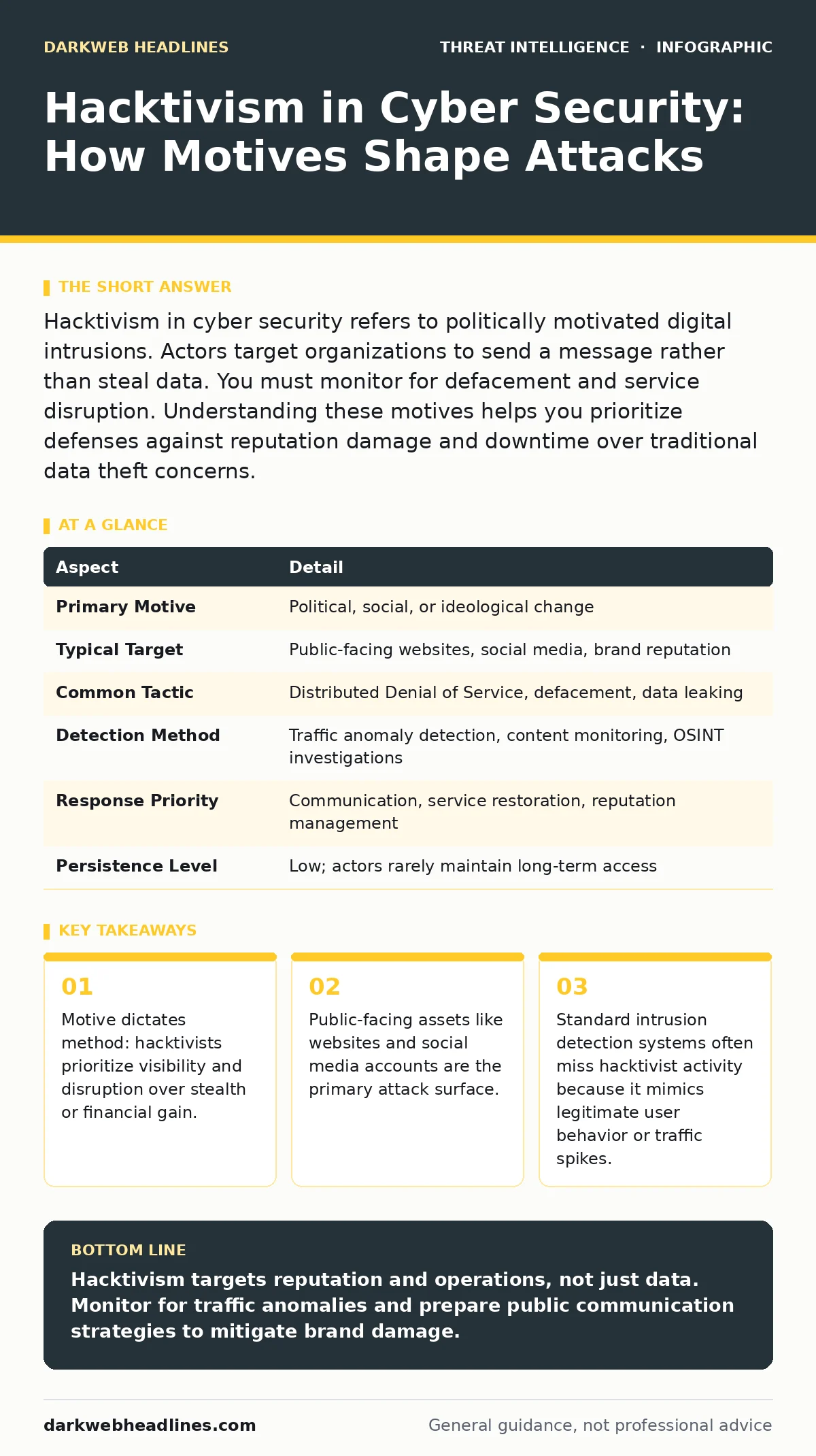
Hacktivism in cyber security refers to politically motivated digital intrusions. Actors target organizations to send a message rather than steal data. You must monitor for defacement and service disruption. Understanding these motives helps you prioritize defenses against reputation damage and downtime over traditional data theft concerns.
Understanding the Core Mechanics of Hacktivism
Hacktivism combines hacking techniques with activist goals. It is not a random act of vandalism. It is a calculated effort to influence public opinion or pressure an organization into changing its behavior. The attacker uses digital tools to create a public spectacle. This spectacle forces the target to respond. The response validates the attacker's message. This dynamic differs from criminal hacking. Criminal hackers seek profit. Hacktivists seek attention and ideological shift.
The technical execution relies on widely available tools. Attackers rarely develop custom malware. They use open-source frameworks and pre-built scripts. This lowers the barrier to entry. It also means the attack signatures are known. However, the volume of attacks can overwhelm automated defenses. The attacker does not need to be technically elite. They need persistence and a clear narrative.
| Aspect | Detail |
|---|---|
| Primary Motive | Political, social, or ideological change |
| Typical Target | Public-facing websites, social media, brand reputation |
| Common Tactic | Distributed Denial of Service, defacement, data leaking |
| Detection Method | Traffic anomaly detection, content monitoring, OSINT investigations |
| Response Priority | Communication, service restoration, reputation management |
| Persistence Level | Low; actors rarely maintain long-term access |
How Hacktivism in Cyber Security Operates
The attack cycle begins with reconnaissance. The attacker identifies the target's public stance. They look for contradictions between stated values and actual practices. This intelligence gathering often overlaps with OSINT investigations. The attacker collects emails, employee names, and server details. They map the digital footprint. This phase is passive and leaves little trace.
Once the target is selected, the attacker chooses a weapon. Distributed Denial of Service attacks are common. These floods of traffic crash servers. The goal is downtime. Defacement is another method. The attacker replaces the website content with political messages. This is highly visible. It generates media coverage. Some actors leak internal documents. This is less about selling data and more about shaming the organization.
The execution phase is often short. Hacktivists do not want to linger. Lingering increases the risk of attribution. They strike hard and fast. Then they retreat. This pattern makes them difficult to track. Traditional security teams look for slow, creeping intrusions. Hacktivism is a sudden spike. It requires different monitoring thresholds.
Who Bears the Cost of Ideological Attacks
Hacktivism affects more than just the IT department. The primary victim is the brand. Reputation damage spreads quickly. Social media amplifies the attack. Customers see the disruption. They question the company's reliability. Trust erodes. Restoring trust takes longer than restoring servers. The financial cost comes from lost business and legal fees.
Employees also feel the impact. They may be harassed online. Their personal information might be leaked. This creates a hostile work environment. Morale drops. Productivity suffers. The organization must support its staff. This requires clear communication policies. It also requires emotional support resources.
Suppliers and partners are at risk too. If the target organization is part of a supply chain, attackers may pivot. They look for weaker links. Smaller vendors often lack strong defenses. Attacking them causes collateral damage. The main target suffers from upstream failures. This expands the attack surface. It forces a broader response strategy.
Common Misconceptions About Activist Hacking
People often mistake hacktivism for state-sponsored espionage. They assume the techniques are advanced. This is usually false. Most hacktivist groups use low-tech methods. They rely on volume and timing. Assuming sophistication leads to misallocated resources. Teams build expensive defenses against non-existent threats. They ignore basic website security. This is a costly error.
Another mistake is ignoring the narrative. Security teams focus on blocking IP addresses. They forget to address the message. The attacker wants a reaction. A purely technical response feeds the narrative. It shows weakness. A coordinated public response is necessary. It must be calm and factual. Ignoring the human element of the attack leaves a gap.
Many believe hacktivism is harmless. They see it as "digital graffiti." This underestimates the impact. Downtime costs money. Data leaks cause legal issues. The social unrest caused by these attacks can be real. Dismissing the threat leaves the organization exposed. It signals that the brand is an easy target. Other groups may take notice.
Defensive Strategies for Ideological Threats
Defense starts with visibility. You must know what is on your network. Log management is critical. It records traffic patterns. It helps distinguish between a traffic spike and an attack. Without logs, you are blind. You cannot prove what happened. You cannot learn from the incident. Ensure logs are stored securely. They are evidence.
Next, implement rate limiting. This controls how many requests a user can make. It prevents simple flooding attacks. It does not stop distributed attacks. But it raises the cost for the attacker. They need more resources to bypass it. Combine this with content delivery networks. These services absorb traffic spikes. They shield your origin servers.
Communication plans are vital. Prepare templates for public statements. Identify spokespeople. Practice the response. When an attack happens, speed matters. Delay allows rumors to spread. Address the issue directly. Deny the attacker's narrative. Show that you are in control. This reduces the panic. It protects the brand.
See also: Deep Web Intelligence: Why It Changes Security Decisions · Cyber Espionage Myths: Why State Actors Fail and How They Actually Operate
Integrating Threat Intelligence Into Operations
Effective defense requires context. Operational threat intelligence provides this context. It tells you who is active. It shows their tactics. It reveals their targets. Without intelligence, you are guessing. You block random IPs. You miss the real threat. Subscribe to reputable feeds. Filter for hacktivist groups. Analyze their recent activity.
Look for command and control traffic patterns. Even hacktivists use infrastructure. They use chat servers. They use file hosting sites. These leave traces. Monitoring for these connections helps early detection. It also helps attribution. Knowing the group helps predict their next move. It allows proactive defense.
Consider defense evasion techniques. Hacktivists may use legitimate tools. They may use remote desktop abuse to gain access. They may use DNS tunneling to exfiltrate data. These methods look normal. Standard firewalls miss them. You need deep packet inspection. You need behavioral analysis. Look for deviations from the norm.
Preparing for the Next Wave
Hacktivism evolves. New platforms emerge. New tactics appear. You must adapt. Review your defenses regularly. Test your incident response plan. Update your communication templates. Train your staff. Make sure they know what to do. Security is a team effort. Everyone plays a role.
Stay informed. Follow security news. Understand the current climate. Social unrest often triggers hacktivism. Be ready. Have a plan. Execute it calmly. Protect your assets. Protect your reputation. Be resilient. The next attack is coming. Prepare now.
Key takeaways
- Motive dictates method: hacktivists prioritize visibility and disruption over stealth or financial gain.
- Public-facing assets like websites and social media accounts are the primary attack surface.
- Standard intrusion detection systems often miss hacktivist activity because it mimics legitimate user behavior or traffic spikes.
Hacktivism targets reputation and operations, not just data. Monitor for traffic anomalies and prepare public communication strategies to mitigate brand damage.
Frequently asked questions
How do I distinguish hacktivism from a standard DDoS attack?
Hacktivism usually includes a political message or defacement. Standard DDoS attacks focus solely on disruption. Look for posted messages or leaked data. Check social media for coordinated campaigns. The motive is the key differentiator.
Can hacktivists steal sensitive customer data?
Yes, though it is not their primary goal. They may leak data to cause embarrassment. This is different from selling data. The intent is public shaming. Secure your databases regardless of motive. Assume all actors want access.
Should I block known hacktivist IP addresses?
Blocking IPs is a temporary measure. Hacktivists use botnets and proxies. They change IPs frequently. Focus on rate limiting and traffic filtering. Block by behavior, not just identity. This is more effective and sustainable.
What is the role of DNS tunneling in these attacks?
DNS tunneling allows attackers to hide data exfiltration in DNS queries. It bypasses standard firewalls. Hacktivists may use it to steal internal documents. Monitor DNS traffic for unusual patterns. Look for long queries or high frequency.
How this guide was produced: written by the DarkWeb Headlines editorial team with AI assistance, checked against the public references listed below, and reviewed when the facts change. See our editorial policy or report an error.