OSINT Investigation Checklist: Structure Your Open Source Research
Most investigators fail because they track data sources instead of mapping the relationships between entities and their digital footprints.

Use this structured checklist to organize open source intelligence collection. It covers identity resolution, infrastructure mapping, and social graph analysis. Follow the steps to ensure you capture context, not just raw data, for accurate threat assessment.
Defining the Scope and Objectives
Open source intelligence relies on publicly available information to build a picture of a target. You must define what you are looking for before you start collecting. Without a clear objective, you will drown in irrelevant data. This checklist assumes you are investigating a specific entity or incident.
You should establish boundaries for your investigation. Determine which jurisdictions and data types are relevant. This prevents scope creep and keeps your research focused.
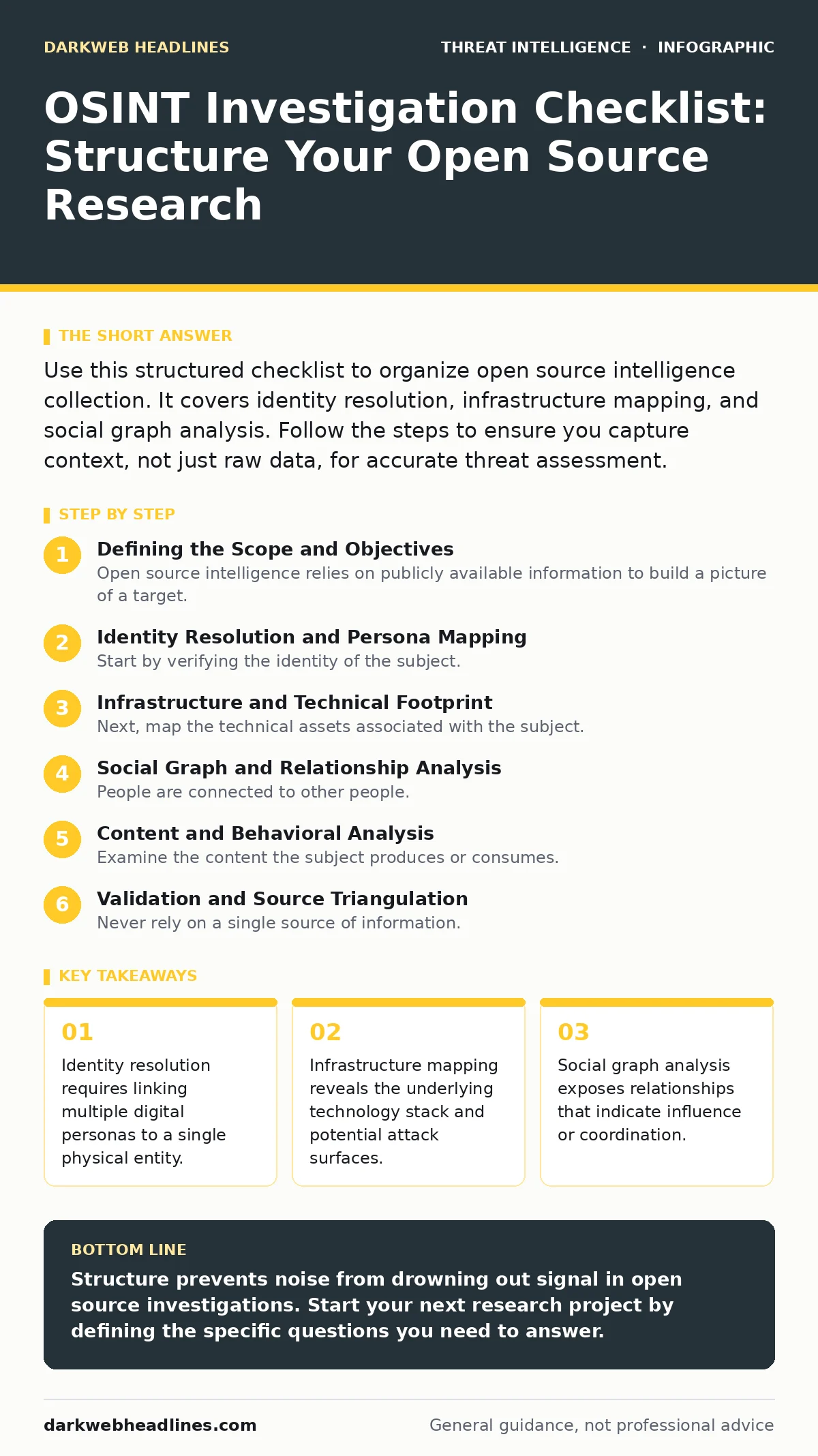
Identity Resolution and Persona Mapping
Start by verifying the identity of the subject. You need to link online handles to real-world identifiers. This step often reveals aliases or previous identities.
- Verify primary identifiers: Confirm the name, location, and role of the subject.
- Map digital aliases: List all known usernames and social media handles.
- Cross-reference public records: Check court documents or business registries for matches.
- Identify associated emails: Gather email addresses from public profiles or leaks.
- Link phone numbers: Find any publicly listed phone numbers associated with the identity.
- Document photo metadata: Check images for embedded location or device data.
Identity resolution is the foundation of any investigation. If you cannot confirm who the subject is, the rest of your data lacks context. This process helps distinguish between a single actor and a coordinated group.
Infrastructure and Technical Footprint
Next, map the technical assets associated with the subject. This includes domains, servers, and software choices. Understanding the infrastructure helps you assess risk and capability.
- Enumerate domains: List all domains registered to the subject or organization.
- Analyze DNS records: Check for mail servers, name servers, and text records.
- Identify hosting providers: Determine where the subject hosts their web content.
- Map IP addresses: Note any static IP addresses associated with the domains.
- Check certificate transparency logs: Look for domain names that have requested SSL certificates.
- Review historical snapshots: Use web archives to see how the site has changed.
This step reveals the technology stack in use. You can infer the maturity of the operation from their technical choices. For deeper insights into how attackers manipulate these systems, see the guide on process injection.
Social Graph and Relationship Analysis
People are connected to other people. Mapping these connections reveals influence and potential collaborators. This is where you move from static data to dynamic relationships.
- List direct connections: Identify friends, colleagues, and followers.
- Identify mutual contacts: Find people who appear in multiple networks.
- Analyze communication patterns: Note frequency and timing of interactions.
- Map organizational ties: Link the subject to companies or groups.
- Track content sharing: See what information the subject amplifies or ignores.
- Identify key influencers: Note who the subject listens to or respects.
Social graphs often reveal hidden hierarchies. A person may have few followers but high influence within a specific group. This analysis helps you understand the subject's network effects.
Content and Behavioral Analysis
Examine the content the subject produces or consumes. This provides insight into their interests, skills, and intentions. Behavioral patterns can predict future actions.
- Catalog public posts: Save text, images, and videos from social platforms.
- Analyze writing style: Note vocabulary, tone, and recurring themes.
- Identify skill indicators: Look for code snippets, technical discussions, or tutorials.
- Map interest clusters: Group topics the subject frequently engages with.
- Track temporal patterns: Note when the subject is most active online.
- Review comment history: See how the subject interacts with others.
Behavioral analysis adds depth to the profile. It helps you understand the "why" behind the actions. This is critical for assessing intent versus accidental exposure.
See also: Deep Web Intelligence: Why It Changes Security Decisions · Cyber Espionage Myths: Why State Actors Fail and How They Actually Operate
Validation and Source Triangulation
Never rely on a single source of information. You must verify findings through multiple independent channels. This reduces the risk of misinformation or manipulation.
- Cross-check facts: Verify key details against at least two unrelated sources.
- Identify conflicting data: Note any discrepancies between sources.
- Assess source credibility: Evaluate the reputation and history of each source.
- Document evidence chain: Record where each piece of information came from.
- Flag unverified claims: Clearly mark any information that lacks corroboration.
- Review for bias: Consider the potential bias of each source.
Triangulation ensures your conclusions are solid. It protects you from being misled by fake profiles or outdated data. For more on interpreting data quality, see the guide on security metrics.
Documentation and Reporting
Finally, structure your findings for clear communication. A disorganized investigation is useless to decision-makers. Your report must be actionable and accurate.
- Summarize key findings: Highlight the most critical discoveries.
- Provide evidence links: Include direct links to source material.
- Note limitations: Clearly state what you could not verify.
- Recommend next steps: Suggest further investigation or actions.
- Store data securely: Ensure your notes and evidence are protected.
- Review for clarity: Ensure the report is easy to understand.
Good documentation preserves the value of your work. It allows others to build on your findings. For context on how to use this data, see the guide on operational threat intelligence.
Key takeaways
- Identity resolution requires linking multiple digital personas to a single physical entity.
- Infrastructure mapping reveals the underlying technology stack and potential attack surfaces.
- Social graph analysis exposes relationships that indicate influence or coordination.
Structure prevents noise from drowning out signal in open source investigations. Start your next research project by defining the specific questions you need to answer.
Frequently asked questions
How do I verify an email address is real?
Check for public profiles linking to the address and look for historical usage in public records or forums.
What is the difference between OSINT and surveillance?
OSINT uses only publicly available information, while surveillance involves covert monitoring of private activities.
Can I use this checklist for internal investigations?
Yes, but ensure you comply with company policies and legal requirements regarding employee privacy.
How often should I update my OSINT findings?
Update findings whenever new public information becomes available or when the investigation scope changes.
How this guide was produced: written by the DarkWeb Headlines editorial team with AI assistance, checked against the public references listed below, and reviewed when the facts change. See our editorial policy or report an error.