Business Logic Vulnerability Response: Recovery and Prevention Steps
Business logic flaws bypass standard security controls because the application behaves exactly as coded, requiring manual analysis rather than automated scanning to fix.

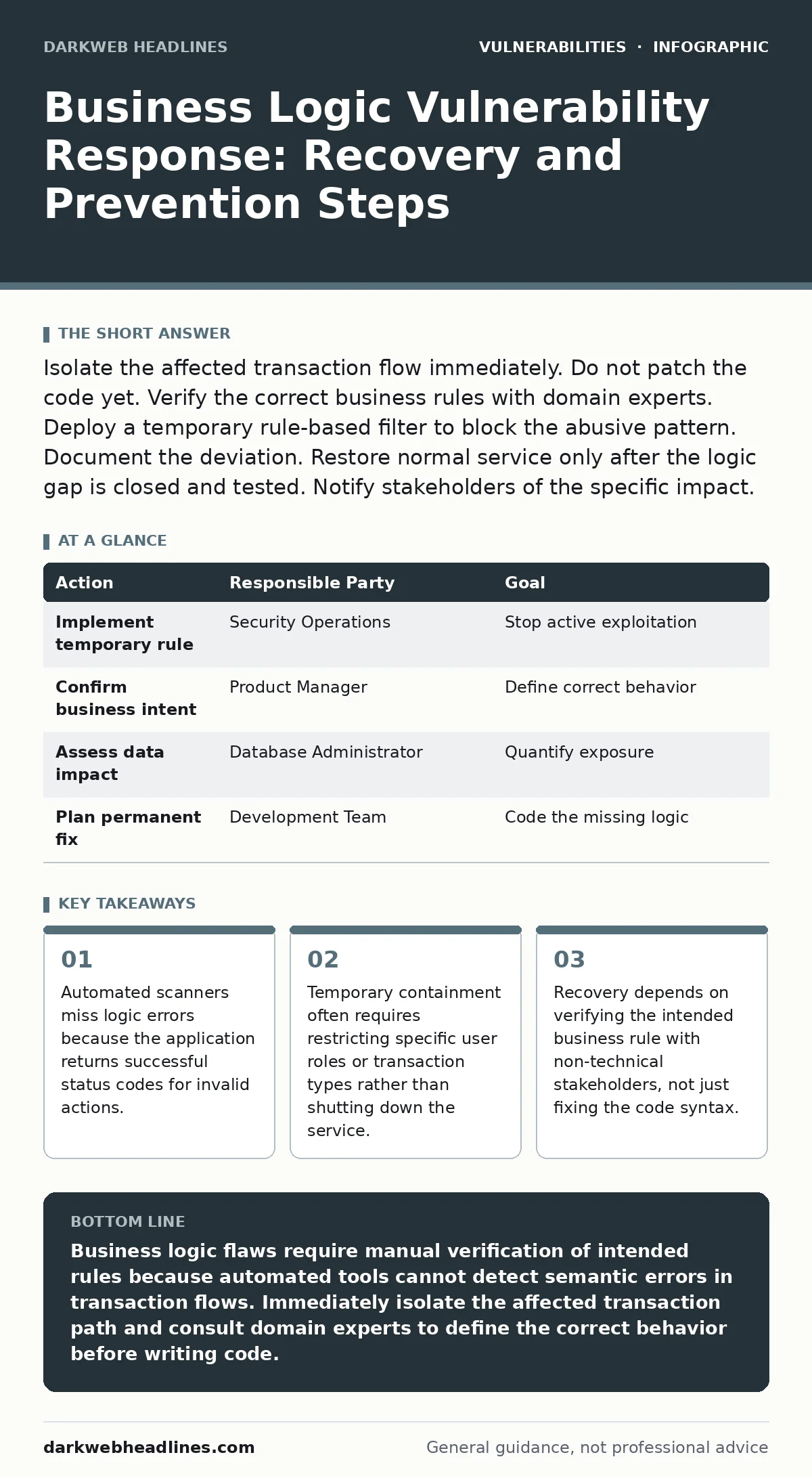
Isolate the affected transaction flow immediately. Do not patch the code yet. Verify the correct business rules with domain experts. Deploy a temporary rule-based filter to block the abusive pattern. Document the deviation. Restore normal service only after the logic gap is closed and tested. Notify stakeholders of the specific impact.
First hour
The initial response to a business logic vulnerability focuses on stopping the abuse while preserving evidence. Unlike buffer overflows or injection flaws, these defects do not crash the application. The system processes the request successfully, which makes detection difficult. You must identify the specific transaction flow that violates the intended business rule. This could involve purchasing items at zero cost, skipping approval steps, or accessing data belonging to another user.
Your primary goal is containment. You need to determine which user accounts are involved and what data was exposed or altered. Check the application logs for sequences of requests that deviate from the standard user journey. Look for rapid succession of actions that a human user would not perform. Identify the entry point where the logic breaks. This might be a specific API endpoint or a web form that accepts unexpected parameter values.
- Identify the specific transaction flow being abused.
- Freeze the affected user accounts to prevent further exploitation.
- Capture full request and response headers for forensic analysis.
- Notify the internal security team and the product owner.
- Verify the intended business rule with the original requirement documentation.
First day
Containment requires blocking the abusive pattern without disrupting legitimate users. Since business logic vulnerabilities are semantic, you cannot simply patch a library or update a firewall rule based on a signature. You must implement a temporary control that enforces the missing business rule. This might involve adding a rate limit to a specific endpoint or disabling a feature for all users.
You must involve the product managers or domain experts. Developers often assume the code reflects the business intent, but legacy code may contain outdated rules. The experts can confirm what the application is supposed to do. This step prevents you from fixing the wrong thing. If the code allows skipping a payment step because it was never implemented, the fix is to add the payment check, not to hide the button.
Review the scope of the impact. Determine how many users could have exploited the flaw. Check if the vulnerability allows privilege escalation or data leakage. If the flaw involves financial transactions, calculate the potential loss. This information helps prioritize the recovery effort. You may need to reverse specific transactions in the database. This requires careful coordination with the database administrators to ensure data integrity.
| Action | Responsible Party | Goal |
|---|---|---|
| Implement temporary rule | Security Operations | Stop active exploitation |
| Confirm business intent | Product Manager | Define correct behavior |
| Assess data impact | Database Administrator | Quantify exposure |
| Plan permanent fix | Development Team | Code the missing logic |
First week
Recovery involves implementing the permanent fix and restoring full service. The development team writes code that enforces the correct business logic. This often requires adding new validation checks at multiple layers. You must verify that the fix does not introduce new vulnerabilities. For example, adding a strict check might break a legitimate edge case. Test the fix thoroughly with both positive and negative test cases.
Deploy the fix to a staging environment first. Run dynamic application security testing (DAST) to check for common code errors, but remember that DAST tools often miss logic flaws. You must manually test the specific transaction flow that was compromised. Verify that the abuse is blocked while legitimate users can still complete their tasks. Monitor the application closely after deployment to the production environment.
You must communicate with stakeholders. Inform users if their data was exposed or if transactions were affected. Provide clear instructions on what they should do. This might include changing passwords or reviewing account statements. Transparency builds trust. If the vulnerability was reported by an external researcher, follow your bug bounty programs policy to reward them appropriately. This encourages responsible disclosure in the future.
Who to tell
Communication must be precise and timely. You must inform the incident response team immediately. They coordinate the technical response and legal considerations. The product owner needs to know about the business impact. They can decide whether to disable features or accept the risk temporarily. Legal counsel must be involved if user data was compromised. They determine notification requirements under relevant privacy laws.
Do not disclose technical details publicly until the fix is deployed. Public disclosure helps attackers find similar vulnerabilities in other systems. Share only what is necessary with your users. Explain that an issue was found and fixed. Assure them that their data is secure. If the vulnerability allows financial loss, provide specific steps for users to verify their transactions. Clear communication reduces panic and support ticket volume.
How to stop a repeat
Preventing future business logic vulnerabilities requires a shift in how you design and test applications. Security must be integrated into the design phase. Developers should define the expected user flow and the constraints for each step. These constraints become part of the acceptance criteria for the feature. Testing should include negative testing, where testers try to break the rules.
Implement strict server-side validation. Never trust client-side inputs. The client can modify any data sent to the server. Validate that each step in a transaction follows the correct sequence. Check that the user has the necessary permissions for each action. Use state machines to enforce the order of operations. This ensures that a user cannot skip steps or repeat actions.
Regularly review the business rules. Business requirements change over time. Code that was correct last year may be obsolete today. Conduct logic reviews as part of your vulnerability management programs. These reviews focus on the semantics of the application rather than just the code syntax. They help identify gaps where the code no longer matches the intended business process.
See also: Initial Access Broker Response: Containment and Recovery Steps · How SOC Playbooks Work: Mechanism, Limits, and Execution
Common pitfalls
One common mistake is assuming that input validation prevents logic flaws. Input validation checks the format of the data, not the meaning. An attacker can send valid data in an invalid sequence. For example, sending a "complete order" request before a "payment" request. The data is valid, but the sequence is wrong. You must validate the state of the transaction, not just the input.
Another pitfall is relying solely on automated testing. Automated tools check for known patterns of vulnerabilities. They do not understand the business context. A tool will not know that a user should not be able to buy an item for zero dollars. Manual testing by people who understand the business is required. These testers can identify logical gaps that automated tools miss.
Long-term resilience
Building resilience against business logic vulnerabilities requires a culture of security. Developers must understand the business impact of their code. They should ask questions about the expected behavior of each feature. Security teams must provide training on logic flaws. This training should include examples of real-world scenarios. It should show how small logic errors can lead to significant damage.
Integrate security into the development lifecycle. Use threat modeling to identify potential logic flaws before coding begins. Threat modeling helps you think like an attacker. It forces you to consider how an attacker might abuse the business rules. This proactive approach is more effective than reactive patching. It reduces the number of vulnerabilities that reach production.
Regular audits of the business logic are necessary. These audits should be conducted by independent parties. They can provide an objective view of the application. They can identify flaws that the internal team might miss due to familiarity. These audits should cover both the code and the configuration. Misconfigurations can also lead to logic flaws.
Final considerations
Business logic vulnerabilities are persistent because they are inherent in the design. They cannot be patched with a simple update. They require a fundamental understanding of the application. Your response must be methodical and thorough. Rushing to fix the code without understanding the business rule leads to incomplete fixes. Take the time to verify the intended behavior.
Recovery is not just about fixing the code. It is about restoring trust with your users. Clear communication and transparent actions are key. Show that you take security seriously. Implement measures to prevent recurrence. This includes better design practices, thorough testing, and regular audits. By addressing the root cause, you reduce the risk of future incidents.
Key takeaways
- Automated scanners miss logic errors because the application returns successful status codes for invalid actions.
- Temporary containment often requires restricting specific user roles or transaction types rather than shutting down the service.
- Recovery depends on verifying the intended business rule with non-technical stakeholders, not just fixing the code syntax.
Business logic flaws require manual verification of intended rules because automated tools cannot detect semantic errors in transaction flows. Immediately isolate the affected transaction path and consult domain experts to define the correct behavior before writing code.
Frequently asked questions
Can a WAF stop business logic vulnerabilities?
No, a Web Application Firewall filters based on known attack signatures. It cannot understand the business context or intent of a transaction, so it will allow valid-looking requests that violate business rules.
How do I know if a logic flaw is critical?
Assess the impact on confidentiality, integrity, and availability. If the flaw allows unauthorized access to sensitive data, financial loss, or bypass of critical controls, it is critical.
Should I disable the feature completely?
Disabling the feature is a valid containment strategy if the impact is severe and a quick fix is not possible. Weigh the business impact of downtime against the risk of continued exploitation.
Do bug bounty programs help find logic flaws?
Yes, human researchers in bug bounty programs are often better at finding logic flaws than automated tools because they can reason about the application's intended behavior and identify semantic gaps.
How this guide was produced: written by the DarkWeb Headlines editorial team with AI assistance, checked against the public references listed below, and reviewed when the facts change. See our editorial policy or report an error.