How SOC Playbooks Work: Mechanism, Limits, and Execution
SOC playbooks function as conditional logic engines that translate raw telemetry into specific remediation actions, reducing analyst cognitive load while introducing rigid failure modes.

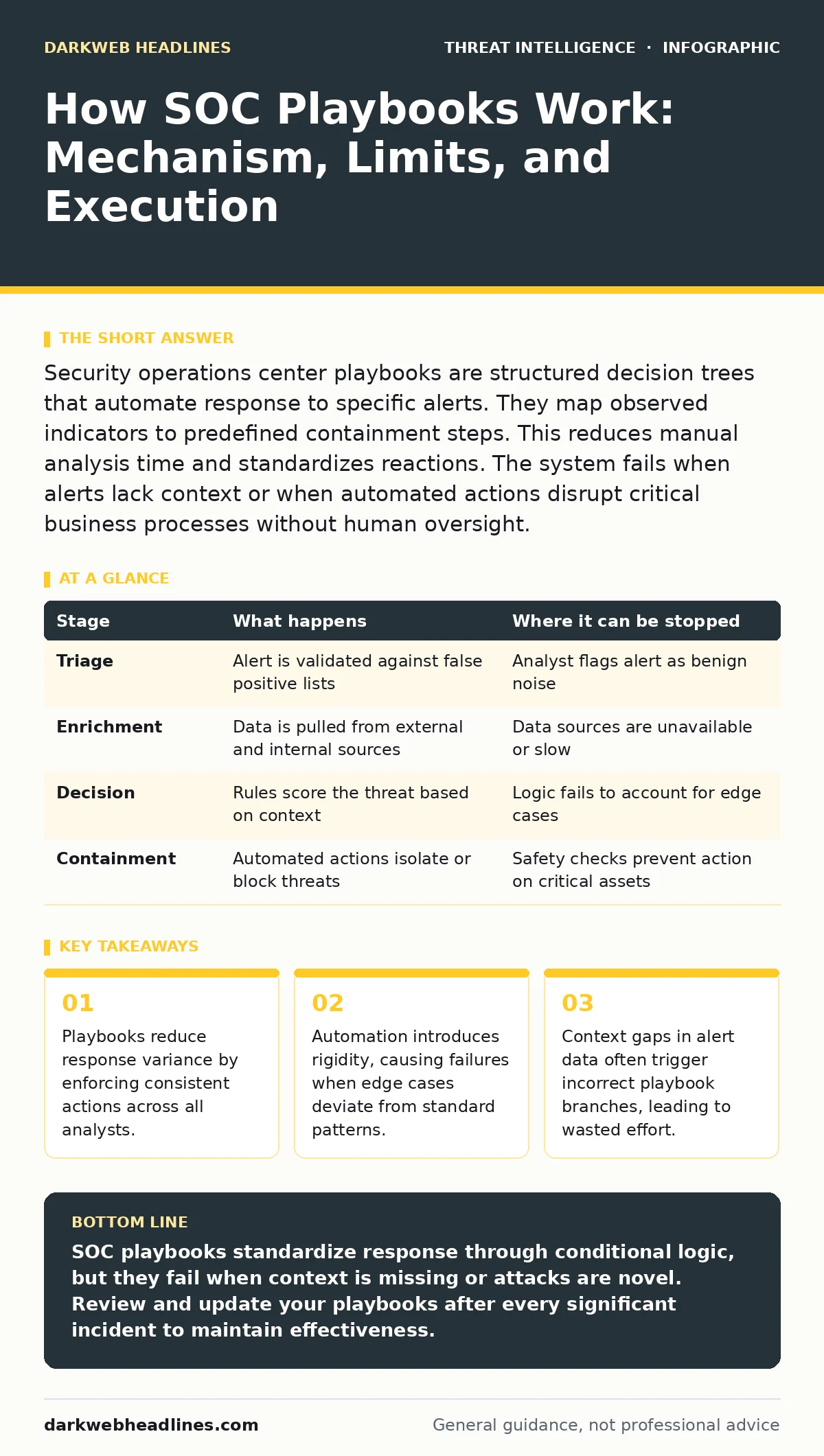
Security operations center playbooks are structured decision trees that automate response to specific alerts. They map observed indicators to predefined containment steps. This reduces manual analysis time and standardizes reactions. The system fails when alerts lack context or when automated actions disrupt critical business processes without human oversight.
Anatomy of a Security Playbook
A security operations center playbook is a documented procedure for handling specific security events. It functions as a decision tree rather than a simple script. The document defines the conditions that trigger each step and the actions an analyst or automated system must take. This structure ensures that every response follows a verified path. The goal is to eliminate guesswork during high-pressure incidents.
Playbooks rely on clear inputs and defined outputs. They connect alert generation to containment measures. Without this link, alerts remain noise. With it, they become actionable intelligence. The effectiveness depends on the accuracy of the underlying data. If the input is wrong, the entire chain fails.
Stage 1: Alert Triage and Validation
The process begins when a detection system generates an alert. This alert contains raw data about a potential security event. The first step is validation. Analysts or automated systems check if the alert matches known benign activity. This reduces false positives. False positives waste time and create alert fatigue.
Validation involves cross-referencing the alert with asset inventory data. You must confirm the affected system exists and is owned by the organization. You also check if the user behavior matches their typical pattern. This step separates real threats from configuration noise. It prevents the playbook from running on irrelevant data.
Stage 2: Context Enrichment
Once validated, the playbook gathers additional context. This stage pulls data from multiple sources. It checks threat intelligence feeds for known malicious indicators. It reviews user account status and recent login history. It examines network logs for related activity. This broadens the view from a single event to a potential campaign.
Context enrichment answers the question of scope. Is this an isolated incident or part of a larger attack? The playbook queries databases to find connections. It links the current alert to other events in the same time window. This helps identify if an attacker has moved laterally. It also determines the severity level.
Stage 3: Decision Logic and Scoring
The playbook applies decision logic to the enriched data. This logic uses rules to score the threat. High scores indicate likely malicious activity. Low scores suggest benign errors. The rules define thresholds for each score. These thresholds determine which response path to follow. The logic must be precise to avoid ambiguity.
Imagine a rule that flags remote code execution. The playbook checks if the process is signed. It checks if the user has administrative privileges. It checks if the code originates from an untrusted source. Each factor adds points to the score. The total score dictates the next action. This scoring mechanism standardizes judgment across different analysts.
Stage 4: Automated Containment
If the score exceeds the threshold, the playbook initiates containment. This step often uses automation to speed up response. The system may isolate the affected host from the network. It may disable the compromised user account. It may block specific IP addresses at the firewall. These actions limit the damage immediately.
Automation is effective for clear-cut cases. It acts faster than any human. However, it lacks nuance. Automated containment can break critical services if the target is a production server. The playbook must include safety checks. These checks verify that the action will not cause unacceptable downtime. This balance between speed and safety is difficult to achieve.
| Stage | What happens | Where it can be stopped |
|---|---|---|
| Triage | Alert is validated against false positive lists | Analyst flags alert as benign noise |
| Enrichment | Data is pulled from external and internal sources | Data sources are unavailable or slow |
| Decision | Rules score the threat based on context | Logic fails to account for edge cases |
| Containment | Automated actions isolate or block threats | Safety checks prevent action on critical assets |
See also: Isolating Infected Devices: 7 Mistakes That Spread Malware · Initial Access Broker Response: Containment and Recovery Steps
Stage 5: Manual Investigation
When automation is insufficient, the playbook hands off to a human analyst. This stage requires deep technical investigation. The analyst reviews logs and memory dumps. They look for signs of persistence and lateral movement. They determine the root cause of the incident. This manual work is slower but more accurate.
Analysts use their expertise to fill gaps in the data. They identify tactics that automated rules miss. For example, they might spot subtle indicators of defense evasion techniques. They analyze command and control traffic patterns that look like normal web browsing. This human element adds necessary depth to the response.
Stage 6: Remediation and Recovery
After containment, the focus shifts to fixing the issue. The playbook guides the restoration of services. This involves removing malicious artifacts and patching vulnerabilities. It may require resetting credentials for affected users. It ensures that the attacker cannot return through the same entry point. The system is then monitored for recurrence.
Remediation is not just about technical fixes. It involves updating the playbook itself. If the incident revealed a gap in detection, the playbook must be updated. If the containment caused issues, the rules must be adjusted. This feedback loop improves future responses. It turns each incident into a learning opportunity.
Limits and Failure Modes
Playbooks are not perfect. They struggle with novel attacks that do not match known patterns. They fail when data is incomplete or inaccurate. They can create a false sense of security. Analysts may rely too heavily on automation and miss subtle signs. This over-reliance reduces manual skills over time.
The rigidity of playbooks is their greatest weakness. They assume a linear path to resolution. Real attacks are chaotic and adaptive. An attacker might use initial access brokers to gain entry through unexpected channels. The playbook may not account for this complexity. It may stop at the first sign of compromise without seeing the full scope.
Maintenance and Evolution
Playbooks require constant maintenance. Threat tactics change rapidly. Old rules become obsolete. New tools and platforms introduce new variables. The playbook must be updated to reflect these changes. This requires regular review and testing. Red teaming exercises can help identify gaps in the playbook logic.
Testing involves simulating attacks to see if the playbook responds correctly. This validates the logic and the automation. It reveals where the process breaks down. It ensures that the playbook remains effective against current threats. Without this maintenance, playbooks become liabilities rather than assets. They consume resources without providing value.
Integration with Broader Strategy
Playbooks do not exist in isolation. They connect to other security functions. They feed into operational threat intelligence efforts. They inform vulnerability management programs. They support incident response plans. This integration ensures a cohesive security posture. It aligns technical responses with strategic goals.
The playbook is a tool, not a strategy. It supports the broader security program. It provides consistency and speed. It reduces the burden on analysts. But it must be used wisely. It must be part of a layered defense. It must be complemented by human judgment and continuous improvement. Only then does it deliver real protection.
Key takeaways
- Playbooks reduce response variance by enforcing consistent actions across all analysts.
- Automation introduces rigidity, causing failures when edge cases deviate from standard patterns.
- Context gaps in alert data often trigger incorrect playbook branches, leading to wasted effort.
SOC playbooks standardize response through conditional logic, but they fail when context is missing or attacks are novel. Review and update your playbooks after every significant incident to maintain effectiveness.
Frequently asked questions
Do playbooks replace security analysts?
No, playbooks automate routine tasks and provide guidance, but analysts are still needed for complex investigations and decision-making.
How often should playbooks be updated?
Playbooks should be reviewed after every major incident and updated quarterly to reflect new threats and changes in the environment.
Can playbooks handle zero-day attacks?
Playbooks can handle zero-day attacks if they are based on behavioral indicators rather than specific signatures, but they may miss novel tactics.
What is the biggest risk of using playbooks?
The biggest risk is over-automation, which can lead to disruptive actions on critical systems or missed detections due to rigid logic.
How this guide was produced: written by the DarkWeb Headlines editorial team with AI assistance, checked against the public references listed below, and reviewed when the facts change. See our editorial policy or report an error.