Java Deserialization Response: Immediate Containment and Recovery Steps
Java deserialization flaws allow remote attackers to execute arbitrary code on your server, often bypassing standard web application firewalls and requiring immediate process isolation.

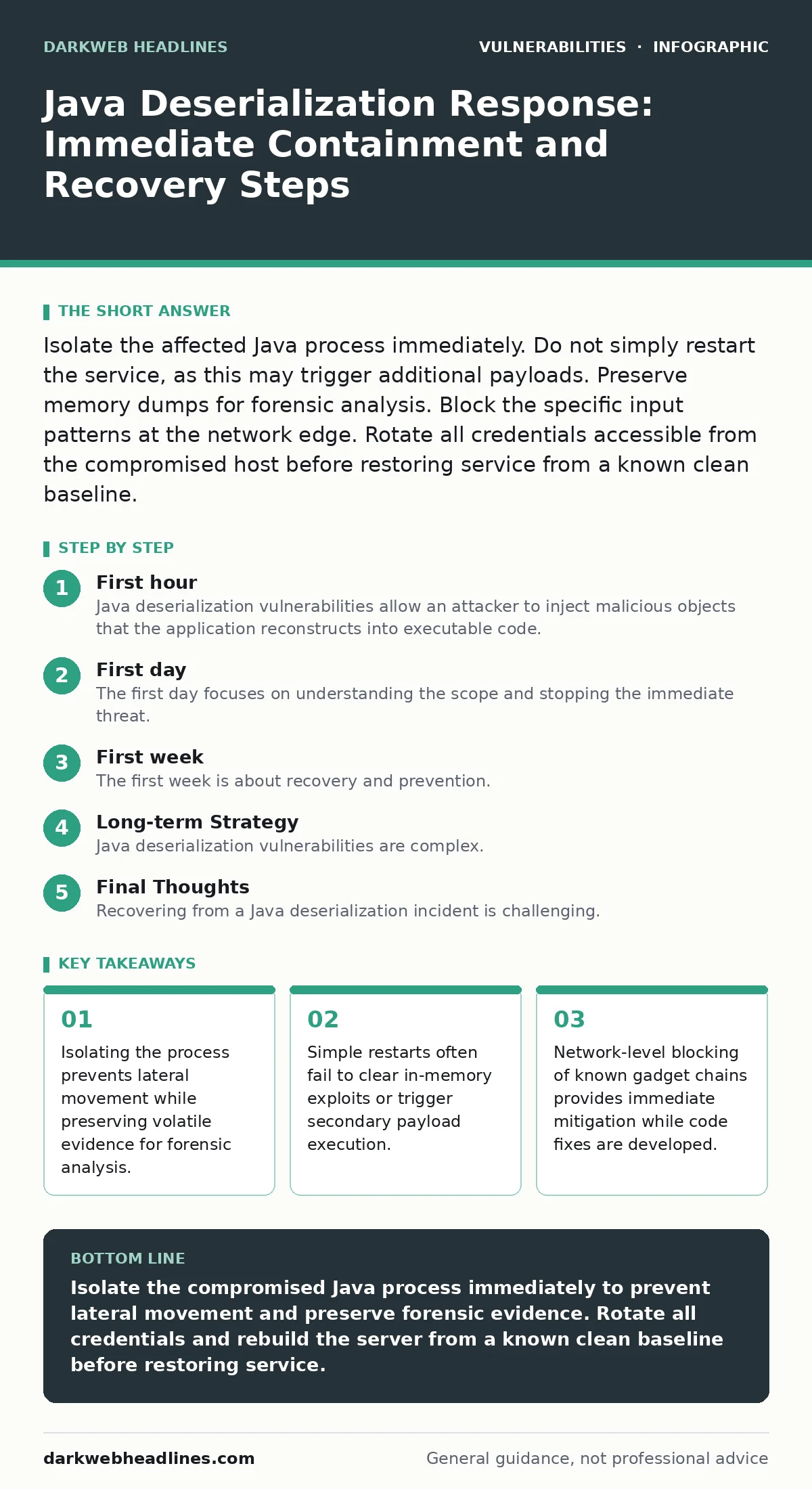
Isolate the affected Java process immediately. Do not simply restart the service, as this may trigger additional payloads. Preserve memory dumps for forensic analysis. Block the specific input patterns at the network edge. Rotate all credentials accessible from the compromised host before restoring service from a known clean baseline.
First hour
Java deserialization vulnerabilities allow an attacker to inject malicious objects that the application reconstructs into executable code. You must act before the attacker establishes persistence. The first hour determines whether the breach remains contained or spreads across your infrastructure.
Immediate Isolation Checklist
- Identify the specific process ID consuming abnormal resources or exhibiting unexpected network traffic.
- Block outbound traffic from the compromised host at the firewall level to prevent data exfiltration.
- Capture a memory dump of the running process for later forensic analysis.
- Isolate the host from the internal network to stop lateral movement attempts.
Containment Actions
You cannot fix the code in the first hour. You must stop the bleeding. Identify the entry point. Most deserialization attacks come through HTTP POST requests containing specific byte sequences. Use your web application firewall or load balancer to block requests matching known malicious patterns. This is a temporary measure. It does not fix the vulnerability. It buys you time.
Imagine a scenario where an attacker uses a common gadget chain to execute a reverse shell. The shell runs in memory. If you restart the server, the shell dies, but the attacker may have already copied files to disk. By isolating the host first, you keep the attacker inside a box with no network access.
First day
The first day focuses on understanding the scope and stopping the immediate threat. You need to determine what the attacker accessed and how they entered. This requires correlating logs from the web server, the application, and the operating system.
Forensic Analysis Steps
- Analyze the memory dump for signs of injected classes or unusual object graphs.
- Review web server logs for large POST requests containing Base64-encoded data.
- Check for new user accounts or modified system binaries on the host.
- Identify other systems that communicated with the compromised host.
Java deserialization often relies on third-party libraries that contain "gadgets." These are harmless objects that, when chained together, perform dangerous actions. You must identify which library was used. This tells you which versions of dependencies are vulnerable.
Communication Protocol
You must tell the right people. Notify your incident response team, legal counsel, and executive leadership. Provide clear, factual updates. Avoid speculation. State what is known, what is unknown, and what is being done. If customer data was accessed, prepare for regulatory notification requirements.
Consider how this relates to authorization bypass vulnerabilities. An attacker who executes arbitrary code may already have root or administrator privileges. They can bypass any access controls you have in place. Assume full compromise of the host until proven otherwise.
First week
The first week is about recovery and prevention. You must restore service securely and ensure the attack cannot repeat. This involves patching, configuration changes, and monitoring.
Secure Recovery Process
Do not restore from a backup taken after the initial compromise. The backup may contain the attacker's persistence mechanisms. Use a known clean backup or rebuild the server from scratch. Verify the integrity of all binaries and configuration files.
Rotate all credentials. This includes database passwords, API keys, and service account credentials. The attacker may have extracted these from memory or configuration files. Assume every secret accessible to the compromised process is compromised.
Preventing Recurrence
Fixing the root cause requires more than just updating libraries. You must prevent the application from deserializing untrusted data. Use allowlists for the classes that can be deserialized. This restricts the objects the application can create. It is a defense-in-depth measure.
You should also implement input validation. Reject requests that contain serialized data unless absolutely necessary. If you must use serialization, use a safer alternative like JSON or Protocol Buffers. These formats do not execute code during parsing.
Monitoring and Testing
After recovery, increase monitoring. Look for signs of repeated attack attempts. Use dynamic application security testing (DAST) to scan for remaining vulnerabilities. This helps you identify other endpoints that might be vulnerable to similar attacks.
Review your bug bounty programs to see if external researchers have reported similar issues. They may have found variations of the vulnerability that you missed. Incorporate their findings into your remediation plan.
Long-term Strategy
Java deserialization vulnerabilities are complex. They often exist in legacy code. You need a strategy to manage this risk over time.
Code Review Practices
Train your developers to recognize dangerous patterns. Deserialization of untrusted input is a high-risk operation. It should be avoided whenever possible. If it is necessary, it must be strictly controlled.
Consider how attack vectors in CVSS score these vulnerabilities. Deserialization often scores high because it allows remote code execution with low complexity. This means attackers can exploit it easily. Prioritize fixing these issues over lower-risk vulnerabilities.
Dependency Management
Keep your third-party libraries up to date. New versions often fix known gadget chains. Use automated tools to scan for vulnerable dependencies. This helps you identify risks before attackers do.
Think about time-of-check to time-of-use (TOCTOU) bugs. While different from deserialization, they both involve race conditions and trust assumptions. Strengthening your overall security posture helps mitigate multiple types of risks.
See also: Initial Access Broker Response: Containment and Recovery Steps · How SOC Playbooks Work: Mechanism, Limits, and Execution
Final Thoughts
Recovering from a Java deserialization incident is challenging. It requires immediate action, careful analysis, and thorough remediation. You must balance speed with accuracy. Rushing can lead to missed evidence or incomplete fixes.
Remember that Patch Tuesday updates may not fix deserialization issues in your specific application. You often need custom patches. Plan for this in your development cycle.
By following these steps, you can contain the breach, recover your systems, and prevent future incidents. Stay vigilant and keep your dependencies updated.
Key takeaways
- Isolating the process prevents lateral movement while preserving volatile evidence for forensic analysis.
- Simple restarts often fail to clear in-memory exploits or trigger secondary payload execution.
- Network-level blocking of known gadget chains provides immediate mitigation while code fixes are developed.
Isolate the compromised Java process immediately to prevent lateral movement and preserve forensic evidence. Rotate all credentials and rebuild the server from a known clean baseline before restoring service.
Frequently asked questions
How do I know if my Java application is vulnerable to deserialization?
Check if your application accepts serialized objects from untrusted sources. Look for libraries like Commons Collections in your dependencies. Use static analysis tools to find deserialization endpoints.
Can a web application firewall stop all deserialization attacks?
No. WAFs can block known patterns, but attackers can encode payloads differently. You must fix the code to prevent deserialization of untrusted data. WAFs are only a temporary mitigation.
Is JSON serialization safe from these vulnerabilities?
JSON is generally safer because it does not execute code during parsing. However, you must still validate input. Some JSON libraries have their own vulnerabilities, so keep them updated.
How long should I keep the isolated host offline?
Keep it offline until you have completed forensic analysis and confirmed the extent of the compromise. This may take days or weeks. Do not rush to bring it back online.
How this guide was produced: written by the DarkWeb Headlines editorial team with AI assistance, checked against the public references listed below, and reviewed when the facts change. See our editorial policy or report an error.