CVSS Attack Vector Misconceptions: Fix Your Score Interpretation
The network vector in Common Vulnerability Scoring System metrics often masks the physical proximity an attacker actually requires to exploit the flaw.

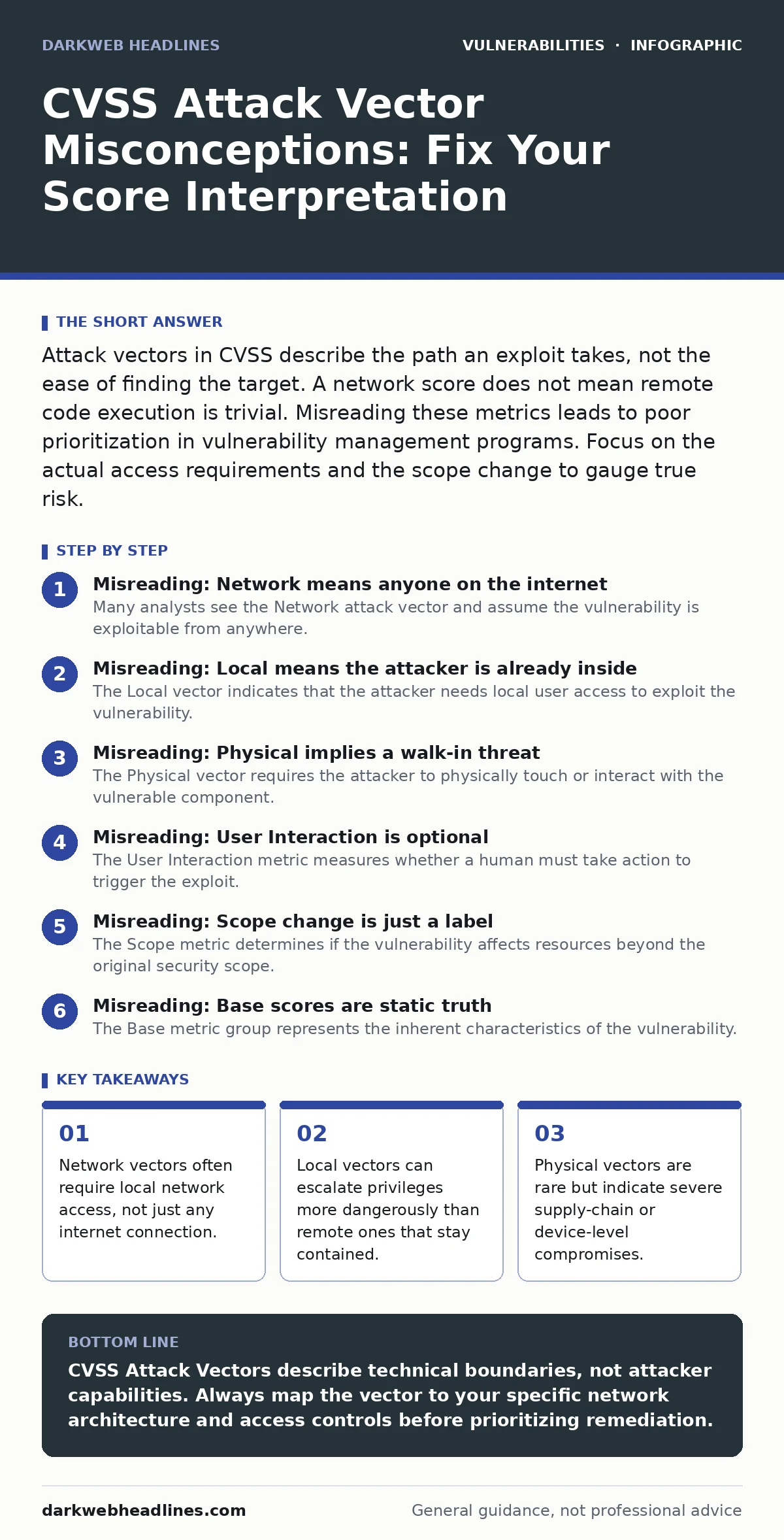
Attack vectors in CVSS describe the path an exploit takes, not the ease of finding the target. A network score does not mean remote code execution is trivial. Misreading these metrics leads to poor prioritization in vulnerability management programs. Focus on the actual access requirements and the scope change to gauge true risk.
Misreading: Network means anyone on the internet
Many analysts see the Network attack vector and assume the vulnerability is exploitable from anywhere. This is a dangerous shortcut. The CVSS specification defines Network as exploitable without requiring local network access, but it does not guarantee zero-touch exploitation.
Often, the attacker must first bypass a firewall or establish a session. The metric describes the boundary the exploit crosses, not the attacker’s starting position. If the service is behind a NAT or requires authentication, the effective difficulty increases significantly.
Correct reading: Treat Network as a technical boundary definition. Verify whether the exposed service is actually reachable from the public internet or if it sits in a restricted internal segment.
Misreading: Local means the attacker is already inside
The Local vector indicates that the attacker needs local user access to exploit the vulnerability. This usually means they must log in via console or SSH. Some readers dismiss Local scores as low risk because gaining initial access is hard.
This ignores the privilege escalation path. An attacker with a low-privileged account can use a Local vulnerability to gain root or system access. The damage potential is often higher than a Network vector that allows reading public data.
Correct reading: Evaluate Local vulnerabilities based on the privilege difference between the attacker and the target. A jump from user to root is often more critical than a remote read-only access.
Misreading: Physical implies a walk-in threat
The Physical vector requires the attacker to physically touch or interact with the vulnerable component. This includes plugging in a USB device or accessing a maintenance port. Many teams ignore these scores because they assume their data center is secure.
Physical access bypasses many logical controls. An attacker with physical access can often reset passwords, install keyloggers, or dump memory. The CVSS score reflects the difficulty of gaining that access, not the severity of the outcome.
Correct reading: Do not discard Physical scores. If the hardware is in a kiosk, a public terminal, or a less secure branch office, the physical barrier is weak. The risk depends on your physical security controls.
Misreading: User Interaction is optional
The User Interaction metric measures whether a human must take action to trigger the exploit. A score of None means the exploit works automatically. Some analysts assume None means the attack is silent and stealthy.
User Interaction does not measure stealth. It measures dependency. If an attack requires a user to click a link, the attack surface shrinks. It also introduces social engineering as a prerequisite. This changes the mitigation strategy from patching to user training.
Correct reading: Separate technical exploitability from human behavior. A vulnerability with User Interaction is still critical if the target audience is prone to phishing. Reference our guide on security advisories to understand how vendors classify these dependencies.
Misreading: Scope change is just a label
The Scope metric determines if the vulnerability affects resources beyond the original security scope. A change in scope often boosts the base score significantly. Many readers see the score jump and assume the impact is proportional.
Scope change indicates a trust boundary violation. An attacker in one context gains control over another. This is common in browser exploits or container escapes. The score increases because the blast radius expands across different security domains.
Correct reading: Look for Scope changes when analyzing complex architectures. A vulnerability that breaks out of a sandbox or virtual machine is more dangerous than one contained within it. This relates to how we categorize CWE weakness categories for boundary errors.
See also: Malicious Typosquatted Packages: 7 Mistakes That Invite Supply Chain Attacks · TOCTOU Bugs: 7 Mistakes That Leave Your Code Open to Race Conditions
Misreading: Base scores are static truth
The Base metric group represents the inherent characteristics of the vulnerability. It does not change over time. Some teams treat the Base score as the final risk rating. This ignores the environment and the specific configuration of your systems.
A high Base score means little if the vulnerable component is disabled or isolated. Conversely, a low Base score can be catastrophic in a specific environment. The Base score is a constant, but your risk is variable.
Correct reading: Use the Base score for initial filtering, then apply Environmental metrics. Adjust for the presence of mitigating controls and the value of the affected asset. This approach aligns with mature vulnerability management programs.
Misreading: Attack Complexity is about coding skill
The Attack Complexity metric measures the conditions beyond the attacker’s control. Low complexity means the attack is straightforward. High complexity means specific conditions must exist. Many assume Low complexity means the exploit code is simple to write.
Complexity refers to the reliability of the attack. Low complexity means the exploit works reliably without special conditions. High complexity might require a specific race condition or a particular memory layout. The difficulty of writing the code is separate from the difficulty of executing it.
Correct reading: Focus on the reliability of the exploit. If the complexity is Low, assume automated tools can find and exploit it. This is why proof-of-concept exploits spread rapidly when complexity is low.
Misreading: Privileges Required are binary
The Privileges Required metric indicates the level of access needed. None, Low, or High. Some analysts treat Low and High as similar because both require some access. This misses the nuance of account permissions.
Low privileges often mean a standard user account. High privileges mean an administrator or root account. The difference in damage potential is massive. An attacker with High privileges can often bypass the vulnerability entirely by using legitimate tools.
Correct reading: Assess the value of the required account. If the vulnerability requires High privileges, the attacker likely already has significant control. The vulnerability might be redundant or less useful for initial access.
Key takeaways
- Network vectors often require local network access, not just any internet connection.
- Local vectors can escalate privileges more dangerously than remote ones that stay contained.
- Physical vectors are rare but indicate severe supply-chain or device-level compromises.
CVSS Attack Vectors describe technical boundaries, not attacker capabilities. Always map the vector to your specific network architecture and access controls before prioritizing remediation.
Frequently asked questions
Does a Network vector mean I need a firewall?
A Network vector indicates the exploit crosses a network boundary. Firewalls help mitigate this, but you must also ensure the service is not unnecessarily exposed to untrusted networks.
How do I handle Local privilege escalation?
Treat Local privilege escalation as a high priority if you have many user accounts. Limit the number of accounts with low-level access and enforce strict least-privilege principles.
Is Physical access really a CVSS concern?
Yes, if your hardware is accessible to untrusted persons. Physical attacks can bypass many software controls, making the device itself a trust anchor.
Should I ignore vulnerabilities with User Interaction?
No. User Interaction vulnerabilities are common in web applications and email systems. They require a combination of patching and user awareness training.
How this guide was produced: written by the DarkWeb Headlines editorial team with AI assistance, checked against the public references listed below, and reviewed when the facts change. See our editorial policy or report an error.