Proof-of-Concept Exploits: Meaning, Definition, and Real-World Use
Proof-of-concept exploits prove a vulnerability exists without causing permanent damage, acting as the primary evidence for security researchers and defenders.

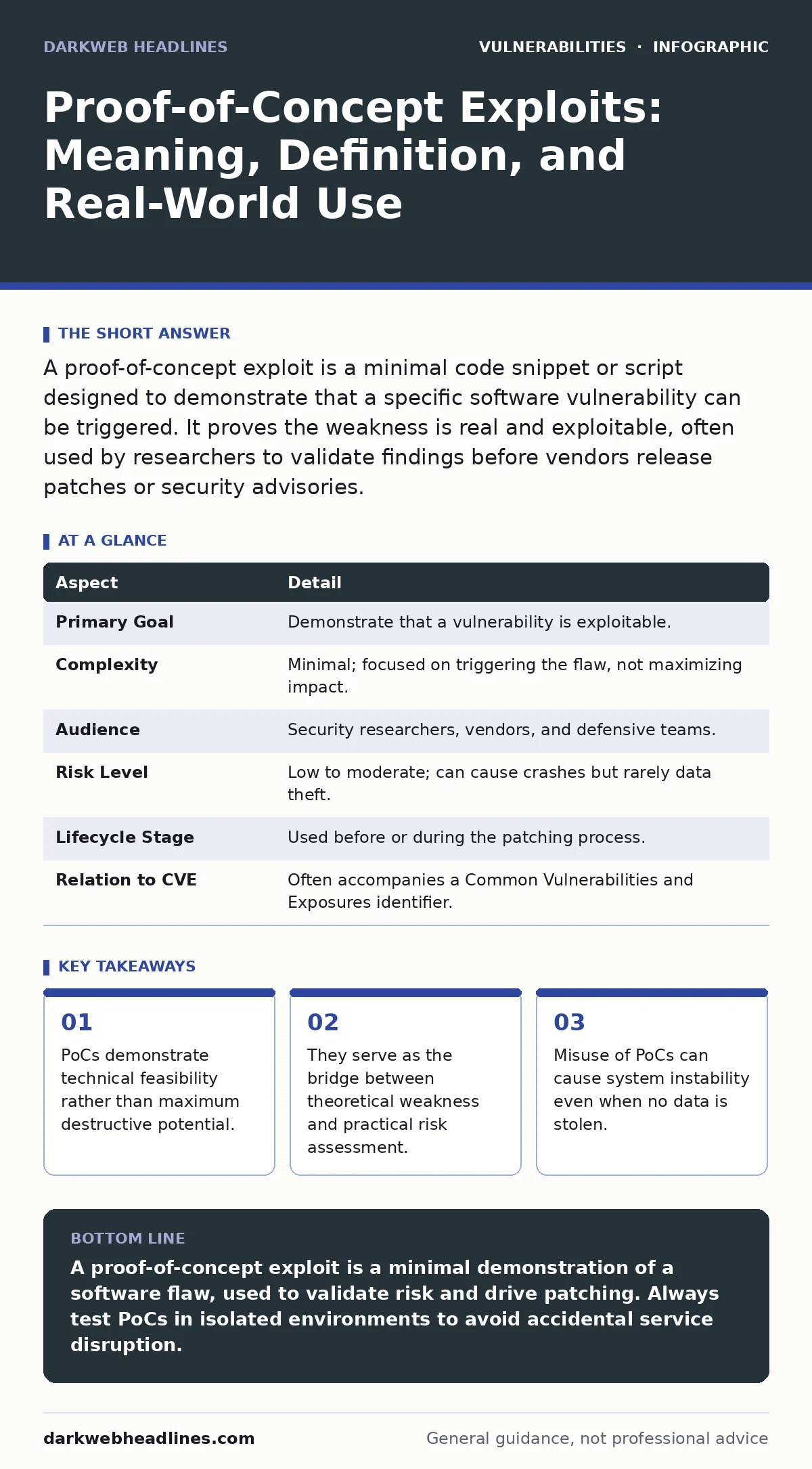
A proof-of-concept exploit is a minimal code snippet or script designed to demonstrate that a specific software vulnerability can be triggered. It proves the weakness is real and exploitable, often used by researchers to validate findings before vendors release patches or security advisories.
The Blueprint Analogy
Imagine you find a flaw in a building’s foundation. You do not need to blow up the structure to prove the crack exists. You simply place a heavy weight on the weak spot to show it bends. A proof-of-concept exploit works the same way in software. It is the digital equivalent of that weight.
The goal is not to destroy the building. The goal is to show the architect that the design is flawed. In cybersecurity, this demonstration forces vendors to acknowledge the issue and release a fix. Without this proof, many vulnerabilities would remain theoretical curiosities, ignored by development teams who prioritize feature requests over abstract risks.
What Is a Proof-of-Concept?
A proof-of-concept exploit, or PoC, is a small piece of code or a sequence of inputs that triggers a known vulnerability. It is designed to be as simple as possible. Complexity is the enemy of clarity in this context. If the code is too messy, defenders cannot understand what went wrong.
The term comes from engineering and product development. Before building a full product, engineers create a prototype to prove the concept works. In security, the "product" is the attack. The PoC proves the attack is possible. It strips away the noise of a real-world attack, such as evasion techniques or payload delivery mechanisms.
This simplicity makes PoCs valuable for education and testing. They allow security teams to see exactly how an input is processed incorrectly by the software. You can run a PoC in a controlled environment to verify your systems are vulnerable. This verification is the first step in any effective vulnerability management program.
| Aspect | Detail |
|---|---|
| Primary Goal | Demonstrate that a vulnerability is exploitable. |
| Complexity | Minimal; focused on triggering the flaw, not maximizing impact. |
| Audience | Security researchers, vendors, and defensive teams. |
| Risk Level | Low to moderate; can cause crashes but rarely data theft. |
| Lifecycle Stage | Used before or during the patching process. |
| Relation to CVE | Often accompanies a Common Vulnerabilities and Exposures identifier. |
How PoCs Are Used Daily
Security researchers use PoCs to communicate with vendors. When you discover a flaw, you write a PoC to show exactly how to break the code. This evidence is required for most responsible disclosure processes. Without it, a vendor may dismiss your report as theoretical or incorrect.
Defensive teams use PoCs for validation. When a new security advisory is released, you may not be able to patch your systems immediately. You run the PoC against your internal instances to see if you are affected. This helps you prioritize which systems need emergency attention.
It is also used in red team exercises. Attackers simulate real threats using PoCs to test detection tools. If your intrusion detection system fails to flag the PoC traffic, you know your rules are incomplete. This testing is critical for understanding attack vectors in CVSS scoring, which relies on the ease of exploitation.
The Hidden Cost of Simplicity
Many people assume that because a PoC is simple, it is harmless. This is a dangerous misconception. A PoC often interacts with the target system in an uncontrolled way. It may cause a denial of service by crashing the application.
Imagine you run a PoC against a production web server to test a file upload vulnerability. The script sends malformed data that the server cannot handle. The server crashes and stops serving users. No data was stolen, but the service is down. This is a side effect of the proof, not the intent.
This hidden cost means you should never run PoCs on live systems without explicit permission and a rollback plan. The simplicity that makes them useful for demonstration also makes them unpredictable in complex environments. A PoC that works on one version of software may cause unexpected behavior on another.
Common Misunderstandings
There is a frequent confusion between a PoC and a weaponized exploit. A weaponized exploit is designed to hide, persist, and deliver a payload. It is complex and optimized for stealth. A PoC is designed to be visible and easy to analyze. It does not hide its tracks.
Another mistake is assuming a PoC guarantees success in all scenarios. Software runs on many different configurations. A PoC might work on a default installation but fail on a hardened server. Defenders often modify default settings, which can break the assumptions the PoC relies on.
People also mistake the existence of a PoC for the severity of the risk. Just because a flaw can be proven does not mean it is easy to exploit in the wild. Some PoCs require specific conditions, such as user interaction or network access, that are rare in practice. This is why context matters more than the code itself.
See also: Malicious Typosquatted Packages: 7 Mistakes That Invite Supply Chain Attacks · TOCTOU Bugs: 7 Mistakes That Leave Your Code Open to Race Conditions
The Researcher’s Dilemma
Researchers face a ethical tightrope. They must share enough detail to help defenders, but not so much that attackers can easily copy the code. This is why many PoCs are released after a patch is available. This practice, known as coordinated disclosure, minimizes the window of exposure.
However, some researchers argue for immediate release. They believe that transparency forces faster patching. If you wait too long, attackers may find the flaw independently. This debate affects how you see zero-day vulnerabilities. A zero-day is a flaw unknown to the vendor. Once a PoC is public, it is no longer a zero-day from the perspective of the attacker.
For students entering the field, this tension is important to understand. Your code has power. Releasing a PoC can protect users or endanger them, depending on timing and context. Always consider the potential for misuse before publishing your findings.
From PoC to Patch
The lifecycle of a vulnerability often starts with a PoC. After the researcher shares the proof, the vendor analyzes it. They write a fix and test it. Then they release a patch. This process is the core of vulnerability management programs.
If the vendor fails to patch, the PoC remains a risk. Attackers may adapt the simple PoC into a complex exploit. They add obfuscation to bypass detection. They add payloads to steal data. The simple proof becomes a sophisticated weapon.
This evolution is why you must monitor security advisories closely. A PoC is a warning sign. It tells you that a weakness exists and that the clock is ticking. Your response should be to validate your exposure and plan for mitigation.
Building Your Own Understanding
You do not need to write exploits to understand them. Reading PoCs is a valuable skill for any security professional. It teaches you how software fails. It shows you the gap between intended behavior and actual behavior.
Start by reading open-source PoCs for well-known issues. Look for the input that triggers the flaw. Trace that input through the code logic. See where the validation fails. This exercise builds your intuition for finding weaknesses in new software.
This skill complements your knowledge of CWE weakness categories. The Common Weakness Enumeration provides a standard list of flaw types. PoCs show you how those abstract categories manifest in real code. Together, they provide a complete picture of software risk.
Final Thoughts on Evidence
Proof-of-concept exploits are the evidence of software fragility. They are not the crime, but they prove the opportunity for crime. Understanding them helps you prioritize your defenses. It helps you communicate risk to stakeholders who may not understand technical details.
You should view PoCs as tools for improvement, not just threats. They drive the cycle of discovery and repair. By studying them, you become a better defender. You learn to anticipate where the cracks will form and how to shore them up before they are exploited.
Key takeaways
- PoCs demonstrate technical feasibility rather than maximum destructive potential.
- They serve as the bridge between theoretical weakness and practical risk assessment.
- Misuse of PoCs can cause system instability even when no data is stolen.
- Defenders use PoCs to test detection capabilities before a patch is available.
A proof-of-concept exploit is a minimal demonstration of a software flaw, used to validate risk and drive patching. Always test PoCs in isolated environments to avoid accidental service disruption.
Frequently asked questions
Is a proof-of-concept exploit illegal?
Writing or sharing a PoC for educational or research purposes is generally legal. Using it against systems you do not own or have permission to test is illegal.
How is a PoC different from a zero-day?
A zero-day is a vulnerability unknown to the vendor. A PoC is the code that demonstrates the vulnerability. A PoC can exist for both zero-days and known flaws.
Can I use a PoC to hack a system?
You should only use PoCs on systems you own or have explicit written permission to test. Unauthorized use is a criminal offense.
Do PoCs always work?
No. PoCs often rely on specific configurations or default settings. They may fail on hardened systems or different software versions.
How this guide was produced: written by the DarkWeb Headlines editorial team with AI assistance, checked against the public references listed below, and reviewed when the facts change. See our editorial policy or report an error.