TOCTOU Bugs: 7 Mistakes That Leave Your Code Open to Race Conditions
Time-of-check to time-of-use flaws occur because systems verify a condition and then act on it, allowing attackers to alter the state between those two discrete moments.

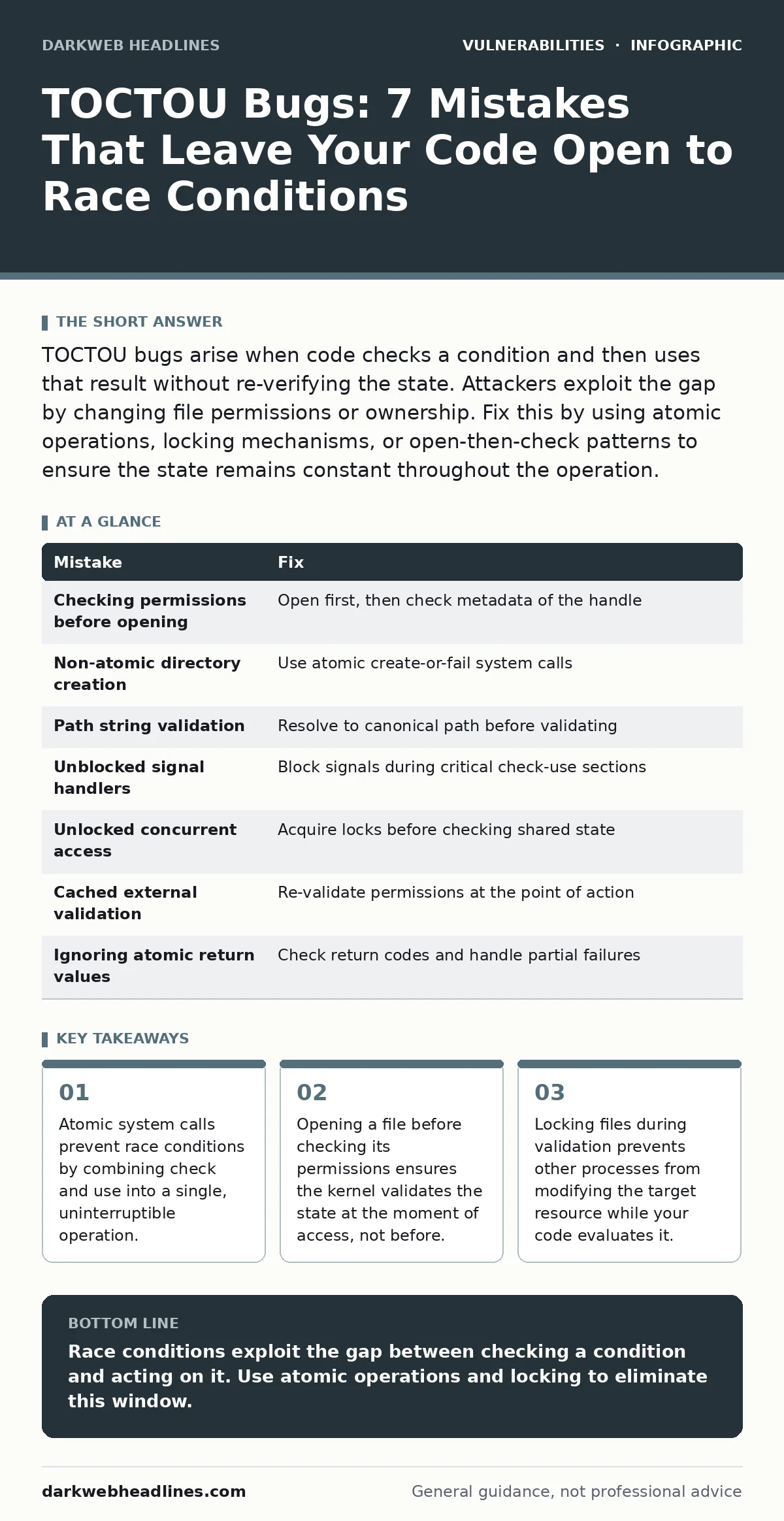
TOCTOU bugs arise when code checks a condition and then uses that result without re-verifying the state. Attackers exploit the gap by changing file permissions or ownership. Fix this by using atomic operations, locking mechanisms, or open-then-check patterns to ensure the state remains constant throughout the operation.
Mistake 1: Checking File Permissions Before Opening
Developers often verify that a file exists and is readable before attempting to open it. This sequence creates a window where an attacker can replace the legitimate file with a malicious symlink or alter permissions. The system grants access based on the initial state, but the subsequent operation targets the modified resource.
Why it hurts:
The operating system validates permissions at the time of the check, not at the time of the open call. An attacker can swap the file target during the microsecond gap. This leads to unauthorized data exfiltration or privilege escalation because the application trusts the initial validation result rather than the current reality of the file system.
The fix:
Open the file first using secure flags that prevent following symbolic links. Then check the metadata of the opened file descriptor. This ensures the kernel validates the permissions at the exact moment the application gains access. This pattern eliminates the race window because the check and the use are effectively bound to the same open handle.
Mistake 2: Using Non-Atomic Directory Operations
Applications that create temporary files in shared directories often check if a filename is available before creating it. This approach fails in multi-user environments where another process can create a file with the same name between the check and the creation. The application may overwrite sensitive data or fail to write expected configuration.
Why it hurts:
Shared directories allow any user to create files. If your code checks for existence and then creates, an attacker can predict the filename and place a malicious file there. Your application opens this attacker-controlled file, believing it is its own temporary storage. This breaks the isolation boundary and allows arbitrary code execution through crafted temporary content.
The fix:
Use atomic file creation functions that fail if the file already exists. These system calls perform the existence check and creation in a single kernel operation. Alternatively, use unique naming schemes that are impossible to predict. This ensures that the file you create is genuinely new and not a pre-planted trap by another process waiting in the directory.
Mistake 3: Relying on User Input for Path Validation
Code that accepts file paths from users and validates them against allowlists often processes the path string before resolving it. Attackers can craft paths that appear valid during string comparison but resolve to different locations after the operating system interprets them. This discrepancy allows bypassing security controls designed to restrict access to specific directories.
Why it hurts:
String validation does not account for how the kernel resolves path components. Symlinks, hard links, and relative path tricks can redirect the final access to a restricted area. The application believes it is accessing a safe location because the string matched the allowlist, but the kernel follows a different route. This leads to unauthorized access to system files or other users' private data.
The fix:
Resolve the path to its absolute, canonical form before validation. Use system calls that strip away symlinks and relative components. Then validate the resolved path against your security policy. This ensures that the location you are checking is the exact location you will access. It prevents attackers from using path tricks to evade your string-based security filters.
Mistake 4: Ignoring Signal Handlers During Critical Sections
Applications that perform long-running checks often allow signal handlers to interrupt the process. If a signal handler modifies global state or file descriptors while the main thread is checking conditions, the subsequent use of that state becomes unsafe. The main thread assumes the state is stable, but the interrupt has changed the underlying reality.
Why it hurts:
Signal handlers execute asynchronously. If your main code checks a variable and then uses it, a signal can change that variable in between. The application proceeds with stale or corrupted data. This can lead to logic errors that bypass security checks. In severe cases, it allows attackers to manipulate the application's state to perform actions it was not authorized to perform.
The fix:
Block signals during critical sections where state is checked and used. Restore the signal mask immediately after the operation completes. This ensures that no asynchronous interrupt can modify the state while your code is evaluating it. Alternatively, use lock-free data structures or atomic variables that are safe to access from signal handlers without causing race conditions.
Mistake 5: Failing to Lock Resources During Validation
When multiple threads access shared resources, checking a condition without holding a lock allows other threads to modify the resource. This is common in web servers handling concurrent requests. One thread checks a user's balance, while another processes a withdrawal. The first thread uses the stale balance, leading to incorrect financial transactions or logic errors.
Why it hurts:
Concurrency introduces non-deterministic timing. Without locks, threads interleave their operations in unpredictable ways. A check performed by one thread may be invalidated by an update from another thread before the first thread acts. This results in data corruption, inconsistent state, or security bypasses. The application behaves correctly in isolation but fails under concurrent load, creating exploitable race conditions.
The fix:
Acquire a lock before checking the resource and release it only after the use is complete. This serializes access to the shared state. Ensure that the critical section is as short as possible to minimize performance impact. Use mutexes or semaphores to enforce mutual exclusion. This guarantees that the state you check is the same state you use, preventing other threads from interfering.
See also: Malicious Typosquatted Packages: 7 Mistakes That Invite Supply Chain Attacks · CVE Monitoring Mistakes: 7 Errors That Blind Your Security Team
Mistake 6: Trusting External Services Without Re-validation
Applications that rely on external APIs or services for authorization often cache the result. If the service state changes after the cache is populated but before the action is taken, the application acts on outdated information. This is common in distributed systems where network latency creates gaps between check and use. The application assumes the external state is static.
Why it hurts:
External services are dynamic. A user's permissions might be revoked, or a token might expire, after your application caches the validation result. Acting on this stale cache allows unauthorized access. The race condition exists between your cache update and the actual action. Attackers can exploit this by triggering state changes in the external service during the window of your cached validity.
The fix:
Re-validate critical permissions at the point of action, not just at the start of the session. Use short-lived tokens that force re-authentication for sensitive operations. Avoid caching authorization decisions for long periods. This ensures that the application always reflects the current state of the external service. It reduces the window of opportunity for attackers to exploit stale authorization data.
Mistake 7: Improper Error Handling in Atomic Operations
Developers often assume that atomic operations always succeed or fail cleanly. However, some atomic functions may return partial results or leave the system in an inconsistent state if interrupted. Failing to handle these edge cases properly can lead to resources being left in a vulnerable state. The application proceeds assuming success, but the underlying operation was incomplete.
Why it hurts:
Atomic operations are not magic. They can fail due to resource constraints or permissions. If your code does not check the return value of an atomic call, it may proceed with invalid assumptions. This can lead to file descriptors being left open, locks being unreleased, or permissions being incorrectly set. Attackers can exploit these inconsistent states to bypass security controls or cause denial of service.
The fix:
Always check the return value of atomic operations. Handle failure cases explicitly by rolling back any partial changes. Ensure that resources are cleaned up even if the operation fails. Use finally blocks or context managers to guarantee cleanup. This ensures that the system remains in a consistent state, preventing attackers from exploiting incomplete operations or leftover resources.
| Mistake | Fix |
|---|---|
| Checking permissions before opening | Open first, then check metadata of the handle |
| Non-atomic directory creation | Use atomic create-or-fail system calls |
| Path string validation | Resolve to canonical path before validating |
| Unblocked signal handlers | Block signals during critical check-use sections |
| Unlocked concurrent access | Acquire locks before checking shared state |
| Cached external validation | Re-validate permissions at the point of action |
| Ignoring atomic return values | Check return codes and handle partial failures |
Understanding these patterns helps you recognize race conditions in your own code. Similar issues appear in Java deserialization vulnerabilities where state validation is bypassed.
Proper vulnerability management programs include static analysis for race conditions. Bug bounty programs often reward findings in these complex timing issues. Patch Tuesday releases frequently address such kernel-level race conditions. Clickjacking is a different vector but highlights the need for strict state validation. Prototype pollution shows how object state can be corrupted externally. Unsafe YAML deserialization demonstrates risks of trusting external data structures. Chrome zero-day vulnerabilities often involve complex race conditions in browser engines.
Key takeaways
- Atomic system calls prevent race conditions by combining check and use into a single, uninterruptible operation.
- Opening a file before checking its permissions ensures the kernel validates the state at the moment of access, not before.
- Locking files during validation prevents other processes from modifying the target resource while your code evaluates it.
Race conditions exploit the gap between checking a condition and acting on it. Use atomic operations and locking to eliminate this window.
Frequently asked questions
How do I detect TOCTOU bugs in my code?
Use static analysis tools that flag check-then-act patterns. Review code for file operations, permission checks, and concurrent access to shared state. Look for gaps between validation and execution.
Are atomic operations always safe from race conditions?
Atomic operations prevent race conditions for the specific operation they perform. They do not protect against broader logic errors or improper error handling. You must still validate return values and manage resources correctly.
Can TOCTOU bugs occur in web applications?
Yes, web applications are susceptible if they cache authorization results or handle concurrent requests without proper locking. Session management and database transactions must also be atomic to prevent these issues.
What is the difference between TOCTOU and TOCTTOU?
TOCTTOU is a variant where the check is performed, then the state is used, then checked again. It is still vulnerable because the state can change between the final check and the actual use. The core issue remains the non-atomic nature of the sequence.
How this guide was produced: written by the DarkWeb Headlines editorial team with AI assistance, checked against the public references listed below, and reviewed when the facts change. See our editorial policy or report an error.