CVE Monitoring Mistakes: 7 Errors That Blind Your Security Team
Tracking vulnerability identifiers without mapping them to your specific asset inventory creates noise that hides critical risks and wastes engineering hours.

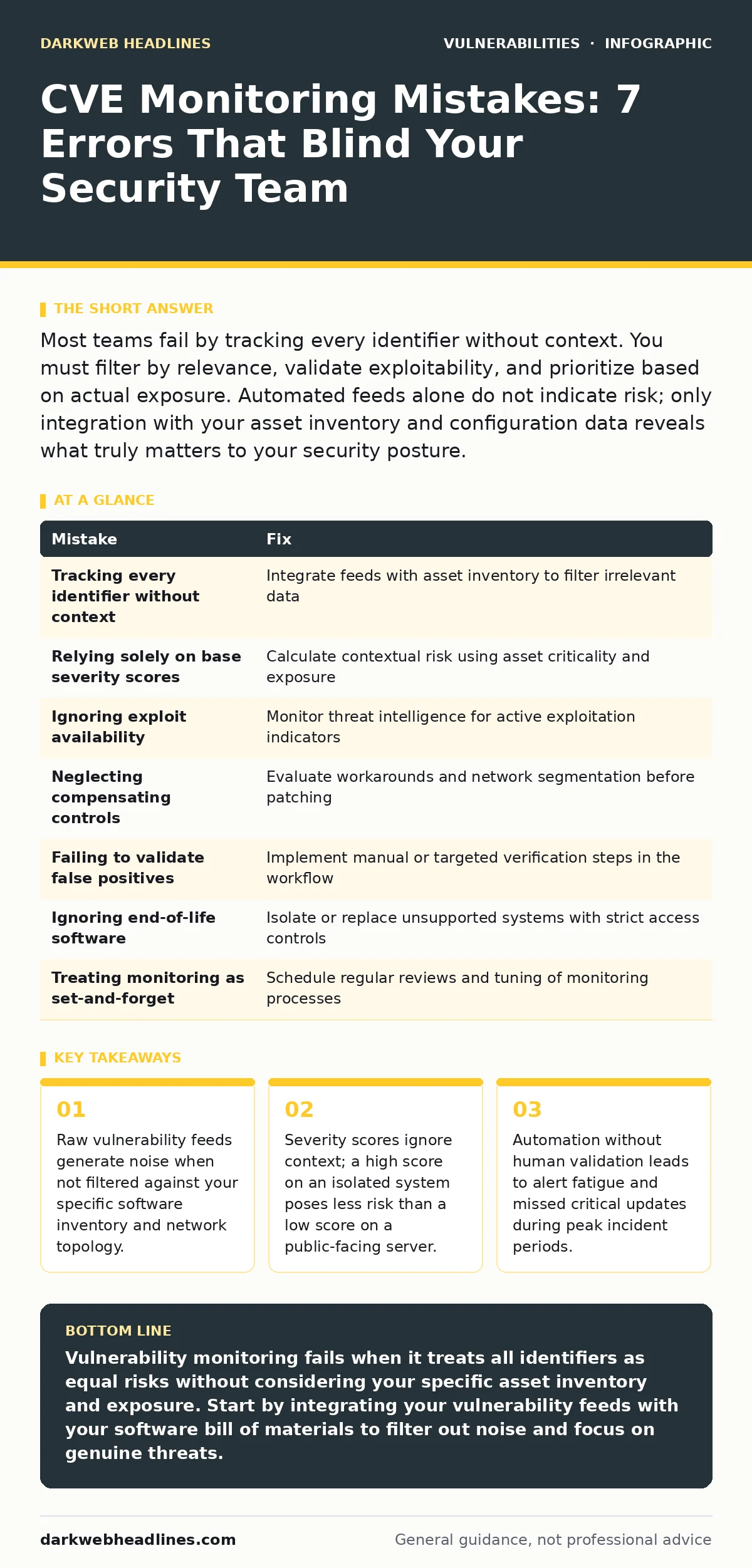
Most teams fail by tracking every identifier without context. You must filter by relevance, validate exploitability, and prioritize based on actual exposure. Automated feeds alone do not indicate risk; only integration with your asset inventory and configuration data reveals what truly matters to your security posture.
Mistake 1: Tracking Every Identifier Without Inventory Context
Why it hurts:
Vulnerability databases contain millions of entries for software you do not use. Monitoring every identifier creates signal-to-noise ratio issues that overwhelm security teams. You waste hours triaging false positives for applications that do not exist in your environment. This noise dilutes attention from genuine risks, leading to delayed responses for actual exposures. The cognitive load of filtering irrelevant data manually reduces overall team efficiency and morale.
The fix:
Integrate your vulnerability feed with a software bill of materials (SBOM) or configuration management database. Only alert on identifiers that match known assets in your inventory. This reduces noise by filtering out irrelevant data at the ingestion stage. You gain clarity by seeing only what applies to your specific environment. Regularly update your asset inventory to ensure the filter remains accurate as software versions change.
Mistake 2: Relying Solely on Base Severity Scores
Why it hurts:
Severity scores provide a standardized metric for potential impact but ignore environmental context. A high score for a vulnerability in an internal, air-gapped system poses minimal risk compared to a moderate score on a public-facing web server. Treating all high scores equally leads to inefficient resource allocation. You may spend critical engineering time patching low-risk internal systems while leaving high-risk external services exposed. This misalignment wastes effort and leaves true attack vectors unaddressed.
The fix:
Calculate contextual risk by combining severity scores with asset criticality and exposure data. Consider factors such as internet accessibility, data sensitivity, and compensating controls. Use frameworks that allow you to adjust base scores based on your specific environment. This approach ensures you prioritize patches that reduce actual risk rather than just theoretical severity. Refer to guides on attack vectors in CVSS to understand how environmental factors influence final risk calculations.
Mistake 3: Ignoring Exploit Availability and Activity
Why it hurts:
Not all vulnerabilities are equally likely to be exploited. Some remain theoretical for years, while others trigger active attacks within days of disclosure. Monitoring only the existence of a vulnerability without checking for exploit code or active campaigns leads to poor prioritization. You might patch a low-risk issue while ignoring a vulnerability that attackers are actively leveraging in the wild. This reactive stance leaves your organization vulnerable to immediate threats that require urgent attention.
The fix:
Monitor threat intelligence feeds for indicators of active exploitation. Look for signals such as proof-of-concept code, exploit kits, or reports of active scanning. Prioritize vulnerabilities that show signs of active abuse over those that are purely theoretical. This intelligence-driven approach allows you to focus on the most immediate threats. Understanding CWE weakness categories helps you identify which vulnerabilities are more likely to have reliable exploit paths.
Mistake 4: Neglecting Compensation Controls and Mitigations
Why it hurts:
Patching is not the only way to reduce risk. Sometimes, a vulnerability can be mitigated through configuration changes, network segmentation, or application-level controls. Ignoring these options leads to unnecessary downtime and complex patching cycles. You might rush to apply a patch that introduces instability when a simple firewall rule could block the exploit path. This failure to consider alternatives increases operational risk and wastes engineering resources on full remediation when partial mitigation suffices.
The fix:
Evaluate each vulnerability for available compensating controls before attempting a full patch. Check vendor documentation for workarounds or configuration hardening steps. Implement network segmentation to limit the blast radius of potential exploitation. Document these temporary measures and schedule proper patching when feasible. This balanced approach reduces immediate risk while maintaining system stability. Explore dynamic application security testing (DAST) results to identify if configuration changes can block specific exploit attempts.
Mistake 5: Failing to Validate False Positives
Why it hurts:
Automated scanners and feeds often report vulnerabilities that do not exist in your specific configuration. These false positives create unnecessary work and erode trust in the monitoring process. Teams may ignore alerts entirely if they find too many inaccuracies, leading to missed real vulnerabilities. This distrust in the tooling results in a false sense of security. You need to verify the presence of the vulnerable component and its specific configuration to ensure the alert is valid before taking action.
The fix:
Implement a validation step in your workflow to confirm the existence of the vulnerability. Use manual checks or targeted scans to verify the scanner's findings. Update your monitoring rules to exclude known false positive scenarios. This reduces noise and ensures that your team focuses on genuine issues. Regularly review and refine your validation criteria as new software versions and configurations are deployed.
See also: Vulnerability Management Definition and Process · What Is Vulnerability Management: A Practical Framework for Risk Reduction
Mistake 6: Ignoring End-of-Life Software
Why it hurts:
Software that has reached end-of-life (EOL) no longer receives security updates. Monitoring these systems for standard vulnerability identifiers is futile because no patches will be released. Teams often waste resources trying to find fixes for EOL software that do not exist. This leaves critical systems exposed to known vulnerabilities with no official remediation path. The risk accumulates over time as new vulnerabilities are discovered for the unsupported software.
The fix:
Identify and inventory all EOL software in your environment. Develop a plan to replace or isolate these systems. Implement strict network segmentation to limit access to EOL assets. Consider virtual patching or intrusion prevention system rules to block known exploit attempts. Prioritize replacement projects based on the risk exposure of each EOL system. This proactive management reduces the attack surface associated with unsupported software.
Mistake 7: Treating Monitoring as a Set-and-Forget Task
Why it hurts:
Vulnerability monitoring requires ongoing maintenance and tuning. Rules that worked last year may generate excessive noise today. Algorithms and feed structures change, requiring adjustments to your filtering logic. Neglecting to review and update your monitoring processes leads to degraded performance and missed alerts. You assume the system works as intended without verifying its accuracy. This complacency allows gaps in coverage to grow unnoticed over time.
The fix:
Schedule regular reviews of your vulnerability monitoring processes. Analyze alert trends to identify noise sources and refine filters. Update integration mappings as your software inventory changes. Test your alerting mechanisms periodically to ensure they function correctly. Engage with your team to gather feedback on alert quality and relevance. Continuous improvement ensures your monitoring remains effective and actionable.
| Mistake | Fix |
|---|---|
| Tracking every identifier without context | Integrate feeds with asset inventory to filter irrelevant data |
| Relying solely on base severity scores | Calculate contextual risk using asset criticality and exposure |
| Ignoring exploit availability | Monitor threat intelligence for active exploitation indicators |
| Neglecting compensating controls | Evaluate workarounds and network segmentation before patching |
| Failing to validate false positives | Implement manual or targeted verification steps in the workflow |
| Ignoring end-of-life software | Isolate or replace unsupported systems with strict access controls |
| Treating monitoring as set-and-forget | Schedule regular reviews and tuning of monitoring processes |
Summary of Best Practices
Effective vulnerability monitoring requires more than just subscribing to feeds. You must integrate data with your specific environment, validate findings, and prioritize based on actual risk. This approach ensures you focus on the most critical issues and respond efficiently. Regular maintenance and tuning keep your processes accurate and effective.
Key takeaways
- Raw vulnerability feeds generate noise when not filtered against your specific software inventory and network topology.
- Severity scores ignore context; a high score on an isolated system poses less risk than a low score on a public-facing server.
- Automation without human validation leads to alert fatigue and missed critical updates during peak incident periods.
Vulnerability monitoring fails when it treats all identifiers as equal risks without considering your specific asset inventory and exposure. Start by integrating your vulnerability feeds with your software bill of materials to filter out noise and focus on genuine threats.
Frequently asked questions
How often should I review my vulnerability monitoring rules?
Review your rules quarterly or whenever significant changes occur in your software inventory or network architecture. Regular reviews ensure filters remain accurate and relevant.
Can I rely entirely on automated scanning for vulnerability detection?
No. Automated scanners miss context and can generate false positives. Combine scanning with manual validation and threat intelligence to ensure accurate risk assessment.
What is the difference between a vulnerability and a risk?
A vulnerability is a weakness in a system. Risk is the potential for loss or damage when that weakness is exploited. Context determines the risk level.
How do I handle vulnerabilities in third-party applications?
Contact vendors for patches and monitor their security advisories. Implement compensating controls if patches are delayed. Consider replacing applications with poor security support.
How this guide was produced: written by the DarkWeb Headlines editorial team with AI assistance, checked against the public references listed below, and reviewed when the facts change. See our editorial policy or report an error.