What Is Vulnerability Management: A Practical Framework for Risk Reduction
Vulnerability management prioritizes fixes by business impact rather than severity scores, revealing that some high-risk flaws require no immediate action.
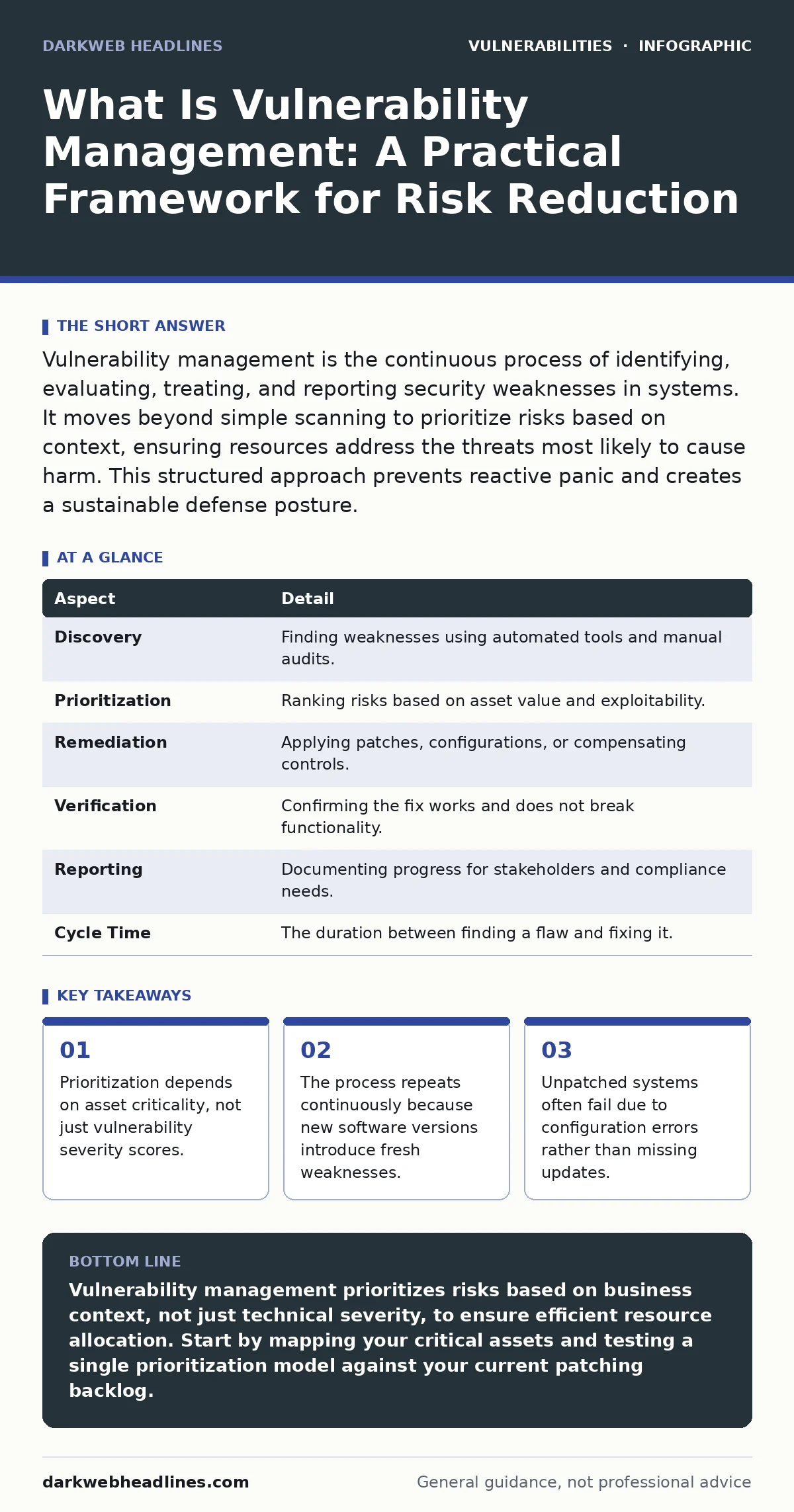
Vulnerability management is the continuous process of identifying, evaluating, treating, and reporting security weaknesses in systems. It moves beyond simple scanning to prioritize risks based on context, ensuring resources address the threats most likely to cause harm. This structured approach prevents reactive panic and creates a sustainable defense posture.
What Is Vulnerability Management and Why It Matters
What is vulnerability management? It is the systematic process of identifying, classifying, remediating, and managing security flaws in your computing environment. This discipline transforms raw data from scanners into actionable risk decisions. Organizations treat vulnerabilities as technical debts that accrue interest through potential exploitation. You manage this debt by balancing security needs against operational stability.
The goal is not to eliminate every flaw immediately. Total elimination is impossible in complex networks. Instead, you reduce exposure to acceptable levels by focusing on the weaknesses that matter most to your specific operations. This approach prevents security teams from chasing every alert while ignoring the doors left open for attackers.
| Aspect | Detail |
|---|---|
| Discovery | Finding weaknesses using automated tools and manual audits. |
| Prioritization | Ranking risks based on asset value and exploitability. |
| Remediation | Applying patches, configurations, or compensating controls. |
| Verification | Confirming the fix works and does not break functionality. |
| Reporting | Documenting progress for stakeholders and compliance needs. |
| Cycle Time | The duration between finding a flaw and fixing it. |
The Continuous Cycle of Discovery and Assessment
Discovery begins with asset inventory. You cannot protect what you do not know exists. Automated scanners probe systems for known weaknesses, comparing them against databases like CWE weakness categories. These categories standardize the description of coding errors, allowing tools to recognize patterns across different software. Manual reviews catch logic errors that scanners miss, such as flawed business rules.
Assessment follows discovery. You determine if a found weakness is real or a false positive. Then you evaluate its context. A flaw in an internal printer differs from one in a public web server. You check if the vulnerable code is actually reachable. Network segmentation often blocks access to vulnerable services, reducing the effective risk. This step prevents wasted effort on theoretical threats.
Prioritization Beyond Standard Severity Scores
Many teams rely solely on standard scoring models. Attack vectors in CVSS provide a baseline for severity, but they ignore your environment. A high score on an isolated device poses less risk than a moderate score on a customer-facing database. You must adjust scores based on exposure and impact.
Consider the value of the data stored on the affected system. Consider the likelihood of an attacker reaching it. This contextual analysis reveals hidden costs. Fixing a low-severity bug might require downtime that costs more than the potential loss from exploitation. You weigh these factors to create a realistic repair schedule. This prevents security teams from becoming bottlenecks for business operations.
Remediation Strategies and Compensating Controls
Remediation is the act of fixing the weakness. The ideal solution is applying a vendor patch. However, patches can introduce new bugs or break applications. You test updates in a staging environment before production deployment. If a patch is unavailable, you use compensating controls. These are alternative measures that reduce risk.
Common controls include network segmentation, web application firewalls, or disabling specific features. For instance, if a file upload vulnerability exists and no patch is ready, you might restrict upload permissions to trusted users only. This does not fix the code, but it prevents exploitation. You document these temporary measures and set a deadline for permanent resolution. This ensures temporary fixes do not become permanent negligence.
Verification and the Illusion of Closure
Verification confirms the remediation worked. You rescan the system to ensure the vulnerability is gone. You also check for collateral damage. Did the patch break a dependent service? Did the compensating control block legitimate users? This step closes the loop. Without verification, you assume fixes work when they may not.
Many teams skip this step due to time pressure. This creates a false sense of security. The vulnerability may persist, or a new one may appear due to misconfiguration. Regular audits verify that your management process itself is functioning. You review whether your prioritization logic remains valid as your network changes. This ensures the program evolves with your infrastructure.
See also: CVE Monitoring Mistakes: 7 Errors That Blind Your Security Team · Cisco IOS XE Vulnerability Myths Debunked for Network Security
Common Misconceptions in Vulnerability Programs
Many believe vulnerability management is a one-time project. It is a continuous cycle. New software releases introduce new flaws daily. Old patches degrade over time as dependencies change. You must run this process repeatedly. Stopping the cycle leaves your environment exposed to emerging threats.
Another error is treating all vulnerabilities equally. This wastes resources on low-risk items while high-risk items remain open. You must distinguish between noise and signal. Some flaws are theoretical and unlikely to be exploited. Others are actively targeted by attackers. Focusing on active threats provides better protection per hour spent. This targeted approach is more effective than blanket patching.
Integrating with Broader Security Efforts
Vulnerability management does not exist in isolation. It feeds into incident response and threat intelligence. When a new exploit emerges, your inventory tells you who is affected instantly. This speeds up containment. You also share data with development teams. They learn which types of errors cause the most issues.
This feedback loop improves security by design. Developers avoid patterns that lead to common weaknesses. You might see fewer instances of clickjacking if training emphasizes secure UI practices. Similarly, understanding privilege escalation vulnerabilities helps engineers restrict permissions early. This proactive stance reduces the volume of flaws you must manage later.
Building a Sustainable Management Program
Success requires clear ownership and metrics. Define who approves patches and who tests them. Measure your mean time to remediate. Track how this time changes over months. Improvement matters more than perfect scores. You aim for steady reduction in high-risk exposure.
Communication is key. Explain risks to stakeholders in business terms. They understand downtime costs better than technical severity scores. This alignment secures the resources you need. A sustainable program respects operational limits while maintaining security standards. You build resilience by accepting that some risk remains. You manage it intelligently rather than trying to eliminate it entirely.
Key takeaways
- Prioritization depends on asset criticality, not just vulnerability severity scores.
- The process repeats continuously because new software versions introduce fresh weaknesses.
- Unpatched systems often fail due to configuration errors rather than missing updates.
Vulnerability management prioritizes risks based on business context, not just technical severity, to ensure efficient resource allocation. Start by mapping your critical assets and testing a single prioritization model against your current patching backlog.
Frequently asked questions
How often should I run vulnerability scans?
Run automated scans weekly or daily for critical assets. Perform full network scans monthly to catch drift. Frequency depends on your change rate and risk tolerance.
Do I need to patch every finding immediately?
No. Prioritize based on exploitability and impact. Low-risk findings can wait for scheduled maintenance. Critical exposures on internet-facing systems require urgent attention.
What is the difference between vulnerability management and patch management?
Patch management applies updates. Vulnerability management decides which updates to apply, when, and how to handle unpatchable risks. It includes assessment and verification steps.
Can automated tools replace human analysis?
Tools find flaws efficiently, but humans assess context. You determine business impact and choose remediation strategies. Automation supports decision-making but does not replace judgment.
How this guide was produced: written by the DarkWeb Headlines editorial team with AI assistance, checked against the public references listed below, and reviewed when the facts change. See our editorial policy or report an error.