Cisco IOS XE Vulnerability Myths Debunked for Network Security
Network operators often misjudge risk by assuming hardware isolation prevents software exploits, leading to overlooked attack surfaces in management planes.
Cisco IOS XE vulnerabilities are not limited to outdated versions or external networks. Internal misconfigurations, unpatched management interfaces, and overlooked software components create significant risks regardless of physical location or perceived security posture.
Myth: Hardware Isolation Prevents Software Exploits
Reality: Physical separation of network devices does not eliminate software vulnerability risks. Attackers target the management plane, which often remains accessible even when data planes are segmented. An operator might believe that placing a router in a secure cabinet removes threat exposure. This assumption fails because management interfaces listen on standard ports that traverse physical boundaries.
Imagine a scenario where an attacker gains access to the corporate Wi-Fi. They do not need to breach the core routing infrastructure directly. Instead, they target the out-of-band management channel that connects administrative workstations to network devices. This channel often shares the same underlying operating system kernel. If that kernel contains a flaw, the physical location of the device becomes irrelevant.
The management plane handles configuration, monitoring, and control traffic. It is distinct from the data plane, which forwards packets. Many operators focus heavily on securing the data plane with strict access control lists. They neglect the management plane, assuming it is inherently secure due to its administrative nature. This creates a blind spot. An exploit in the management interface can allow an attacker to modify configurations, disable logging, or pivot into the data plane.
Myth: Only Outdated Versions Contain Critical Flaws
Reality: Current and supported versions of Cisco IOS XE frequently contain vulnerabilities. Software complexity ensures that new bugs are introduced with every release. Believing that running the latest version eliminates risk leads to complacency in patch management. Attackers actively scan for devices running the most recent code, knowing that zero-day exploits may exist before vendors issue fixes.
Consider the lifecycle of software development. Engineers add features, optimize performance, and integrate third-party libraries. Each change introduces potential defects. A vulnerability found in a legacy version may have a variant in the current version. The underlying architecture often remains similar. Exploits that target memory management or input validation can apply across multiple releases.
Operators often delay updates to avoid stability issues. This creates a window of exposure. Even if a device runs the latest supported image, it may lack specific security patches released after the main version update. Cisco provides out-of-band security patches for critical issues. These patches are separate from the regular release cycle. Failing to apply these specific fixes leaves the device vulnerable, regardless of the main version number.
Myth: Internal Networks Are Safe from Exploitation
Reality: Internal network traffic is not inherently trusted and can carry exploit payloads. Lateral movement is a common tactic where attackers move from a compromised endpoint to network infrastructure. Assuming that internal users cannot exploit IOS XE vulnerabilities ignores the reality of insider threats and compromised workstations.
Suppose an employee’s laptop is infected with malware. That malware can scan the internal network for open management ports. It can attempt to exploit known vulnerabilities in the connected routers and switches. The traffic appears legitimate because it originates from within the trusted zone. Firewall rules that block external attacks often allow internal traffic by default.
This misconception leads to insufficient monitoring of internal traffic. Operators focus on perimeter defense. They neglect network segmentation within the data center or office environment. Without micro-segmentation, a single compromised device can provide an attacker with a foothold to target critical network infrastructure. The principle of least access must apply to internal users and devices as well.
Myth: Vendor Patches Fix All Underlying Issues
Reality: Vendor patches address specific known vulnerabilities but do not eliminate all risks. Some vulnerabilities stem from third-party libraries or open-source components integrated into the operating system. These components may have their own vulnerability lifecycle, independent of the vendor’s main release schedule.
Cisco IOS XE incorporates many open-source projects. These projects are maintained by different communities. A vulnerability in an open-source library, such as those prone to Java deserialization vulnerabilities or prototype pollution, may affect the operating system. The vendor patches the integration, but the underlying library may still have unpatched flaws.
Operators sometimes assume that applying the vendor’s patch resolves the entire issue. This is not always true. The patch may mitigate the immediate exploit but leave the underlying weakness intact. This is similar to time-of-check to time-of-use (TOCTOU) bugs, where the fix addresses the symptom but not the race condition. Understanding the composition of the operating system helps operators assess residual risk.
Myth: Complex Configurations Hinder Attackers
Reality: Complex configurations often introduce misconfigurations that facilitate exploitation. Attackers look for weak points in configuration logic, such as overly permissive access lists or default credentials. Complexity increases the likelihood of human error, which attackers exploit more easily than software bugs.
Imagine a network with hundreds of access control lists. Managing these rules is difficult. An administrator might inadvertently create a rule that allows unauthorized access to a management interface. This misconfiguration is easier to exploit than a complex software vulnerability. Attackers scan for common misconfigurations first.
Simplicity in configuration reduces the attack surface. Operators should regularly audit configurations for unnecessary permissions. Removing unused accounts, disabling unused services, and simplifying access rules reduce the opportunities for exploitation. Complexity does not equal security. It often equals obscurity, which is not a reliable defense mechanism.
See also: Command and Control Traffic Myths That Blind Defenders · How ARP Spoofing Works: The Step-by-Step Attack Lifecycle
Myth: Vulnerability Scanners Detect All Risks
Reality: Vulnerability scanners identify known issues but miss logical flaws and misconfigurations. They cannot detect zero-day exploits or complex attack chains. Operators who rely solely on scanner results may overlook significant risks that require manual assessment and threat modeling.
Scanners compare device configurations and software versions against databases of known vulnerabilities. They are effective for identifying unpatched systems. However, they cannot assess the context of the deployment. A vulnerability might be present but not exploitable due to network segmentation. Conversely, a misconfiguration might be exploitable but not flagged by a scanner.
Manual review and penetration testing complement automated scanning. These methods uncover logical flaws and business logic errors. They also test the effectiveness of security controls in real-world scenarios. A comprehensive security strategy combines automated scanning with manual assessment to ensure a thorough understanding of the risk landscape.
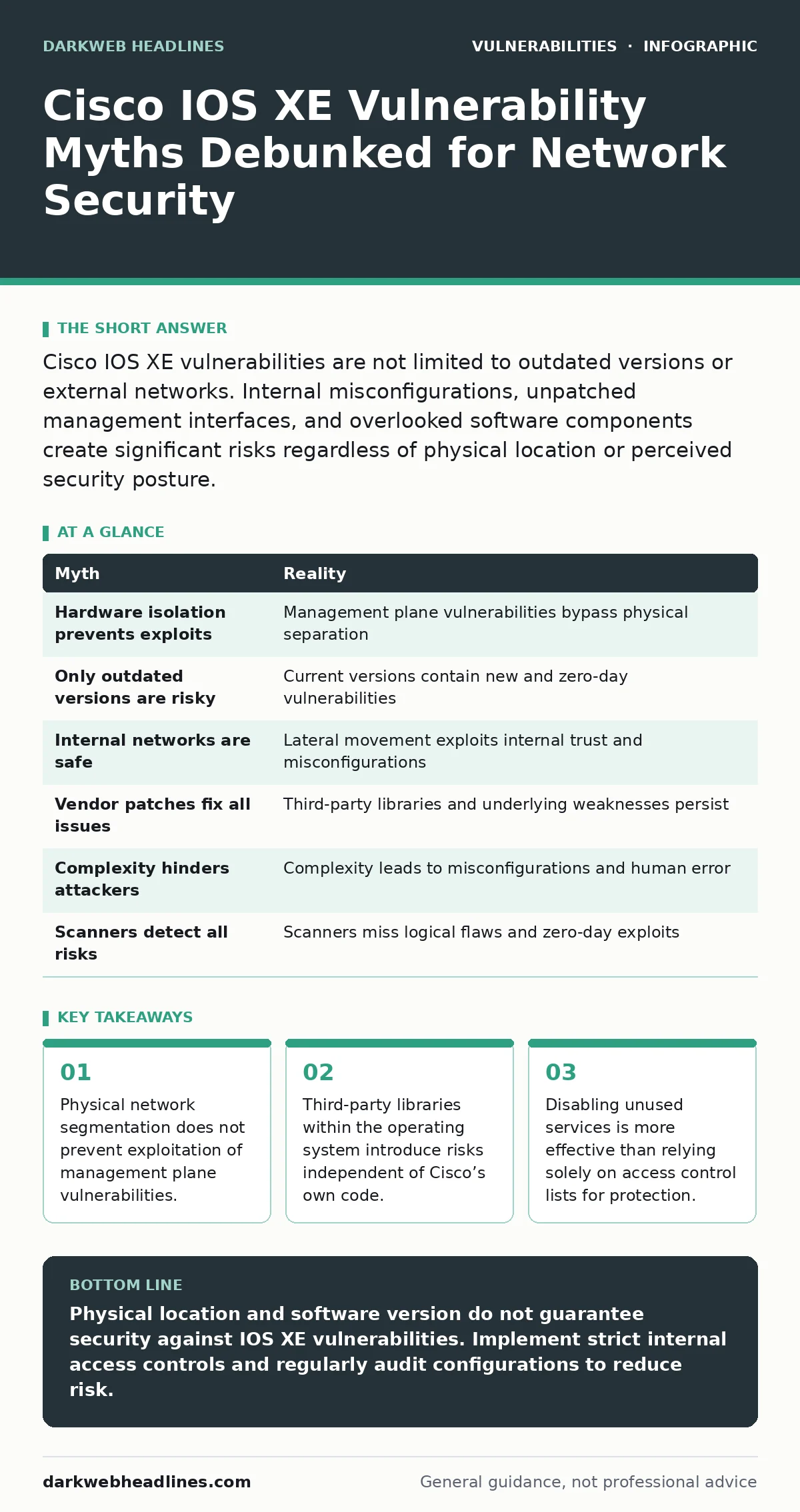
| Myth | Reality |
|---|---|
| Hardware isolation prevents exploits | Management plane vulnerabilities bypass physical separation |
| Only outdated versions are risky | Current versions contain new and zero-day vulnerabilities |
| Internal networks are safe | Lateral movement exploits internal trust and misconfigurations |
| Vendor patches fix all issues | Third-party libraries and underlying weaknesses persist |
| Complexity hinders attackers | Complexity leads to misconfigurations and human error |
| Scanners detect all risks | Scanners miss logical flaws and zero-day exploits |
Key takeaways
- Physical network segmentation does not prevent exploitation of management plane vulnerabilities.
- Third-party libraries within the operating system introduce risks independent of Cisco’s own code.
- Disabling unused services is more effective than relying solely on access control lists for protection.
Physical location and software version do not guarantee security against IOS XE vulnerabilities. Implement strict internal access controls and regularly audit configurations to reduce risk.
Frequently asked questions
How do I know if my IOS XE version is vulnerable?
Check the vendor’s security advisory page for your specific version and compare it with known vulnerability databases.
Can I mitigate risks without patching immediately?
Yes, by restricting access to management interfaces, disabling unused services, and implementing network segmentation.
Are open-source components in IOS XE a major risk?
They can be, as vulnerabilities in these components may be exploited independently of the main operating system.
How often should I audit my network configurations?
Regularly, especially after any changes, to ensure that misconfigurations are identified and corrected promptly.
How this guide was produced: written by the DarkWeb Headlines editorial team with AI assistance, checked against the public references listed below, and reviewed when the facts change. See our editorial policy or report an error.