How ARP Spoofing Works: The Step-by-Step Attack Lifecycle
Address Resolution Protocol lacks authentication, allowing any local device to rewrite neighbor mappings and intercept traffic without triggering alarms.

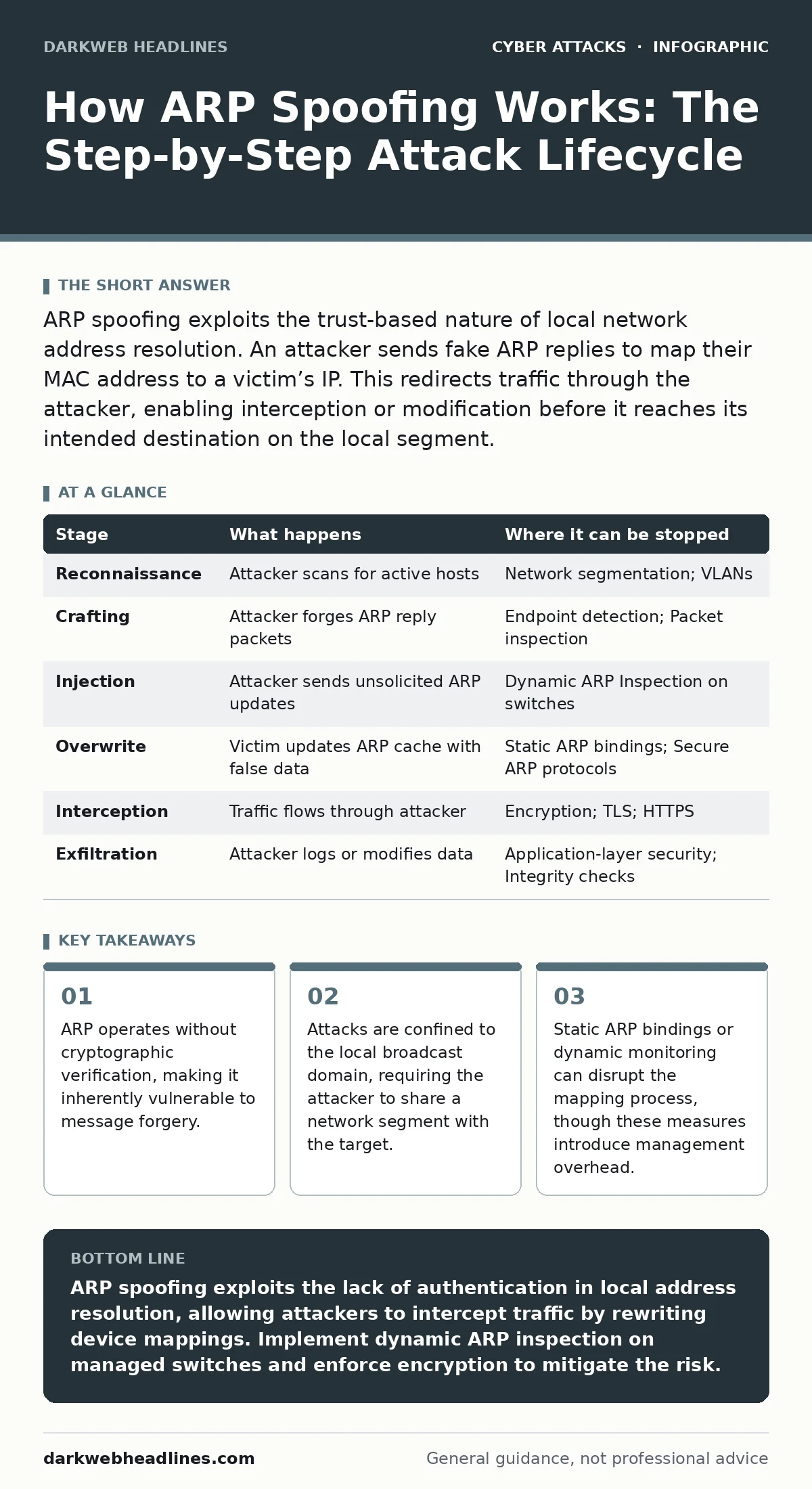
ARP spoofing exploits the trust-based nature of local network address resolution. An attacker sends fake ARP replies to map their MAC address to a victim’s IP. This redirects traffic through the attacker, enabling interception or modification before it reaches its intended destination on the local segment.
The Foundation of Local Trust
Local area networks rely on the Address Resolution Protocol to translate logical Internet Protocol addresses into physical Media Access Control addresses. IP addresses function as logical labels for routing, while MAC addresses identify the specific hardware interface. Without this translation, a device knows where to send data but not which physical port to use. The protocol assumes that any device claiming to own an IP address is truthful. This assumption creates a single point of failure in the local network stack.
The protocol operates on a broadcast mechanism. When a device needs to communicate with another, it shouts into the digital void asking who holds a specific IP. The owner responds with their MAC address. The requester stores this pairing in a local cache. This cache is mutable. It accepts updates without verification. An attacker exploits this mutability by providing false information before the legitimate owner can respond, or by overriding an existing entry.
Stage 1: Reconnaissance and Positioning
The attacker must first determine which devices reside on the same broadcast domain. ARP spoofing cannot traverse routers or firewalls that segment IP subnets. The attacker scans the local network to identify active hosts. This scanning often involves sending ARP requests for common IP ranges or monitoring existing ARP traffic. The goal is to find a high-value target, such as a gateway or a specific workstation.
Positioning is critical. The attacker needs a stable network connection and sufficient bandwidth to handle redirected traffic without causing noticeable latency. If the attacker’s connection drops, the attack fails immediately. The attacker may also look for signs of dynamic host configuration protocol activity to predict new IP assignments. This stage is quiet. It generates minimal noise, making it difficult for basic intrusion detection systems to flag.
Stage 2: Crafting the Poison
Once the target is identified, the attacker prepares the malicious packets. These packets are ARP replies, also known as ARP responses. A standard ARP reply tells a device, "I am this IP, and my MAC address is this." The attacker crafts a reply that claims to be the target’s IP but uses the attacker’s MAC address. Alternatively, the attacker claims to be the default gateway for the victim. This second approach is often more effective because it captures all outbound traffic.
The packet structure must be precise. It must mimic the format of a legitimate ARP message. The attacker sets the sender protocol address to the victim’s IP and the sender hardware address to their own MAC. The target protocol address is set to the victim’s IP, and the target hardware address is set to the attacker’s MAC. This contradiction confuses the victim’s stack. The victim updates its ARP cache to associate the attacker’s hardware with the intended destination.
Stage 3: Injection and Cache Overwrite
The attacker transmits the crafted ARP reply to the victim. This transmission is often unsolicited. The victim did not ask for this information. However, the ARP specification allows for unsolicited replies. These are sometimes used to update caches after an IP change. The attacker exploits this feature. The victim receives the packet and updates its ARP cache table. The old mapping is discarded. The new, false mapping takes precedence.
This overwrite happens silently. No error messages appear on the victim’s screen. The operating system assumes the network is functioning correctly. The attacker may repeat this process periodically. ARP caches have timeouts. If the attacker stops sending packets, the victim will eventually refresh the cache with the correct information. Continuous injection maintains the deception. The attacker must balance the frequency of packets to avoid triggering rate-limiting defenses.
Stage 4: Traffic Redirection and Interception
With the cache poisoned, the victim sends data to the attacker’s MAC address. The attacker’s network interface receives the frames. The attacker now sits in the middle of the communication. This is known as a man-in-the-middle position. The attacker can inspect the contents of the packets. If the traffic is unencrypted, the attacker reads it in plain text. This includes login credentials, emails, and file transfers.
The attacker can also modify the traffic. They can inject malicious code into web pages or alter data in transit. To maintain the stealth of the attack, the attacker often forwards the traffic to the real destination. This requires enabling IP forwarding on the attacker’s machine. If the attacker does not forward the traffic, the victim experiences a network outage. This draws immediate attention. The goal is to remain invisible while harvesting data.
See also: Unauthorized Access Prevention Checklist for Systems · Command and Control Traffic Myths That Blind Defenders
Stage 5: Data Exfiltration or Disruption
The attacker decides how to use the intercepted data. They may log sensitive information for later theft. This is common in corporate espionage or credential harvesting. The attacker might also use the position to launch further attacks. For instance, they could inject scripts into web sessions to compromise the victim’s browser. This connects to the mechanics of session hijacking, where stolen cookies allow unauthorized access to active accounts.
In some cases, the goal is disruption rather than data theft. The attacker may drop packets selectively to cause intermittent connectivity issues. This is a denial-of-service tactic. It frustrates users and diverts IT support resources. The attacker can also craft responses that cause the victim’s applications to crash. This exploits the lack of integrity checks in the ARP protocol. The victim has no way to verify that the data they received was not tampered with.
Interrupting the Attack Lifecycle
ARP spoofing relies on the absence of authentication. Defenses must introduce verification or monitoring. Static ARP bindings map specific IP addresses to MAC addresses manually. This prevents cache poisoning because the system ignores dynamic updates. However, this is difficult to manage in large networks. Every device change requires manual updates. It is error-prone and inflexible.
Dynamic ARP inspection is a more scalable solution. This feature, available on managed switches, validates ARP packets against a trusted database. The switch drops packets that do not match the expected IP-to-MAC mapping. This stops the attack at the network infrastructure level. It requires proper configuration of the switch. If the database is incorrect, legitimate traffic is blocked. This mirrors the complexity of BGP hijacking, where route validation prevents large-scale traffic diversion.
| Stage | What happens | Where it can be stopped |
|---|---|---|
| Reconnaissance | Attacker scans for active hosts | Network segmentation; VLANs |
| Crafting | Attacker forges ARP reply packets | Endpoint detection; Packet inspection |
| Injection | Attacker sends unsolicited ARP updates | Dynamic ARP Inspection on switches |
| Overwrite | Victim updates ARP cache with false data | Static ARP bindings; Secure ARP protocols |
| Interception | Traffic flows through attacker | Encryption; TLS; HTTPS |
| Exfiltration | Attacker logs or modifies data | Application-layer security; Integrity checks |
The Hidden Cost of Defense
Implementing defenses against ARP spoofing introduces operational complexity. Static bindings require constant maintenance. Dynamic inspection requires switch support and correct configuration. These measures increase the cost of network management. They also create a false sense of security. If an attacker gains physical access to a switch or compromises a trusted port, these defenses can be bypassed.
Furthermore, ARP spoofing is just one vector in a broader attack surface. It often works in conjunction with other techniques. For instance, an attacker might use clone phishing to deliver malware that disables local security tools. Or they might use typosquatting to direct users to malicious sites that exploit the intercepted session. Understanding ARP spoofing requires seeing it as part of a chain, not an isolated event.
The protocol’s design flaw is fundamental. It was built for a trusted environment. Modern networks are not trusted. Until a replacement protocol with built-in authentication becomes ubiquitous, ARP spoofing will remain a viable threat. The best defense is a combination of network segmentation, dynamic inspection, and user awareness. This layered approach reduces the risk without creating unmanageable overhead.
Key takeaways
- ARP operates without cryptographic verification, making it inherently vulnerable to message forgery.
- Attacks are confined to the local broadcast domain, requiring the attacker to share a network segment with the target.
- Static ARP bindings or dynamic monitoring can disrupt the mapping process, though these measures introduce management overhead.
ARP spoofing exploits the lack of authentication in local address resolution, allowing attackers to intercept traffic by rewriting device mappings. Implement dynamic ARP inspection on managed switches and enforce encryption to mitigate the risk.
Frequently asked questions
Can ARP spoofing work over Wi-Fi?
Yes, Wi-Fi networks function as broadcast domains. Any device connected to the same SSID can send ARP packets to others, making wireless networks highly susceptible.
Does HTTPS prevent ARP spoofing?
HTTPS encrypts the content of the traffic, preventing the attacker from reading sensitive data. However, it does not stop the attacker from redirecting the traffic or causing latency.
How do I know if I am being targeted?
Look for duplicate IP addresses, unexpected network slowdowns, or strange gateway changes. Network monitoring tools can alert you to rapid ARP cache changes.
Is static ARP binding enough?
Static binding prevents cache poisoning for specific devices. However, it is not scalable for large networks and does not protect against other layers of attack.
How this guide was produced: written by the DarkWeb Headlines editorial team with AI assistance, checked against the public references listed below, and reviewed when the facts change. See our editorial policy or report an error.