ARP Spoofing vs IP Spoofing: Key Differences, Risks, and Defenses
ARP spoofing hijacks local traffic by lying about hardware addresses, while IP spoofing hides remote sources by falsifying network headers.

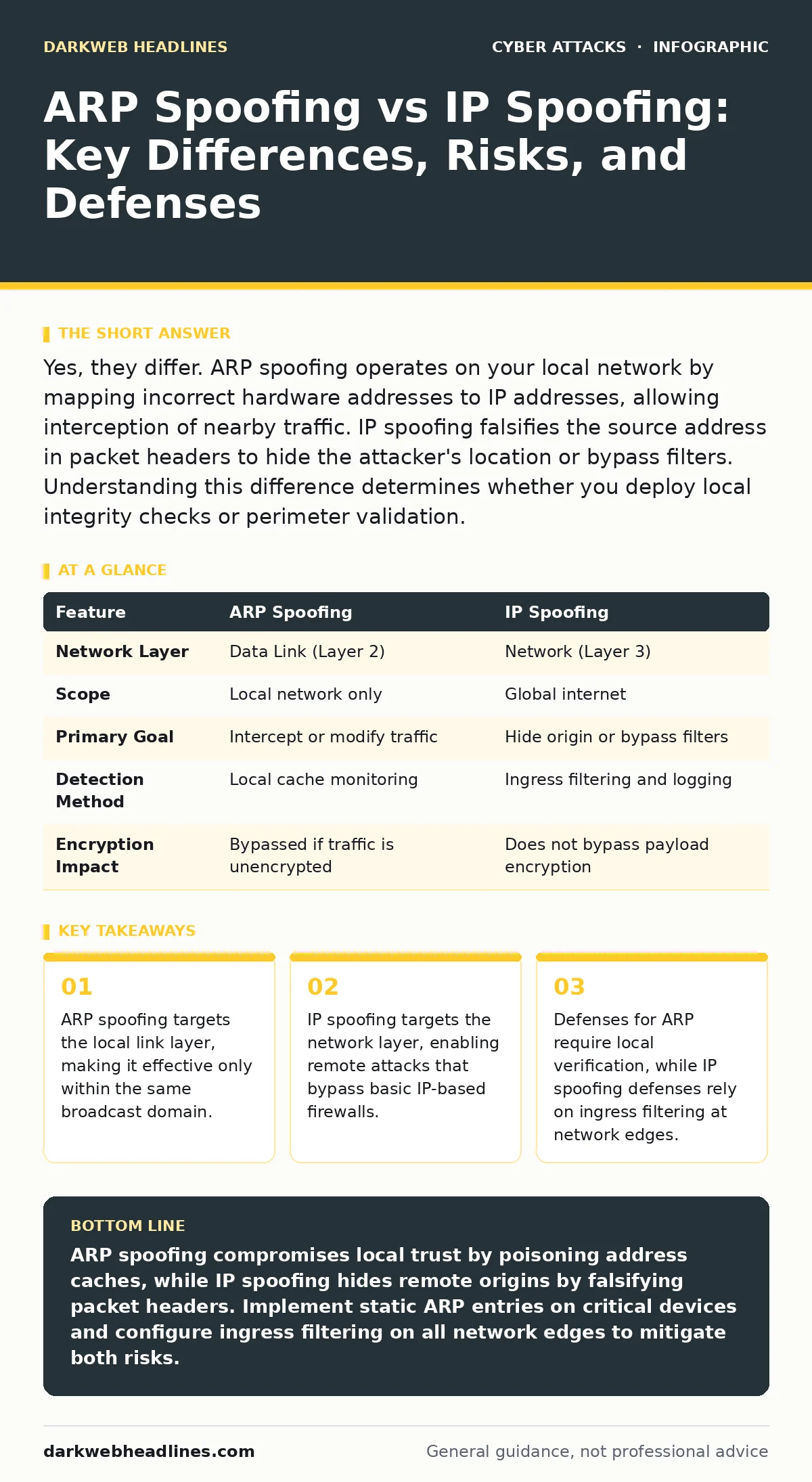
Yes, they differ. ARP spoofing operates on your local network by mapping incorrect hardware addresses to IP addresses, allowing interception of nearby traffic. IP spoofing falsifies the source address in packet headers to hide the attacker's location or bypass filters. Understanding this difference determines whether you deploy local integrity checks or perimeter validation.
What is the difference between arp spoofing and ip spoofing?
The difference between arp spoofing and ip spoofing lies in the network layer they exploit and the scope of their impact. ARP spoofing corrupts the address resolution protocol cache on devices within the same local network segment. This allows an attacker to intercept, modify, or stop traffic between devices on that specific segment. IP spoofing falsifies the source IP address in packet headers to disguise the origin of an attack. This technique operates across the global internet, making it difficult to trace the true sender. You use different defenses because one is a local trust issue and the other is a remote anonymity issue.
How does ARP spoofing work on a local network?
ARP spoofing works by sending falsified ARP messages to associate the attacker's MAC address with the IP address of a legitimate device. ARP, or Address Resolution Protocol, maps IP addresses to physical hardware addresses. When a device sends data, it checks its ARP cache to find the correct destination. If an attacker injects a fake mapping, traffic intended for another device flows to the attacker instead. The attacker can then forward the traffic to the real destination, creating a man-in-the-middle position. This allows the attacker to read unencrypted data or inject malicious content. The victim often notices no immediate change in connectivity, making detection difficult.
How does IP spoofing hide an attacker's location?
IP spoofing hides an attacker's location by crafting packets with a forged source IP address. The Internet Protocol relies on these headers for routing and return paths. An attacker replaces their real IP with one belonging to a trusted host or a random address. This makes the traffic appear to originate from a legitimate source.
Firewalls that allow traffic from trusted IP addresses may permit the spoofed packets. The primary goal is often to mask the origin during denial-of-service attacks or to bypass access controls. Since the spoofed address is fake, reply packets sent to it are lost or routed incorrectly. The attacker never receives the replies, which is why this technique is common in connectionless protocols.
What are the limitations of each technique?
ARP spoofing is limited to the local broadcast domain. It cannot work across routers because ARP requests do not traverse network boundaries. The attacker must be on the same physical or virtual switch as the victim. IP spoofing faces the limitation of stateful firewalls and sequence number checks. Modern connection-oriented protocols use initial sequence numbers that are hard to predict.
If an attacker cannot guess these numbers, they cannot establish a full connection. IP spoofing is therefore less effective for hijacking existing sessions and more effective for flooding targets or bypassing simple IP filters. Understanding these limits helps you prioritize which threats are realistic for your environment.
| Feature | ARP Spoofing | IP Spoofing |
|---|---|---|
| Network Layer | Data Link (Layer 2) | Network (Layer 3) |
| Scope | Local network only | Global internet |
| Primary Goal | Intercept or modify traffic | Hide origin or bypass filters |
| Detection Method | Local cache monitoring | Ingress filtering and logging |
| Encryption Impact | Bypassed if traffic is unencrypted | Does not bypass payload encryption |
Why does encryption not stop ARP spoofing?
Encryption does not stop ARP spoofing because the address resolution process occurs before encryption is applied. TLS, or Transport Layer Security, encrypts the payload of the connection. However, the device must first know where to send the encrypted packet. If the ARP cache is poisoned, the device sends the encrypted data to the attacker's hardware address.
The attacker receives the encrypted stream. While they cannot read the content without the keys, they can still drop the packets, causing a denial of service. They can also perform downgrade attacks if the protocol negotiation happens before full encryption is established. This is a hidden cost of relying solely on transport-level security.
See also: Unauthorized Access Prevention Checklist for Systems · Command and Control Traffic Myths That Blind Defenders
How do you detect ARP spoofing attempts?
You detect ARP spoofing by monitoring for inconsistencies in ARP responses. Tools can watch for duplicate IP addresses claiming different MAC addresses. If a single IP address suddenly maps to two different hardware addresses, a conflict exists. You can also compare the gateway's MAC address against known static values. Any deviation suggests the gateway entry has been poisoned. Network switches can be configured with port security features that limit the number of MAC addresses per port. This prevents an attacker from injecting multiple fake mappings. Regular audits of ARP tables on critical servers provide an additional layer of visibility into local network health.
What defenses stop IP spoofing effectively?
Defenses against IP spoofing focus on validating packet sources at network boundaries. Ingress filtering, often implemented via BCP38, drops packets that claim to originate from addresses outside the network's assigned range. This prevents attackers from using your network as a source for spoofed traffic. Egress filtering ensures that outbound packets have valid source addresses.
Stateful firewalls track connection states and reject packets that do not match established sessions. This blocks many spoofed packets that lack a prior handshake. These measures require configuration at the router or firewall level, not on individual endpoints. They are most effective when deployed consistently across all network edges.
How does this relate to other common attacks?
Understanding these spoofing techniques clarifies why other security measures are necessary. For instance, typosquatting relies on user error rather than network protocol flaws, requiring different mitigation strategies. Malicious email attachments often exploit software vulnerabilities that might be delivered via a clone phishing campaign. Angler phishing on social media uses brand impersonation to trick users, unrelated to network layer spoofing. Passkeys reduce the risk of credential theft that might occur if an attacker successfully performs a man-in-the-middle attack using ARP spoofing. DMARC helps prevent email header spoofing, which is conceptually similar to IP spoofing but operates in the mail transfer protocol space. Malicious bot traffic can amplify the impact of IP spoofing in denial-of-service scenarios. Recognizing these distinct vectors helps you build a layered defense.
Key takeaways
- ARP spoofing targets the local link layer, making it effective only within the same broadcast domain.
- IP spoofing targets the network layer, enabling remote attacks that bypass basic IP-based firewalls.
- Defenses for ARP require local verification, while IP spoofing defenses rely on ingress filtering at network edges.
ARP spoofing compromises local trust by poisoning address caches, while IP spoofing hides remote origins by falsifying packet headers. Implement static ARP entries on critical devices and configure ingress filtering on all network edges to mitigate both risks.
Frequently asked questions
Can ARP spoofing work over Wi-Fi?
Yes, ARP spoofing works over Wi-Fi because it operates at the data link layer, which is present in wireless networks just as in wired ones. Attackers on the same Wi-Fi segment can intercept traffic just as easily.
Does a firewall stop ARP spoofing?
Standard firewalls do not stop ARP spoofing because they operate at higher network layers and do not inspect ARP packets. You need specific ARP inspection features on switches or host-based monitoring tools to detect and prevent this local attack.
How do I know if my IP is spoofed?
You generally cannot tell if your own IP is being spoofed by others, as you do not receive the spoofed packets. However, if you are an administrator, you can detect spoofed traffic originating from your network by checking for source addresses that should not be outbound.
Is IP spoofing illegal?
Using IP spoofing to conduct unauthorized access, denial-of-service attacks, or data interception is illegal in most jurisdictions. The technique itself is a method, but its application in cybercrimes violates computer fraud and abuse laws.
How this guide was produced: written by the DarkWeb Headlines editorial team with AI assistance, checked against the public references listed below, and reviewed when the facts change. See our editorial policy or report an error.