Malicious Bot Traffic Myths: What Operators Actually See
Most bot traffic targets low-value endpoints to bypass security controls, not to steal data directly through high-profile login pages.

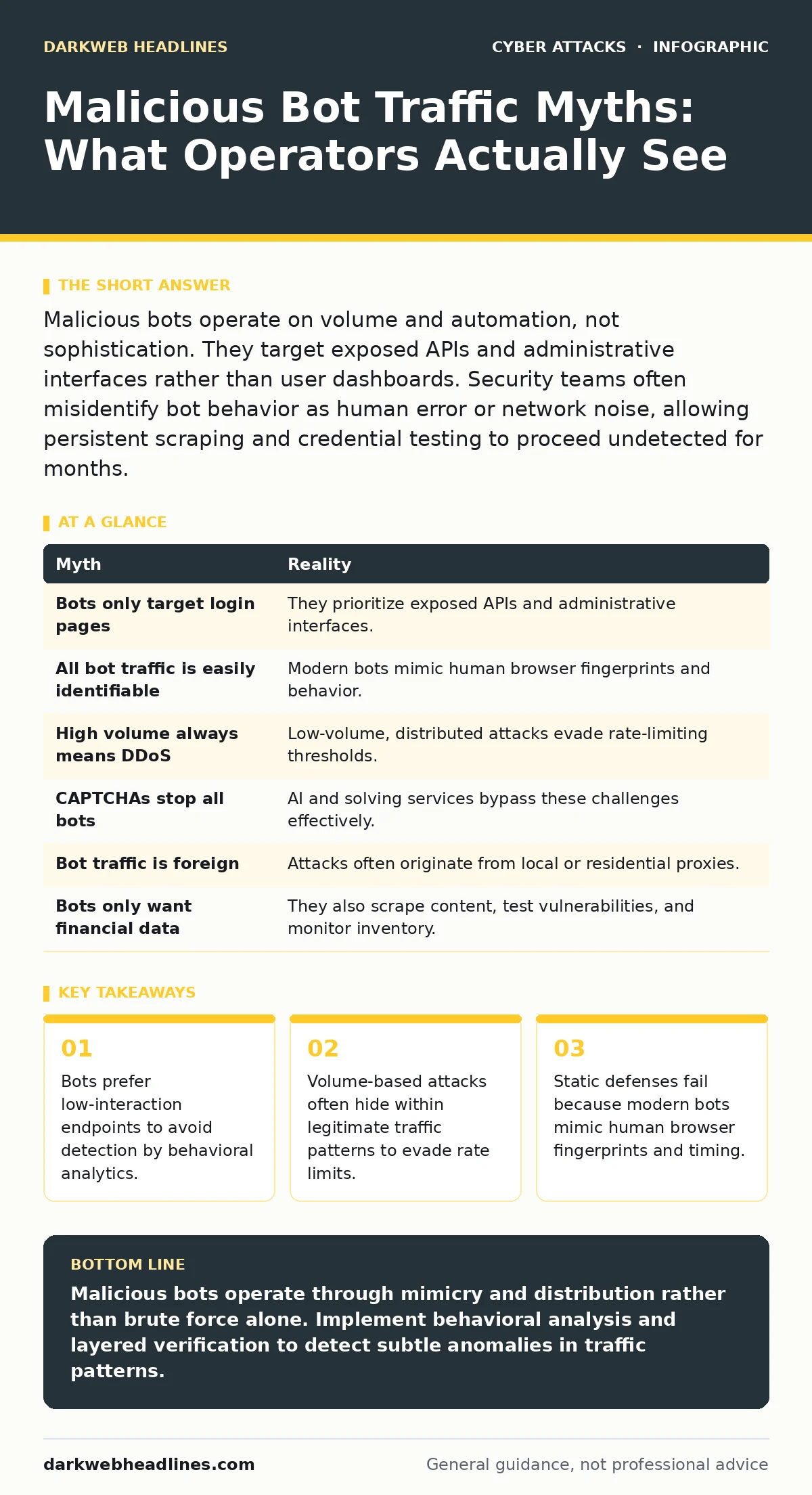
Malicious bots operate on volume and automation, not sophistication. They target exposed APIs and administrative interfaces rather than user dashboards. Security teams often misidentify bot behavior as human error or network noise, allowing persistent scraping and credential testing to proceed undetected for months.
Myth: Bots only target login pages
Reality: Attackers prioritize endpoints that grant immediate access or data exposure without requiring authentication. Login pages are heavily monitored and protected by multi-factor authentication. Bots instead target public APIs, search functions, and administrative interfaces. These endpoints often lack the same scrutiny as primary authentication portals.
Imagine a bot scanning for exposed configuration files or default administrative routes. These paths often return rich data without triggering security alerts. Security teams focus on protecting the front door, leaving the side windows open. This misdirection allows attackers to harvest data or deploy payloads through less defended vectors.
Myth: All bot traffic is easily identifiable
Reality: Modern malicious bots replicate legitimate browser environments to evade detection. They use residential proxy networks to appear as real users. They mimic mouse movements, scroll speeds, and typing patterns. Traditional signature-based detection fails against these sophisticated emulations.
Suppose a bot uses a headless browser engine to render pages exactly like a consumer device. It generates valid TLS handshakes and standard HTTP headers. Network security tools see only standard web traffic. Without behavioral analysis, distinguishing this traffic from a legitimate user is nearly impossible. This mimicry requires continuous updates to detection models.
Myth: High traffic volume always indicates a DDoS attack
Reality: Many malicious bots operate at low volumes to stay below detection thresholds. They distribute requests across thousands of sources to avoid rate-limiting triggers. This slow-and-low approach allows them to scrape content or test credentials over weeks. Volume alone is an unreliable indicator of malicious intent.
Consider a bot that makes one request per hour from a unique residential IP address. This pattern mimics a casual user browsing your site. Security systems configured to block only high-volume spikes will ignore this activity. The attacker gains access to data or tests credentials without triggering alarms. Low-and-slow attacks exploit the assumption that malice equals volume.
Myth: CAPTCHAs stop all automated bots
Reality: CAPTCHAs are increasingly solvable by machine learning algorithms and third-party solving services. Automated systems can now interpret visual and audio challenges with high accuracy. Relying solely on CAPTCHAs creates a false sense of security. It also degrades the user experience for legitimate visitors.
Suppose your site requires a CAPTCHA after three failed login attempts. An attacker uses an API service that employs humans or AI to solve these challenges in real-time. The bot proceeds with the attack while the legitimate user waits. This arms race shifts the burden to the defender. You must implement layered verification methods instead of single-point controls.
Myth: Bot traffic is always foreign in origin
Reality: Attackers frequently use compromised devices within your own user base or target regions. Residential proxies and botnets often originate from the same geographic locations as your customers. Geo-blocking based on country or city is ineffective and exclusionary. It blocks legitimate users while letting sophisticated local bots pass.
Imagine a botnet composed of infected home routers in major metropolitan areas. These devices send requests that appear to come from legitimate subscribers. Filtering by geography would disrupt your primary user base. Attackers exploit the trust associated with local IP ranges. Detection must rely on behavior and context, not just location data.
See also: File Upload Vulnerabilities: How Malicious Files Break Web Apps · CAPTCHA Best Practices: Hardening Verification Against Automation
Myth: Bots are only interested in financial data
Reality: Malicious bots target a wide range of assets beyond credit cards or bank accounts. They scrape product inventory for arbitrage opportunities. They harvest user content for training AI models. They test for vulnerabilities to deploy malware or ransomware. The financial motive is just one of many drivers.
Suppose a competitor uses bots to monitor price changes and stock levels in real-time. This activity does not involve stealing financial credentials. It undermines your business logic and market position. Other bots might harvest personal information for identity theft or social engineering. Understanding the diverse goals of bots helps you protect the right assets.
| Myth | Reality |
|---|---|
| Bots only target login pages | They prioritize exposed APIs and administrative interfaces. |
| All bot traffic is easily identifiable | Modern bots mimic human browser fingerprints and behavior. |
| High volume always means DDoS | Low-volume, distributed attacks evade rate-limiting thresholds. |
| CAPTCHAs stop all bots | AI and solving services bypass these challenges effectively. |
| Bot traffic is foreign | Attacks often originate from local or residential proxies. |
| Bots only want financial data | They also scrape content, test vulnerabilities, and monitor inventory. |
Key takeaways
- Bots prefer low-interaction endpoints to avoid detection by behavioral analytics.
- Volume-based attacks often hide within legitimate traffic patterns to evade rate limits.
- Static defenses fail because modern bots mimic human browser fingerprints and timing.
Malicious bots operate through mimicry and distribution rather than brute force alone. Implement behavioral analysis and layered verification to detect subtle anomalies in traffic patterns.
Frequently asked questions
How can I distinguish between a malicious bot and a search engine crawler?
Check the user-agent string and request patterns. Legitimate crawlers follow robots.txt and have consistent, low-frequency request patterns. Malicious bots often ignore directives and exhibit erratic or high-frequency behavior.
How do I protect against credential stuffing attacks?
Implement multi-factor authentication and monitor for impossible travel scenarios. Use device fingerprinting to identify new or suspicious devices. Rate-limiting login attempts helps mitigate the impact of automated credential testing.
How this guide was produced: written by the DarkWeb Headlines editorial team with AI assistance, checked against the public references listed below, and reviewed when the facts change. See our editorial policy or report an error.