Difference Between Clickjacking and CSRF: Mechanisms, Defenses, and Testing
Clickjacking hijacks the user interface layer to force clicks, while CSRF exploits the browser’s automatic credential handling to force actions.
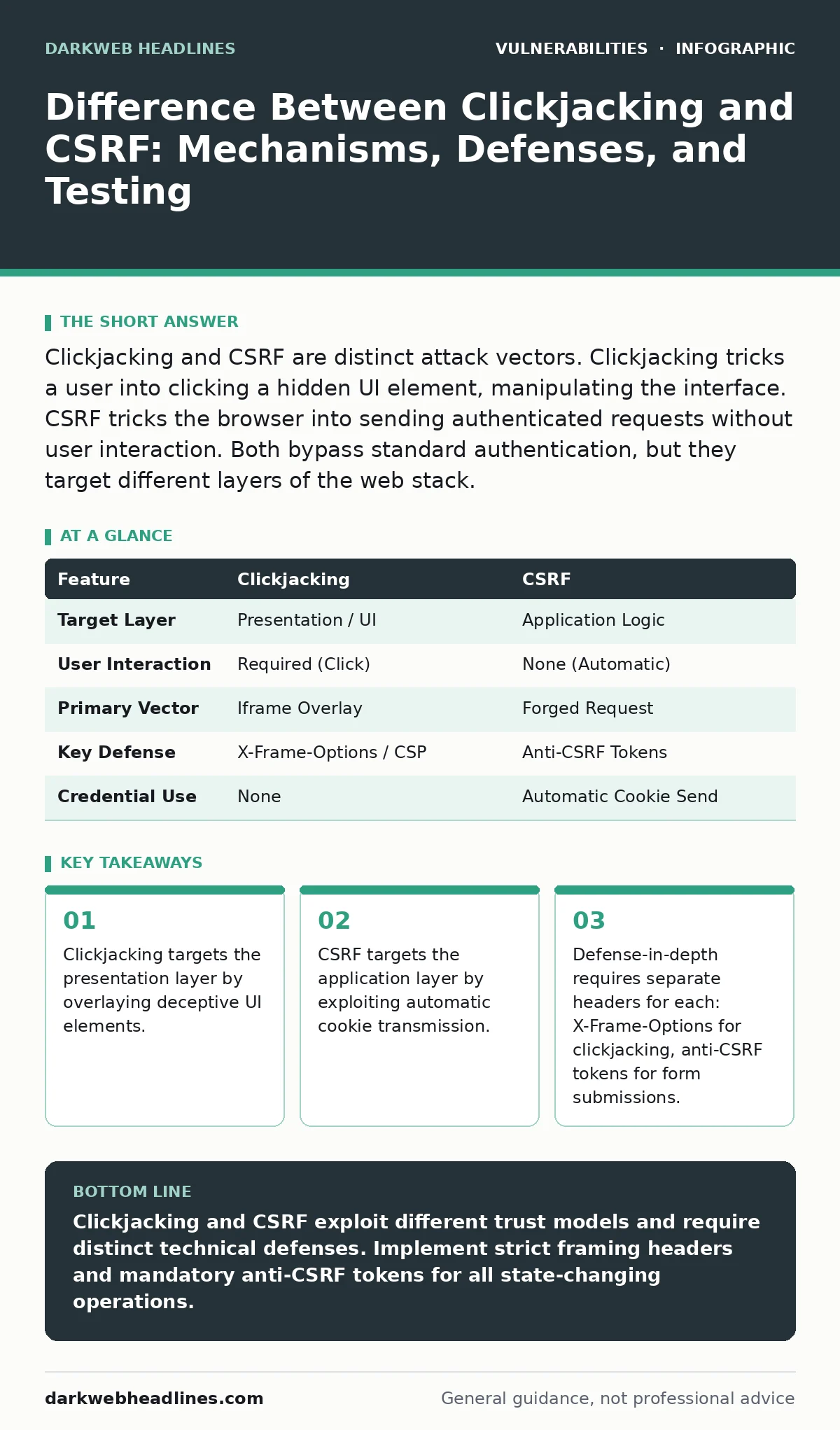
Clickjacking and CSRF are distinct attack vectors. Clickjacking tricks a user into clicking a hidden UI element, manipulating the interface. CSRF tricks the browser into sending authenticated requests without user interaction. Both bypass standard authentication, but they target different layers of the web stack.
What is the difference between clickjacking and CSRF?
The difference between clickjacking and CSRF lies in the layer of the web stack they exploit and the user interaction they require. Clickjacking is a user-interface redress attack that hides malicious elements behind legitimate ones. It forces the user to click a button they did not intend to press. CSRF is a cross-site request forgery that exploits the trust a website places in an authenticated user’s browser. It forces the browser to send a state-changing request without the user’s knowledge.
Clickjacking relies on visual deception. An attacker embeds your site in an invisible iframe on a malicious page. The user thinks they are clicking a harmless button, but they are actually clicking a hidden delete account link on your site. CSRF relies on automatic authentication. The browser sends cookies with every request to your domain. If your application does not verify the origin of the request, it processes the forged command as if the user intended it.
How does clickjacking manipulate the user interface?
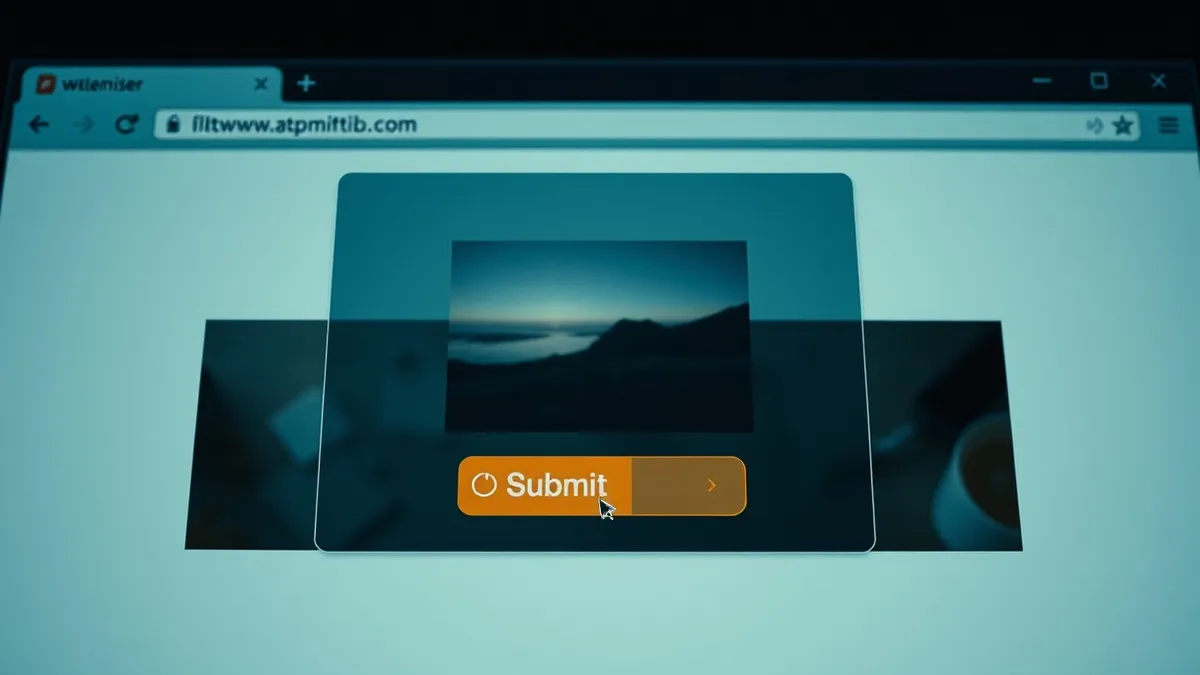
Clickjacking manipulates the user interface by stacking multiple transparent layers on top of each other. The attacker creates a page with a visible layer, such as a game or a video player. Beneath this layer, they embed an iframe containing your vulnerable website. They use CSS opacity settings to make the iframe completely invisible to the human eye.
When you click what you believe is a button on the visible layer, your mouse event passes through to the invisible layer below. The browser registers the click on the hidden element. If that element is a "Delete" or "Transfer Funds" button, the action executes. The success of this attack depends entirely on the target site allowing itself to be framed. If the site sends proper framing restrictions, the browser blocks the iframe, and the attack fails.
How does CSRF exploit browser authentication?
CSRF exploits browser authentication by leveraging the automatic inclusion of credentials in HTTP requests. When you log into a banking site, the server issues a session cookie. Your browser stores this cookie and sends it with every subsequent request to that domain. The server uses this cookie to identify you.
An attacker cannot read your cookie due to same-origin policy restrictions. However, they can force your browser to make a request to the banking site. They might host an image tag or a form on their own malicious website. When you visit their site, your browser automatically attaches your banking session cookie to the request. The banking server sees a valid cookie and processes the request. The attacker has successfully forged a request using your credentials without ever knowing the cookie value.
What headers prevent clickjacking attacks?
You prevent clickjacking by sending specific HTTP response headers that control framing behavior. The X-Frame-Options header is the standard mechanism for this defense. It tells the browser whether the site allows itself to be rendered inside an iframe. Setting this header to DENY prevents any framing. Setting it to SAMEORIGIN allows framing only by pages from the same domain.
Modern browsers also support the Content Security Policy (CSP) header. The frame-ancestors directive within CSP provides finer control than X-Frame-Options. It allows you to specify exactly which domains are permitted to frame your content. Using both headers ensures compatibility with older browsers while providing strict control for modern ones. Without these headers, your site remains vulnerable to UI redress attacks regardless of other security measures.
How do anti-CSRF tokens work?
Anti-CSRF tokens work by binding each state-changing request to a unique, unpredictable value that the attacker cannot guess. When the server generates a form for you, it includes a hidden field containing a random token. This token is tied to your session. When you submit the form, the browser sends the token back.
The server verifies that the token matches the one it issued for your session. If the token is missing or invalid, the server rejects the request. An attacker cannot forge this token because they cannot read the content of your page due to same-origin policy. They can force your browser to send a request, but they cannot include the correct token. This breaks the chain of trust required for a successful CSRF attack.
See also: File Upload Vulnerabilities: How Malicious Files Break Web Apps · CAPTCHA Best Practices: Hardening Verification Against Automation
When do standard defenses fail?
Standard defenses fail when developers misconfigure headers or ignore edge cases. A common failure in clickjacking protection occurs when a site uses SAMEORIGIN but also has a legitimate need to be framed by a partner site. If the developer whitelists the partner incorrectly, attackers can spoof the partner’s domain or use subdomain takeover vulnerabilities to bypass the restriction.
CSRF defenses fail when applications use simple checks like verifying the Referer header. Attackers can strip or spoof this header using proxies or specific network conditions. Another failure mode is when developers use double-submit cookies incorrectly. If the token generation is not cryptographically secure, attackers might predict the token. You must treat every state-changing endpoint as a potential CSRF target, even if it seems low-risk.
| Feature | Clickjacking | CSRF |
|---|---|---|
| Target Layer | Presentation / UI | Application Logic |
| User Interaction | Required (Click) | None (Automatic) |
| Primary Vector | Iframe Overlay | Forged Request |
| Key Defense | X-Frame-Options / CSP | Anti-CSRF Tokens |
| Credential Use | None | Automatic Cookie Send |
How do you test for these vulnerabilities?
You test for clickjacking by attempting to embed the target site in an iframe on a local test page. If the content renders, the site is vulnerable. You should check the response headers for X-Frame-Options or Content-Security-Policy. If these are missing or misconfigured, the site lacks framing protection. This test is simple but often overlooked in dynamic application security testing (DAST) scans that focus on code logic rather than HTTP headers.
Testing for CSRF requires intercepting requests and removing or altering anti-CSRF tokens. You can use a proxy tool to capture a legitimate form submission. Then, replay the request without the token or with an invalid value. If the server processes the request, it is vulnerable. You should also test endpoints that do not use forms, such as API calls triggered by image tags. These often lack token validation because developers assume they are read-only.
What is the relationship to other vulnerabilities?
Clickjacking and CSRF often combine with other weaknesses to increase impact. A clickjacking attack might force a user to grant permissions, which then enables a privilege escalation vulnerability. If the hidden button triggers an API call that lacks proper authorization checks, the attacker gains elevated access.
CSRF can be chained with file upload vulnerabilities. If an attacker can force a victim to upload a malicious file via CSRF, they might achieve remote code execution. This is particularly dangerous if the application does not validate file types or scan for malware. Understanding these combinations helps you prioritize fixes. Protecting against one vector does not secure you against the other. You need a layered approach that addresses both UI and request integrity.
How do you implement a defense strategy?
You implement a defense strategy by integrating protections into your development lifecycle. Start by enforcing strict Content Security Policy headers on all responses. This mitigates clickjacking and other injection attacks. Next, ensure every state-changing action requires a unique, unpredictable anti-CSRF token. Validate these tokens server-side before processing any logic.
Regularly review your code for missing headers and unprotected endpoints. Include clickjacking and CSRF checks in your vulnerability management programs. Do not assume that using a secure framework automatically protects you. Misconfiguration is a common cause of failure. Test your defenses manually to ensure they work as expected. This proactive approach reduces the risk of both UI and request forgery attacks.
Key takeaways
- Clickjacking targets the presentation layer by overlaying deceptive UI elements.
- CSRF targets the application layer by exploiting automatic cookie transmission.
- Defense-in-depth requires separate headers for each: X-Frame-Options for clickjacking, anti-CSRF tokens for form submissions.
Clickjacking and CSRF exploit different trust models and require distinct technical defenses. Implement strict framing headers and mandatory anti-CSRF tokens for all state-changing operations.
Frequently asked questions
Can HTTPS prevent clickjacking?
No. HTTPS encrypts the connection but does not prevent a site from being embedded in an iframe. You must use X-Frame-Options or CSP headers to block framing.
Is CSRF still a relevant threat?
Yes. Many APIs and single-page applications still rely on cookies for authentication. Without anti-CSRF tokens, these applications remain vulnerable to forged requests.
Do I need CSRF protection for GET requests?
Generally no. GET requests should be idempotent and not change state. However, if a GET request triggers a state change, it must be protected against CSRF.
How does this relate to prototype pollution?
Prototype pollution affects JavaScript object properties and is unrelated to framing or request forgery. It is a different class of vulnerability requiring separate mitigation strategies.
How this guide was produced: written by the DarkWeb Headlines editorial team with AI assistance, checked against the public references listed below, and reviewed when the facts change. See our editorial policy or report an error.