Subdomain Takeover Risks and Low-Cost Protections for Small Business
Abandoned cloud services and forgotten DNS records create hidden entry points that attackers use to hijack your brand identity and steal user sessions.

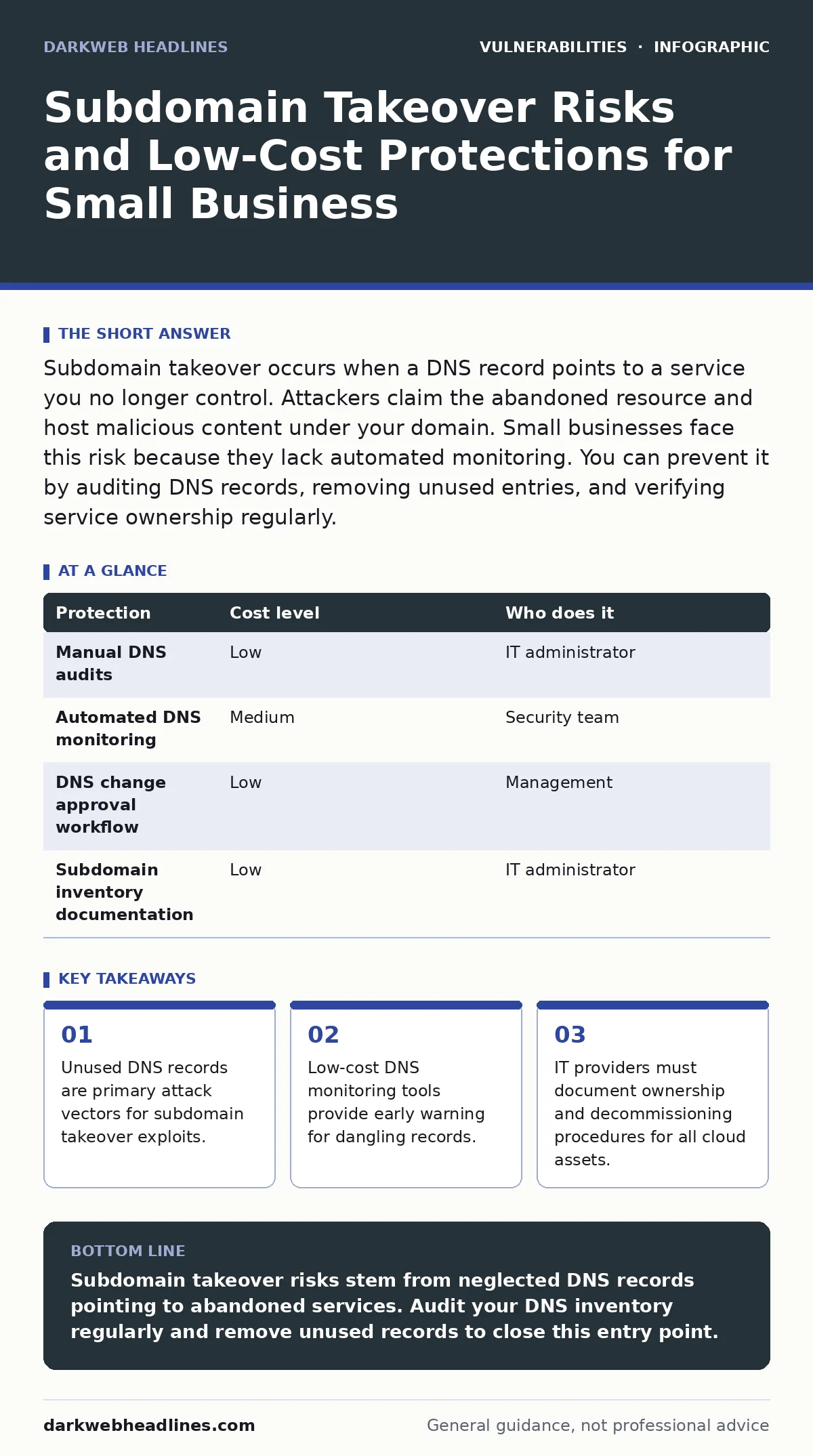
Subdomain takeover occurs when a DNS record points to a service you no longer control. Attackers claim the abandoned resource and host malicious content under your domain. Small businesses face this risk because they lack automated monitoring. You can prevent it by auditing DNS records, removing unused entries, and verifying service ownership regularly.
How Subdomain Takeover Exploits DNS Misconfigurations
Subdomain takeover exploits occur when a domain’s DNS records point to a host that no longer belongs to the organization. The Domain Name System translates human-readable names into machine-readable IP addresses. When you move a service from one provider to another, you update the DNS record to point to the new location. If you cancel the old service but forget to remove or update the DNS record, the pointer becomes dangling.
Attackers scan the internet for these dangling pointers. When they find one, they register a new account on the original service using the same subdomain name. The service accepts the registration because the DNS record still points to it. The attacker now controls the content served at that subdomain. This allows them to host malicious scripts, steal credentials, or impersonate your brand.
The mechanism relies on the separation of DNS management and service hosting. DNS providers do not verify if the target service is active. They only resolve the name to the configured address. This decoupling creates a blind spot for organizations that manage multiple cloud services without centralized oversight. Small organizations are particularly exposed because they often lack dedicated infrastructure teams to audit these records regularly.
Why Small Organizations Face Higher Exposure
Small businesses often adopt cloud services rapidly to support growth. Each new tool requires a DNS configuration. Over time, teams change vendors, cancel subscriptions, or merge services. The initial administrator who configured the DNS record may leave the company. Without a formal handover process, the knowledge of which records are active and which are obsolete disappears.
This drift creates a accumulation of technical debt. A small team might manage five different cloud platforms. Each platform has its own console for managing resources. When a service is discontinued, the focus shifts to the new tool. The old DNS record remains in the background, invisible to daily operations. Attackers exploit this negligence because the cost of scanning for dangling records is low, while the reward of compromising a trusted domain is high.
The risk extends beyond simple phishing. An attacker controlling a subdomain can inject JavaScript into pages served by your organization. This allows them to bypass same-origin policy restrictions. They can access session cookies, intercept API tokens, or redirect users to malicious sites. The impact is amplified because users trust the domain name. They do not suspect that a subdomain they have never visited is compromised.
The Hidden Cost of Abandoned Services
The financial cost of a subdomain takeover is not limited to immediate remediation. Reputational damage erodes customer trust. Users who encounter a phishing page on your domain may assume your security practices are poor. This perception lingers even after the issue is resolved. Search engines may also penalize your domain if it hosts malicious content, affecting search rankings and organic traffic.
Technical remediation requires more than changing a DNS record. You must revoke any tokens or certificates issued to the compromised subdomain. You may need to rotate API keys if the attacker accessed backend services. Incident response teams must investigate the extent of the compromise. This diverts resources from productive work. The hidden cost is the opportunity loss from distracted staff and delayed projects.
Another hidden cost is the complexity of detection. Standard vulnerability scanners often miss subdomain takeover risks. They check for known software flaws but do not validate the state of external dependencies. You need specialized tools or manual audits to identify dangling records. This adds to the operational burden. Organizations that rely on generic security tools remain blind to this specific threat vector.
Low-Cost Protections for DNS Hygiene
Protecting against subdomain takeover does not require expensive enterprise solutions. The primary defense is maintaining accurate DNS records. You should audit your DNS zone files regularly. Remove any records that point to services you no longer use. Keep a documented inventory of all subdomains and their associated services. This inventory should include the provider, the purpose, and the owner.
Automated monitoring tools can alert you to changes in DNS records. These tools scan your domain for new or modified records. They can also check if existing records point to active services. Some tools integrate with your DNS provider to detect unauthorized changes. This provides early warning before an attacker exploits a dangling record. The cost of these tools is often minimal compared to the impact of a breach.
Implementing strict DNS management policies reduces human error. Require approval for all DNS changes. Document the reason for each change. Assign ownership to specific team members. This creates accountability. When a service is discontinued, the owner is responsible for updating the DNS record. This process ensures that no record is left behind. It also simplifies audits and compliance checks.
| Protection | Cost level | Who does it |
|---|---|---|
| Manual DNS audits | Low | IT administrator |
| Automated DNS monitoring | Medium | Security team |
| DNS change approval workflow | Low | Management |
| Subdomain inventory documentation | Low | IT administrator |
What to Ask an IT Provider
When engaging an IT provider, you must verify their approach to DNS management. Ask how they track active subdomains. A provider should maintain a centralized inventory of all DNS records. This inventory should be updated whenever a service is added or removed. Request to see this inventory during onboarding. It demonstrates their organizational rigor.
Ask about their incident response plan for DNS issues. A provider should have a procedure for detecting and remediating dangling records. This includes monitoring for unauthorized changes and alerting you to potential risks. Inquire about their experience with subdomain takeover incidents. A provider who has handled such cases will have refined processes to prevent recurrence.
Finally, ask about their tooling for DNS security. Providers should use automated tools to scan for misconfigurations. These tools should integrate with your DNS provider and cloud services. Ask if they offer regular reports on DNS health. These reports should highlight any records that are at risk of becoming dangling. This transparency ensures you are aware of your exposure.
- How do you maintain an inventory of all DNS records?
- What tools do you use to monitor for dangling DNS records?
- What is your procedure for removing DNS records when a service is discontinued?
- How do you alert us to unauthorized DNS changes?
- Can you provide a sample report of DNS health checks?
See also: Cloud Metadata Service Attacks: Risks and Protection for Small Businesses · 7 Mistakes That Leave Microsoft Exchange Servers Open to Attack
Integrating DNS Security with Broader Practices
Subdomain takeover prevention is part of a broader vulnerability management strategy. You should integrate DNS audits into your regular security reviews. This aligns with the principles of vulnerability management programs. By treating DNS records as critical assets, you ensure they receive the same attention as software patches.
Consider the relationship between subdomain takeover and other web vulnerabilities. An attacker who controls a subdomain can exploit file upload vulnerabilities if the service allows it. They can also leverage clickjacking techniques to trick users into interacting with malicious content. Understanding these connections helps you prioritize defenses. A secure DNS posture reduces the attack surface for these related threats.
You should also evaluate your testing methods. Dynamic application security testing (DAST) tools can identify some configuration errors. However, they may not detect dangling DNS records. You need specialized scanners or manual checks. This highlights the limitation of relying solely on automated testing. A layered approach that combines different tools and processes provides better coverage.
Maintaining Long-Term DNS Integrity
DNS management is an ongoing process. Services change, teams evolve, and technologies update. You must adapt your practices to reflect these changes. Regular reviews of your DNS inventory are necessary. Schedule these reviews quarterly or after major service changes. This ensures that your DNS records remain accurate and secure.
Training staff on DNS hygiene is also valuable. Educate developers and administrators on the risks of dangling records. Encourage them to document all DNS changes. Foster a culture of security awareness. When everyone understands the impact of misconfigured DNS, the likelihood of errors decreases. This cultural shift supports technical controls.
Finally, stay informed about new threats and best practices. The cybersecurity landscape evolves constantly. New techniques for exploiting DNS misconfigurations may emerge. Keep up with industry standards and frameworks. This proactive approach ensures your defenses remain effective. Security is not a one-time task but a continuous commitment.
Key takeaways
- Unused DNS records are primary attack vectors for subdomain takeover exploits.
- Low-cost DNS monitoring tools provide early warning for dangling records.
- IT providers must document ownership and decommissioning procedures for all cloud assets.
Subdomain takeover risks stem from neglected DNS records pointing to abandoned services. Audit your DNS inventory regularly and remove unused records to close this entry point.
Frequently asked questions
How often should I audit my DNS records?
Audit your DNS records at least quarterly or whenever you add or remove a cloud service. Regular checks prevent the accumulation of dangling records.
Can a subdomain takeover affect my main domain?
Directly, no. The main domain remains secure. Indirectly, yes. Attackers can use the subdomain to phishing users or inject scripts that target your main site’s users.
Do I need a security team to prevent subdomain takeover?
No. Small teams can prevent it by maintaining a DNS inventory and removing unused records. Automated monitoring tools can assist with detection.
What is the difference between a dangling pointer and a subdomain takeover?
A dangling pointer is a DNS record pointing to a non-existent service. Subdomain takeover is the act of an attacker exploiting that pointer to control the subdomain.
How this guide was produced: written by the DarkWeb Headlines editorial team with AI assistance, checked against the public references listed below, and reviewed when the facts change. See our editorial policy or report an error.