Cloud Metadata Service Attacks: Risks and Protection for Small Businesses
Default cloud configurations grant unrestricted access to sensitive credentials via a local endpoint, creating a silent backdoor that attackers exploit before you detect the breach.

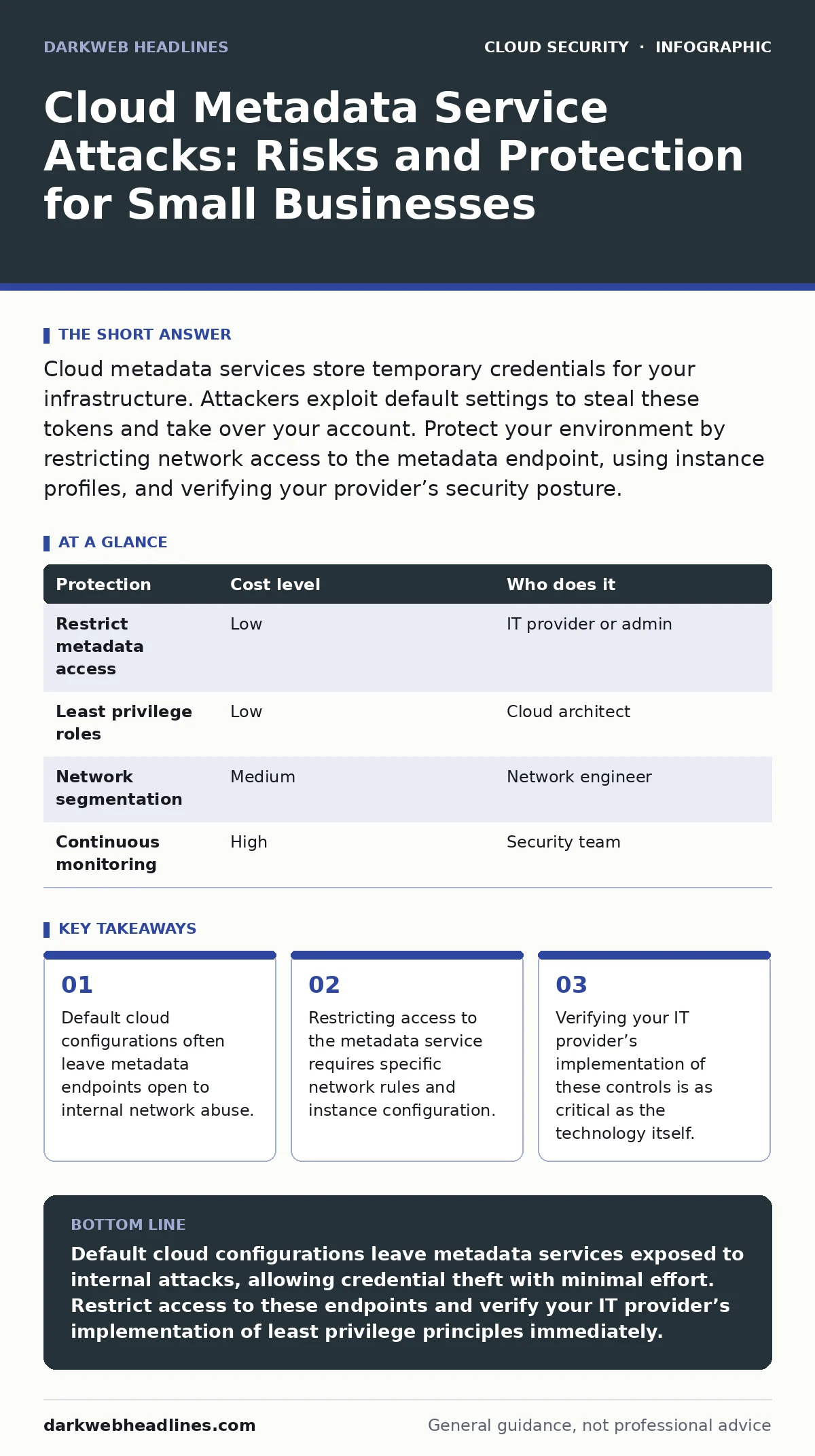
Cloud metadata services store temporary credentials for your infrastructure. Attackers exploit default settings to steal these tokens and take over your account. Protect your environment by restricting network access to the metadata endpoint, using instance profiles, and verifying your provider’s security posture.
The Hidden Credential Store
Cloud infrastructure relies on temporary credentials to allow servers to interact with storage, databases, and other services. These credentials are not static passwords. They rotate automatically and are tied to specific roles. This system is convenient, but it creates a single point of failure.
Every cloud server has a local endpoint that serves these credentials. This endpoint is known as the metadata service. It resides on a link-local address, meaning it is only reachable from the server itself or machines on the same private network. By design, it is always on. It does not require authentication to query.
The risk arises when an attacker gains any foothold on your network. If they can execute code on a compromised server, they can query this endpoint. They do not need to crack passwords. They simply request the credentials that the server is already using. This turns a minor vulnerability into a full account takeover.
Why Small Organizations Are Exposed
Small businesses often adopt cloud services for their ease of use. This convenience comes with default configurations that prioritize functionality over security. Many cloud providers ship servers with the metadata service accessible by default. They assume the user will lock it down.
You may not have dedicated security staff to review these defaults. Your IT provider might deploy resources quickly to meet deadlines. They may not realize that the metadata endpoint is exposed to internal lateral movement. An attacker who compromises one server can pivot to others.
This exposure is compounded by a lack of visibility. You may not know every server running in your environment. Orphaned cloud resources often remain active long after their purpose has ended. These forgotten servers become easy targets because they receive fewer updates and less monitoring.
The Mechanics of the Attack
The attack vector is simple and effective. It begins with a small breach. This could be a weak password, an unpatched application, or a misconfigured firewall. The attacker gains a command shell on a single machine.
From there, the attacker sends a request to the metadata service. The service responds with a set of temporary security tokens. These tokens grant the permissions assigned to that server’s role. If the role has administrative privileges, the attacker now has administrative control.
The attacker does not need to move laterally to other machines immediately. They can use these tokens to create new users, export data, or launch expensive computing instances. The damage spreads rapidly because the credentials are legitimate. Cloud logs show valid actions, not malicious ones. This makes detection difficult without specific monitoring.
Low-Cost Protections
You can mitigate this risk without expensive software. The most effective defense is restricting network access to the metadata endpoint. Most cloud providers offer a setting to require a specific header or token for access. This prevents simple scripts from retrieving credentials.
Another layer of protection is the principle of least privilege. Ensure that each server role has only the permissions it needs. A web server should not have administrative access to your database. If an attacker steals the credentials from the web server, their power is limited.
Regular audits of your cloud resources help identify unnecessary permissions. You should also review your network architecture. Ensure that servers are isolated in separate subnets. This limits the ability of an attacker to move from one machine to another.
| Protection | Cost level | Who does it |
|---|---|---|
| Restrict metadata access | Low | IT provider or admin |
| Least privilege roles | Low | Cloud architect |
| Network segmentation | Medium | Network engineer |
| Continuous monitoring | High | Security team |
What to Ask Your IT Provider
Your IT provider manages the technical implementation. You must verify that they understand these risks. Do not assume that "cloud security" is handled automatically. Ask specific questions about their configuration standards.
- How do you restrict access to the metadata service on new instances?
- Do you use instance profiles to assign permissions, and how are they reviewed?
- What is your process for identifying and removing orphaned cloud resources?
- How do you monitor for unusual activity within the cloud account?
- Can you demonstrate how you handle identity sprawl across multiple services?
Also, ask about their incident response plan. If a metadata token is compromised, what steps do they take? Do they have a way to revoke credentials instantly? Understanding their response capability is as important as their preventive measures.
See also: Identity and Access Management: How Zero Trust Stops Cloud Breaches · Warning Signs of Orphaned Cloud Resources and How to Remediate Them
Integrating with Broader Security
Protecting the metadata service is one part of a larger strategy. You must also address identity and access management to ensure that human users have appropriate controls. Misconfigured IAM roles can bypass even the best technical safeguards.
Consider how you manage software updates and configurations. Policy as code can help enforce security standards automatically. This ensures that every new server is built with the correct restrictions. It reduces the chance of human error during deployment.
You should also be aware of other exposure points. Exposed Docker APIs can provide similar access to containerized workloads. SaaS data exposure remains a risk if users share data externally. A holistic approach covers all these areas.
Building Resilience Over Time
Security is not a one-time task. It requires continuous effort. As your business grows, your cloud environment will change. New services will be added. New users will be granted access. Each change introduces new risks.
Schedule regular reviews of your cloud security posture. Involve your IT provider in these reviews. Ask them to report on any changes to default configurations. Ensure that they follow best practices for every new resource.
Educate your team about these risks. They should understand that cloud security is shared responsibility. You control the data and the configuration. The provider controls the infrastructure. Clear communication prevents gaps in protection.
Key takeaways
- Default cloud configurations often leave metadata endpoints open to internal network abuse.
- Restricting access to the metadata service requires specific network rules and instance configuration.
- Verifying your IT provider’s implementation of these controls is as critical as the technology itself.
Default cloud configurations leave metadata services exposed to internal attacks, allowing credential theft with minimal effort. Restrict access to these endpoints and verify your IT provider’s implementation of least privilege principles immediately.
Frequently asked questions
What is a cloud metadata service?
It is a local endpoint on a cloud server that provides temporary credentials and configuration data to the operating system and applications running on that server.
Why is the metadata service dangerous?
It is accessible without authentication from the server itself. If an attacker compromises the server, they can steal the credentials and gain the permissions assigned to that server’s role.
Can I disable the metadata service?
You cannot fully disable it, as the server needs it to function. However, you can restrict access by requiring specific headers or tokens, making it harder for attackers to query.
How do I know if my provider is securing this?
Ask for their documentation on instance configuration. Look for mentions of restricting metadata access, using instance profiles, and implementing network segmentation.
How this guide was produced: written by the DarkWeb Headlines editorial team with AI assistance, checked against the public references listed below, and reviewed when the facts change. See our editorial policy or report an error.