Policy as Code FAQs: Automating Cloud Security Rules
Treating security rules as software artifacts prevents configuration drift while introducing new risks related to code complexity and execution speed.

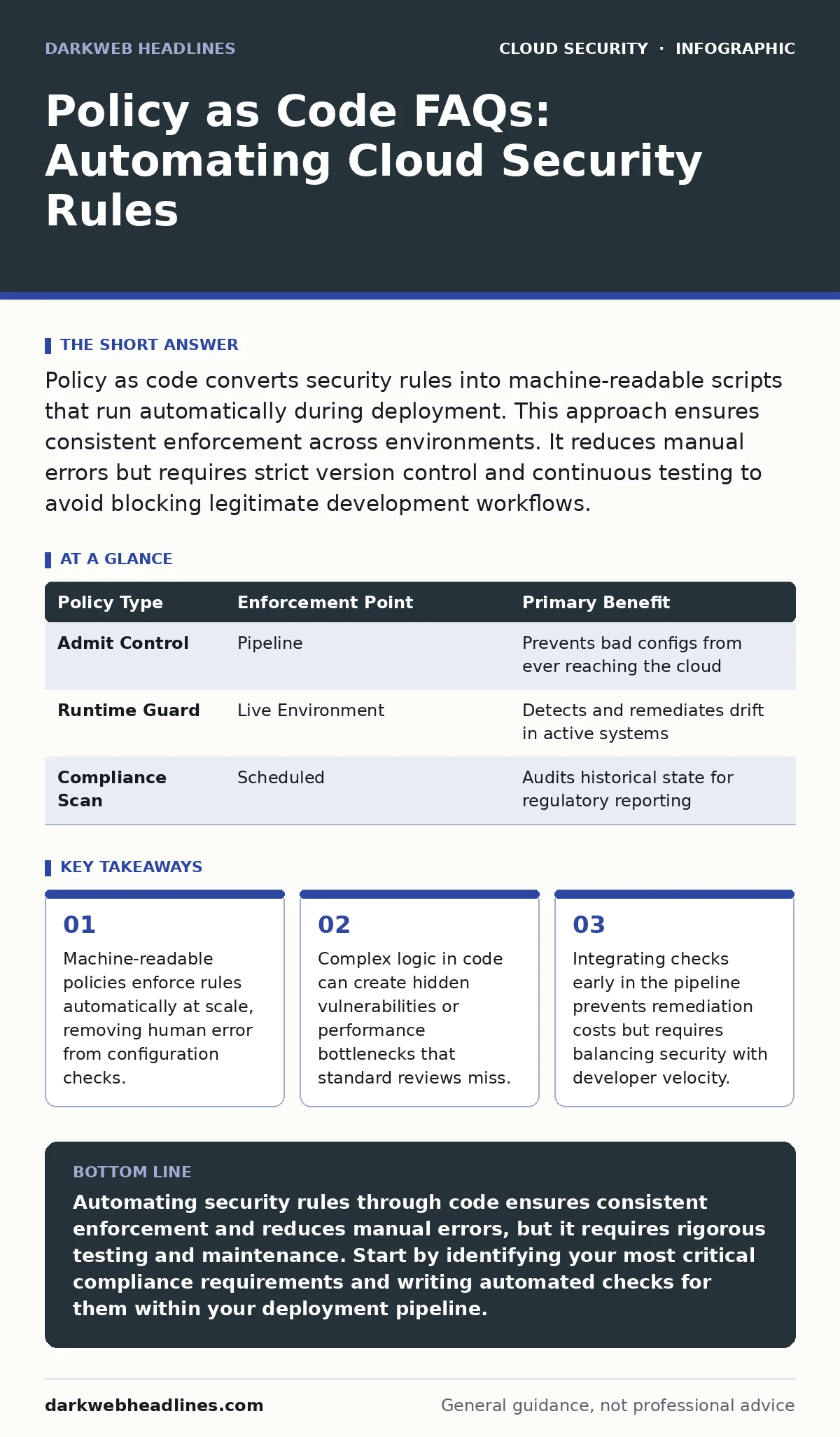
Policy as code converts security rules into machine-readable scripts that run automatically during deployment. This approach ensures consistent enforcement across environments. It reduces manual errors but requires strict version control and continuous testing to avoid blocking legitimate development workflows.
What exactly is policy as code?
Policy as code is the practice of defining security and compliance rules using programming languages or declarative formats rather than written documents. You write these rules as software artifacts that machines can read, execute, and enforce automatically. This shifts security from a manual review process to an automated gate within your deployment pipeline.
Why should I automate my security rules?
Manual configuration checks fail because human attention spans are limited and cloud environments change constantly. Automating rules ensures that every resource, from a simple storage bucket to a complex database, adheres to your standards without exception. This consistency prevents configuration drift, where systems slowly diverge from their secure baseline over time.
How does this prevent misconfigurations?
Misconfigurations occur when a developer sets a resource incorrectly, such as leaving a database open to the public internet. Policy as code intercepts this action before the resource is created or updated. If the proposed configuration violates a rule, the system rejects the change immediately, providing feedback to the user. This stops errors at the source rather than detecting them after they are live.
What languages or frameworks should I use?
You can use general-purpose languages like Python or Go, or specialized policy languages like Rego or OPA. General-purpose languages offer flexibility but require more maintenance and testing. Specialized languages are declarative, meaning you define what is allowed rather than how to check it, which reduces code complexity. Choosing the right tool depends on your team's existing skills and the complexity of your logic.
How do I integrate checks into my workflow?
You embed policy checks into your continuous integration and continuous delivery pipelines. When a developer submits code, the system evaluates the infrastructure definitions against your policy code. If the check fails, the build stops, and the developer receives specific instructions on what is wrong. This immediate feedback loop allows for rapid correction without delaying the entire project timeline.
See also: Identity and Access Management: How Zero Trust Stops Cloud Breaches · Warning Signs of Orphaned Cloud Resources and How to Remediate Them
What happens if a policy is too strict?
Overly strict policies block legitimate work, causing developers to bypass security controls or request frequent exceptions. This friction erodes trust in the security team and slows down delivery. You must balance security requirements with operational needs by allowing temporary overrides with mandatory justification and expiration dates. Regularly review these exceptions to identify patterns that suggest the policy needs adjustment.
| Policy Type | Enforcement Point | Primary Benefit |
|---|---|---|
| Admit Control | Pipeline | Prevents bad configs from ever reaching the cloud |
| Runtime Guard | Live Environment | Detects and remediates drift in active systems |
| Compliance Scan | Scheduled | Audits historical state for regulatory reporting |
How do I handle exceptions without breaking security?
You implement a formal exception management process within your code repository. Developers request exceptions by adding metadata to their infrastructure code, specifying the reason and duration. The policy engine evaluates this metadata and allows the change if it meets predefined criteria, such as approval from a security engineer. This maintains an audit trail and ensures exceptions are temporary and justified.
What are the hidden costs of this approach?
Writing and maintaining policy code requires significant engineering effort and expertise. You must version control, test, and document your policies just like application code. Complex logic can introduce bugs in the policy itself, leading to false positives or negatives. Additionally, evaluating policies at runtime can add latency to deployments, requiring careful optimization of the check logic.
How do I test my security policies?
You write unit tests for your policies to verify they behave as expected under various scenarios. Define test cases that represent compliant and non-compliant configurations, then run these tests automatically whenever the policy code changes. This ensures that updates to the policy do not inadvertently block valid operations or allow prohibited ones. Treat policy code with the same rigor as application code to maintain reliability.
How does this relate to identity and access management?
Policy as code complements identity and access management by enforcing rules based on identity attributes. You can define policies that restrict actions based on the user's role, group membership, or other identity signals. This integration ensures that even if credentials are compromised, the attacker cannot perform actions outside the defined policy boundaries. It adds a layer of contextual security to traditional access controls.
What if my cloud environment changes rapidly?
Rapid changes increase the risk of configuration drift, making automated enforcement more valuable. Policy as code allows you to update rules centrally and push them to all environments instantly. You must ensure your policy engine can handle the volume of checks without becoming a bottleneck. Regularly audit your live environment against your policy code to identify and remediate any drift that occurred outside the pipeline.
Key takeaways
- Machine-readable policies enforce rules automatically at scale, removing human error from configuration checks.
- Complex logic in code can create hidden vulnerabilities or performance bottlenecks that standard reviews miss.
- Integrating checks early in the pipeline prevents remediation costs but requires balancing security with developer velocity.
Automating security rules through code ensures consistent enforcement and reduces manual errors, but it requires rigorous testing and maintenance. Start by identifying your most critical compliance requirements and writing automated checks for them within your deployment pipeline.
Frequently asked questions
Can policy as code replace security audits?
No, it reduces the frequency of manual audits by providing continuous compliance evidence, but periodic independent reviews are still necessary to validate the policies themselves.
How do I manage policy versioning?
Store all policy code in a version control system like Git, using branches and pull requests to review and merge changes, ensuring a complete history of every rule modification.
What is the difference between policy as code and infrastructure as code?
Infrastructure as code defines the resources you want to create, while policy as code defines the rules those resources must follow, acting as a guardrail for the infrastructure definitions.
How do I handle legacy systems that cannot be automated?
You cannot apply policy as code to legacy systems directly, so you must document their exceptions and create compensating controls, such as enhanced monitoring, to mitigate their risk.
How this guide was produced: written by the DarkWeb Headlines editorial team with AI assistance, checked against the public references listed below, and reviewed when the facts change. See our editorial policy or report an error.