Identity and Access Management: How Zero Trust Stops Cloud Breaches
Identity is the new perimeter because traditional firewalls cannot stop threats that originate from within your own authorized users and applications.

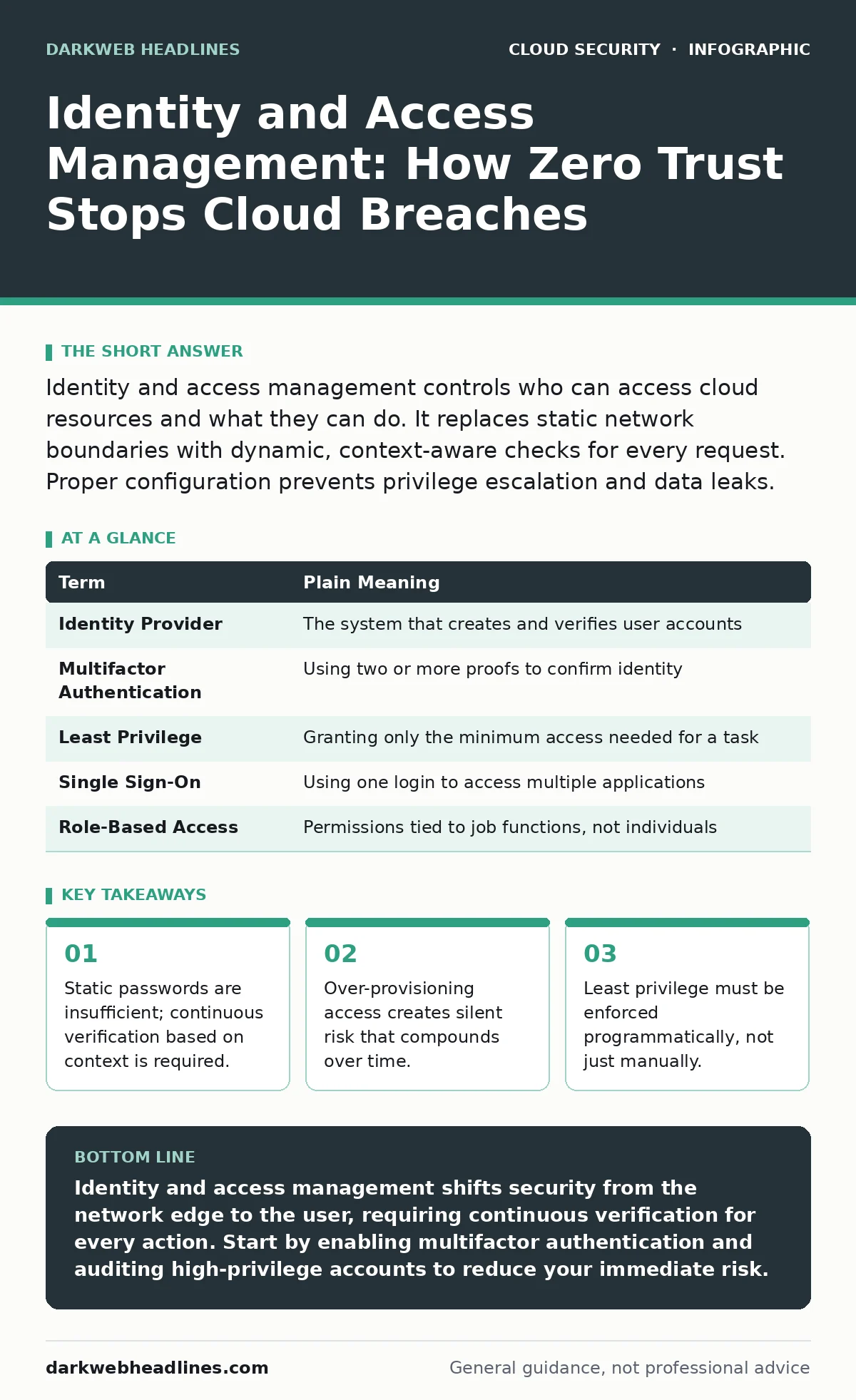
Identity and access management controls who can access cloud resources and what they can do. It replaces static network boundaries with dynamic, context-aware checks for every request. Proper configuration prevents privilege escalation and data leaks.
The Digital Office Building Analogy
Imagine a massive corporate headquarters where every door requires a key card. In the past, you showed your badge at the main entrance and walked freely through every floor. That model assumed safety once you were inside. Cloud infrastructure operates differently. There is no main entrance. Every application, server, and database is a separate room. Identity and access management acts as the security guard at every single door, checking your credentials every time you move from one room to another.
Why Perimeters Have Disappeared
Traditional security relied on a hard shell around the network. If an attacker breached the shell, they had free rein. Modern cloud environments are distributed and permeable. You access systems from home, cafes, and mobile devices. The boundary is no longer the network edge; it is the user identity. This shift means that securing the network is less effective than securing the identity. You must verify who you are before granting any access, regardless of where you are located.
Core Mechanics of Control
The system relies on three pillars: identification, authentication, and authorization. Identification claims an identity, such as a username. Authentication proves that claim, usually with a password or biometric scan. Authorization determines what that identity is allowed to do. These steps happen in milliseconds for every request. If any step fails, access is denied. This granular control allows you to limit damage if one credential is compromised.
| Term | Plain Meaning |
|---|---|
| Identity Provider | The system that creates and verifies user accounts |
| Multifactor Authentication | Using two or more proofs to confirm identity |
| Least Privilege | Granting only the minimum access needed for a task |
| Single Sign-On | Using one login to access multiple applications |
| Role-Based Access | Permissions tied to job functions, not individuals |
The Hidden Cost of Access
A common mistake is granting broad permissions to avoid friction. Users want easy access, so administrators give them more than they need. This creates a large attack surface. If an attacker steals that account, they inherit all those extra permissions. This is a primary vector for cloud privilege escalation. The convenience of easy access trades off against the security of limited blast radius. You must accept some friction to maintain security.
Automating Policy Enforcement
Manual management of permissions does not scale. Humans forget to revoke access when roles change. Policy as code solves this by treating access rules as software. You write rules that define who can do what, and the system enforces them automatically. This ensures consistency and allows for auditing. If a rule changes, the update applies instantly across all environments. This reduces the risk of human error in configuration.
See also: Warning Signs of Orphaned Cloud Resources and How to Remediate Them · Cloud Detection and Response: 8 Practices for Faster Incident Resolution
Practical Steps for Beginners
- Enable multifactor authentication for all administrative accounts immediately. This adds a layer of defense that passwords alone cannot provide.
- Audit existing permissions and remove access for users who no longer need it. Focus on high-privilege accounts first.
- Implement single sign-on to centralize identity management. This reduces the number of passwords users must manage and track.
Understanding Token Risks
Applications use tokens to maintain sessions without asking for passwords repeatedly. OAuth token abuse occurs when attackers steal or forge these tokens. Because tokens often carry high privileges, a stolen token can bypass standard login checks. You must manage token lifetimes carefully. Short-lived tokens reduce the window of opportunity for an attacker. Ensure your applications validate tokens properly before granting access.
The Reality of Continuous Verification
Security is not a one-time setup. It is a continuous process. Users change roles, applications evolve, and threats adapt. You must constantly review and adjust your policies. Static configurations become stale and dangerous over time. By treating identity as the primary control point, you create a system that adapts to change. This approach protects against both external attacks and internal mistakes.
Key takeaways
- Static passwords are insufficient; continuous verification based on context is required.
- Over-provisioning access creates silent risk that compounds over time.
- Least privilege must be enforced programmatically, not just manually.
Identity and access management shifts security from the network edge to the user, requiring continuous verification for every action. Start by enabling multifactor authentication and auditing high-privilege accounts to reduce your immediate risk.
Frequently asked questions
What is the difference between IAM and firewall security?
Firewalls protect network boundaries, while IAM protects individual user and application identities. Firewalls stop external traffic; IAM controls internal access rights.
Why is least privilege difficult to implement?
It requires detailed understanding of every user's needs and constant maintenance. Users often push back against restricted access, creating friction in workflows.
How does single sign-on improve security?
It centralizes authentication, allowing stronger controls like multifactor authentication to be applied uniformly. It also reduces password fatigue and the risk of credential reuse.
What happens if an IAM role is misconfigured?
Misconfigured IAM roles can grant excessive permissions to users or services, leading to unauthorized access and potential data breaches. Regular audits are necessary to catch these errors.
How this guide was produced: written by the DarkWeb Headlines editorial team with AI assistance, checked against the public references listed below, and reviewed when the facts change. See our editorial policy or report an error.