Cloud Privilege Escalation Myths: What Actually Works
Cloud privilege escalation rarely involves breaking encryption; it usually succeeds because identity policies allow lateral movement through overlooked service connections.

Most cloud privilege escalation attacks exploit weak identity boundaries rather than software vulnerabilities. Administrators often misconfigure service permissions, allowing low-privilege roles to assume high-privilege ones. Understanding these identity shifts is more valuable than scanning for traditional exploits.
Myth: Privilege Escalation Requires Finding a Zero-Day Vulnerability
Reality: Most successful escalations use existing features, not unknown bugs. Attackers rarely need to discover a new flaw in the cloud provider’s infrastructure. Instead, they manipulate how permissions are assigned and inherited. This approach relies on misconfiguration rather than code exploitation.
Cloud platforms are complex. They offer many ways to assign access. When administrators grant broad permissions to simplify management, they create paths for escalation. These paths exist by design. The attacker simply follows them. This makes identity management more critical than patching servers. See our guide on misconfigured IAM roles for deeper context on permission boundaries.
Myth: If I Use Multi-Factor Authentication, I Am Safe
Reality: Multi-factor authentication protects login, not what happens after login. Once an attacker has a valid session, MFA is irrelevant. The attacker acts as the authenticated user. They can perform any action that user’s permissions allow.
Imagine a developer with access to a deployment pipeline. If that pipeline uses a service account with administrator rights, the developer’s MFA status does not matter. The pipeline executes commands as the service account. The attacker only needs to influence the pipeline. This is why separating human access from service access matters. Review cloud detection and response strategies to spot unusual post-login activity.
Myth: Temporary Credentials Eliminate Escalation Risk
Reality: Temporary credentials reduce the value of stolen keys, but they do not fix bad permissions. If a temporary token grants excessive access, an attacker can still escalate. The token is valid until it expires. During that window, full access is possible.
Temporary credentials solve the problem of long-lived secrets. They do not solve the problem of over-permissive roles. An attacker with a short-lived token can still modify security groups or create new users. The time window is smaller, but the capability remains. This nuance is often missed in cloud security assessments that focus only on key rotation.
Myth: Only Administrators Can Be Escalated Targets
Reality: Low-privilege users can often reach high-privilege roles through service connections. Attackers do not need to start with admin rights. They look for any role that can assume another role. This chain of trust is the real vulnerability.
Suppose a logging service has permission to write to a storage bucket. If an attacker compromises the logging service, they may not have admin rights. But if the storage bucket is linked to an admin role, the attacker can pivot. This lateral movement is invisible to simple permission checks. It requires mapping trust relationships, not just checking user roles.
Myth: Private Cloud Environments Are Immune to Escalation
Reality: On-premises or private cloud setups still rely on identity and access management. The mechanisms for privilege escalation remain similar. The difference is the tooling, not the concept. Attackers exploit the same permission misconfigurations.
Many teams assume that removing public internet access stops escalation. This is false. Internal networks can be compromised. An attacker inside the network can still abuse local IAM policies. They can assume roles or use service accounts. The isolation is physical, not logical. This misconception often leads to neglected orphaned cloud resources that retain old permissions.
See also: Identity and Access Management: How Zero Trust Stops Cloud Breaches · Warning Signs of Orphaned Cloud Resources and How to Remediate Them
Myth: Scanning for Open Ports Prevents Privilege Escalation
Reality: Port scanners find network access, not identity abuse. Privilege escalation in the cloud is an identity problem. It happens at the API level, not the network level. Closing ports does not stop an attacker with valid credentials.
Traditional security tools focus on network boundaries. They miss the logical boundaries of cloud services. An attacker can use the API to create new users or change permissions. No open port is required. The attack is authorized at the application layer. This is why policy as code is necessary to enforce permission rules automatically.
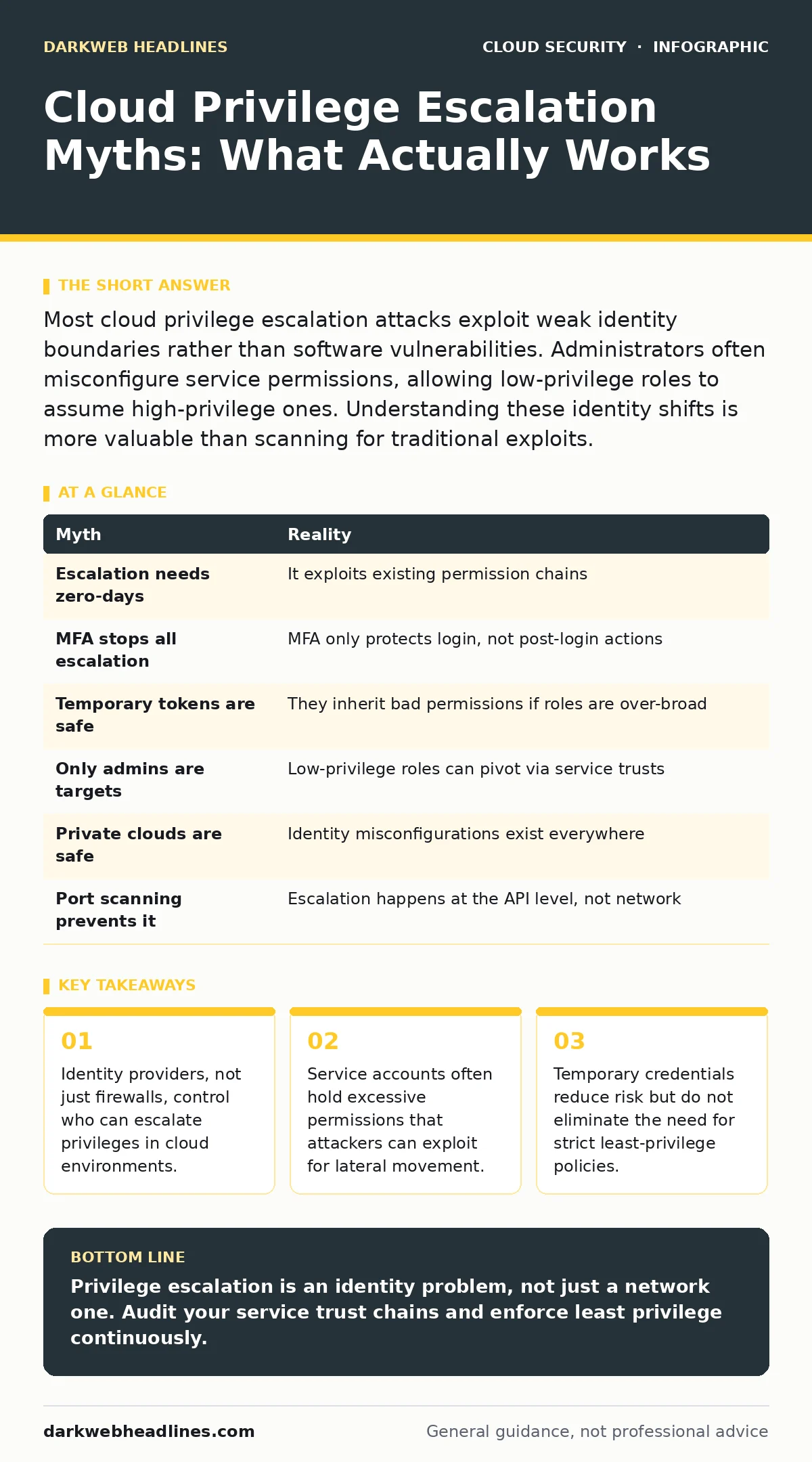
| Myth | Reality |
|---|---|
| Escalation needs zero-days | It exploits existing permission chains |
| MFA stops all escalation | MFA only protects login, not post-login actions |
| Temporary tokens are safe | They inherit bad permissions if roles are over-broad |
| Only admins are targets | Low-privilege roles can pivot via service trusts |
| Private clouds are safe | Identity misconfigurations exist everywhere |
| Port scanning prevents it | Escalation happens at the API level, not network |
Myth: Once Permissions Are Set, They Stay Safe
Reality: Cloud environments change constantly. New services are added. Old ones are forgotten. Permissions accumulate. This drift creates new escalation opportunities over time. Static audits miss these dynamic changes.
Permissions are not static. They grow as teams add tools and integrations. Without continuous monitoring, these additions create gaps. An attacker can exploit a newly granted permission before an audit occurs. This is why continuous verification is needed. It connects to the principles in SaaS data exposure guides, where access controls must evolve with usage.
Key takeaways
- Identity providers, not just firewalls, control who can escalate privileges in cloud environments.
- Service accounts often hold excessive permissions that attackers can exploit for lateral movement.
- Temporary credentials reduce risk but do not eliminate the need for strict least-privilege policies.
Privilege escalation is an identity problem, not just a network one. Audit your service trust chains and enforce least privilege continuously.
Frequently asked questions
How do I find hidden privilege escalation paths?
Map trust relationships between services and review who can assume which roles. Look for service accounts with broad permissions.
Does MFA protect against privilege escalation?
No, MFA only secures the initial login. It does not restrict what an authenticated user or service can do once inside.
Why are temporary credentials not enough?
Temporary tokens inherit the permissions of the role they represent. If the role has excessive access, the token is dangerous.
Can internal networks be vulnerable to escalation?
Yes, identity misconfigurations exist regardless of network location. Attackers can exploit local IAM policies without external access.
How this guide was produced: written by the DarkWeb Headlines editorial team with AI assistance, checked against the public references listed below, and reviewed when the facts change. See our editorial policy or report an error.