Cloud Security Assessments: How to Find Hidden Gaps Before Attackers Do
Static scans miss logic errors, so effective assessments combine automated configuration checks with manual logic reviews to catch the gaps tools ignore.

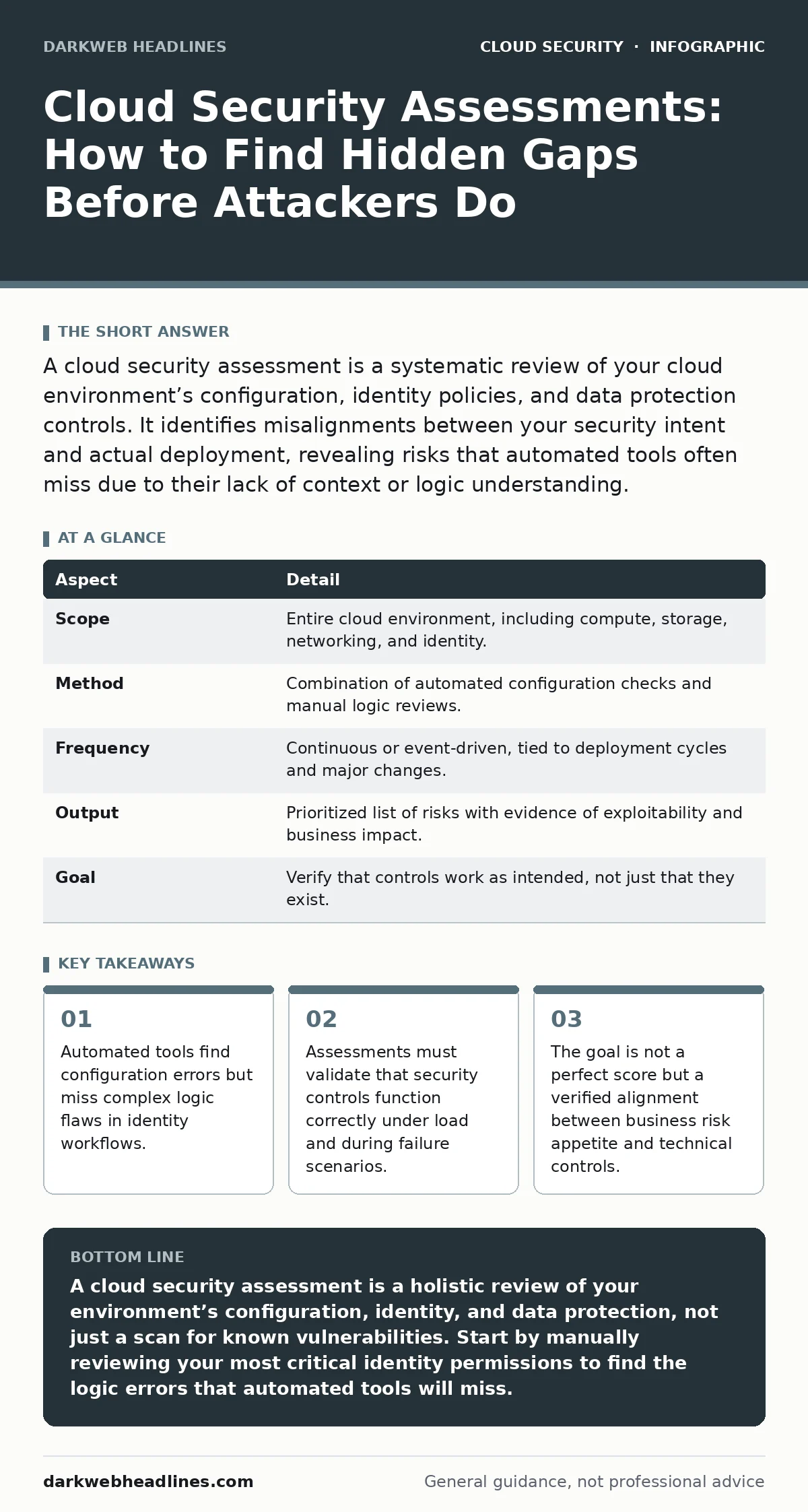
A cloud security assessment is a systematic review of your cloud environment’s configuration, identity policies, and data protection controls. It identifies misalignments between your security intent and actual deployment, revealing risks that automated tools often miss due to their lack of context or logic understanding.
The Difference Between Scanning and Assessing
Imagine you hire an inspector to check a house. The inspector walks through every room, checking that windows lock and doors latch. This is a scan. It is fast, repeatable, and good at finding obvious defects. Now imagine the inspector tries to break in. They test whether the back door stays locked if the front door is propped open. They check if the alarm triggers when a window is opened from the inside. This is an assessment. It tests behavior, not just static state.
Many teams treat cloud security assessments as a periodic scan. They run a tool, fix the red items, and move on. This approach misses the most dangerous risks. Cloud environments are dynamic. Resources spin up and down. Permissions shift. A static snapshot cannot capture the security posture of a system that changes every minute. An assessment must account for this fluidity.
| Aspect | Detail |
|---|---|
| Scope | Entire cloud environment, including compute, storage, networking, and identity. |
| Method | Combination of automated configuration checks and manual logic reviews. |
| Frequency | Continuous or event-driven, tied to deployment cycles and major changes. |
| Output | Prioritized list of risks with evidence of exploitability and business impact. |
| Goal | Verify that controls work as intended, not just that they exist. |
What Problem Does It Solve?
The core problem is complexity. Cloud platforms offer hundreds of services, each with dozens of configuration options. Most teams do not know which options are dangerous. They rely on defaults. Defaults are designed for ease of use, not security. They often expose metadata services, allow broad access to storage buckets, or leave diagnostic ports open.
An assessment solves the problem of unknown unknowns. You might know you have a firewall. You might not know that the firewall rule set allows traffic from a compromised internal subnet to reach your database. You might know you have encryption at rest. You might not know that the encryption keys are stored in a way that allows an attacker with low-level access to decrypt them. The assessment reveals these gaps.
It also solves the problem of trust. You cannot trust a vendor’s security claims without verification. You cannot trust your own teams to configure systems correctly every time. An assessment provides independent verification. It tells you whether your defenses are working or merely present.
The Three Pillars of a Cloud Assessment
A thorough assessment rests on three pillars: configuration, identity, and data. Each pillar requires a different approach.
Configuration checks whether resources are set up securely. This includes checking for open ports, unencrypted storage, and missing logging. Tools excel here. They can scan thousands of resources in minutes. However, they often generate false positives. They flag issues that are not actually risky in your specific context. You must validate every finding.
Identity checks how users and services access resources. This is the most critical pillar. Most breaches start with compromised credentials or overly permissive roles. An assessment must review every identity. It must check for unused accounts, shared credentials, and roles that grant more power than necessary. This requires human judgment. Tools cannot understand the business context of a role.
Data checks how sensitive information is protected. This includes encryption, access controls, and retention policies. An assessment must verify that data is encrypted in transit and at rest. It must check that only authorized personnel can access sensitive data. It must also check that data is deleted when no longer needed. This pillar often requires sampling. You cannot check every byte of data. You must select representative samples and verify their protection.
Where It Fits in Your Defense Strategy
An assessment is not a standalone solution. It is part of a larger defense strategy. It feeds into other controls. The findings from an assessment should inform your incident response plans. They should update your risk register. They should drive changes in your deployment pipeline.
If your assessment finds that misconfigured IAM roles are a common issue, you should implement stricter validation in your deployment process. If it finds that cloud privilege escalation paths exist, you should reduce the privileges of service accounts. The assessment provides the evidence you need to justify these changes.
It also complements other monitoring tools. Cloud detection and response tools alert you to active threats. They do not tell you why the threat succeeded. An assessment explains why. It identifies the root cause. This allows you to fix the underlying problem, not just the symptom.
What People Usually Get Wrong
The most common mistake is treating the assessment as a compliance exercise. Teams run the assessment to get a certificate or a report. They fix the items that are easy to fix. They ignore the items that are hard. They assume that a clean report means a secure environment. This is false. A clean report only means you passed the test. It does not mean you are secure against a determined attacker.
Another mistake is focusing only on the cloud provider’s shared responsibility. Teams assume the provider handles security. They focus only on their own configurations. They forget that the provider’s security does not cover their data or their identity. They leave their back door open while the front door is locked.
A third mistake is neglecting the supply chain. Teams assess their own code and infrastructure. They do not assess the third-party services they use. They do not check if those services have access to their data. They do not verify if those services follow security best practices. This is a blind spot. Attackers often target the weakest link in the chain.
See also: Identity and Access Management: How Zero Trust Stops Cloud Breaches · Warning Signs of Orphaned Cloud Resources and How to Remediate Them
Integrating with Code and Policy
To make assessments sustainable, you must integrate them into your development workflow. This means shifting left. You must check for security issues before code is deployed. This reduces the cost of fixing issues. It also reduces the risk of deploying vulnerable code.
You can use policy as code to enforce security standards automatically. This ensures that every deployment meets your security requirements. It prevents misconfigurations from reaching production. It also provides a clear audit trail. You can see exactly who changed what and when.
You must also monitor for public code repository leaks. Developers often accidentally commit secrets to code repositories. These secrets can be used to access your cloud environment. An assessment should include a check for exposed secrets in your codebase. This is often overlooked but is a high-risk area.
The Human Element
Technology alone cannot secure your cloud. You need people who understand both security and your business. These people must interpret the findings from the assessment. They must prioritize the risks. They must work with engineering teams to fix the issues.
This requires a culture of security. It requires training. It requires clear communication. It requires leadership support. Without these, assessments will fail. Teams will resist changes. They will find ways to bypass controls. They will prioritize speed over security.
The goal is not to stop development. The goal is to enable safe development. Security should be an enabler, not a blocker. It should help teams build better products faster. It should give them confidence that their work is secure. This requires a partnership between security and engineering. It requires trust and collaboration.
Continuous Improvement
Cloud security is not a one-time event. It is a continuous process. You must repeat assessments regularly. You must update your methods as new threats emerge. You must learn from each assessment. You must improve your controls based on the findings.
This requires a feedback loop. You must track the issues found in assessments. You must measure the time it takes to fix them. You must analyze the root causes. You must implement preventive measures. This turns assessments into a learning tool. It helps you get better over time.
It also requires adaptability. Cloud platforms change frequently. New services are added. New features are released. New vulnerabilities are discovered. You must stay informed. You must update your assessment criteria. You must ensure your tools and methods are up to date.
Key takeaways
- Automated tools find configuration errors but miss complex logic flaws in identity workflows.
- Assessments must validate that security controls function correctly under load and during failure scenarios.
- The goal is not a perfect score but a verified alignment between business risk appetite and technical controls.
A cloud security assessment is a holistic review of your environment’s configuration, identity, and data protection, not just a scan for known vulnerabilities. Start by manually reviewing your most critical identity permissions to find the logic errors that automated tools will miss.
Frequently asked questions
How often should I perform a cloud security assessment?
Perform a full assessment at least annually and after any major infrastructure change. Run automated configuration checks continuously to catch drift between deployments.
Do I need external consultants for a cloud security assessment?
Internal teams can perform assessments if they have the necessary skills and objectivity. External consultants provide an unbiased view and specialized expertise but may lack context about your business.
What is the difference between a penetration test and a cloud security assessment?
A penetration test attempts to exploit vulnerabilities to prove risk. A cloud security assessment reviews the entire environment for misconfigurations, policy gaps, and design flaws, including those that may not be immediately exploitable.
How do I prioritize the findings from an assessment?
Prioritize findings based on the potential business impact and the likelihood of exploitation. Focus on issues that expose sensitive data or allow unauthorized access to critical systems first.
How this guide was produced: written by the DarkWeb Headlines editorial team with AI assistance, checked against the public references listed below, and reviewed when the facts change. See our editorial policy or report an error.