Container Runtime Security: 6 Myths That Leave Your Workloads Exposed
Runtime protection fails when teams treat containers as static images, ignoring the dynamic process behaviors that attackers exploit after launch.

Container runtime security is not solved by securing the image build. Attackers exploit the gap between image validation and process execution. You must monitor system calls, restrict kernel access, and enforce least privilege at the process level to stop post-exploitation movement.
Misreading: Signing the image secures the container
Correct reading: Image signing verifies that the artifact has not been altered since it was built. It does not monitor what the container does once it starts. An attacker with access to the runtime environment can inject malicious processes into a signed image. The signature remains valid while the container executes arbitrary code. You must separate build-time integrity from runtime behavior monitoring.
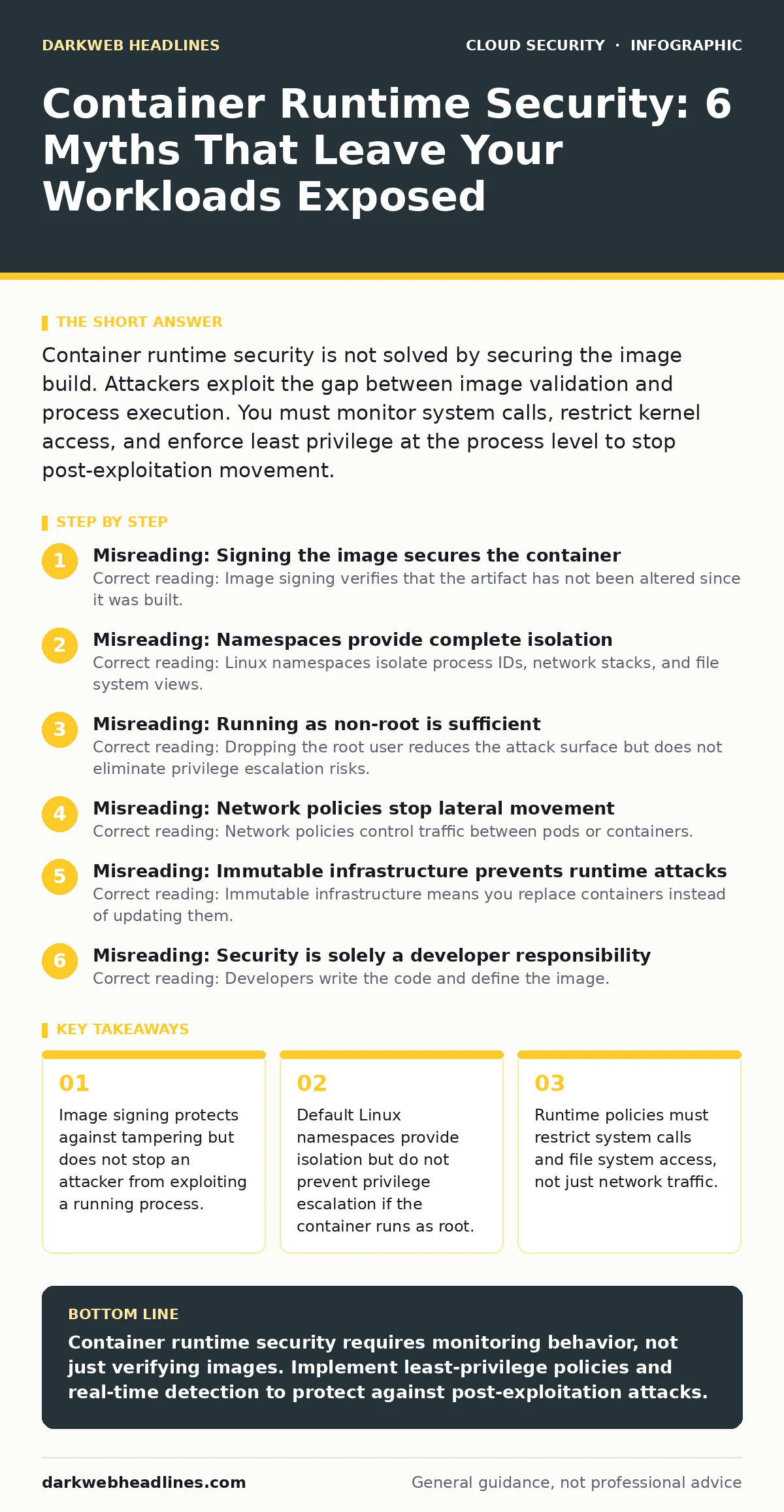
Misreading: Namespaces provide complete isolation
Correct reading: Linux namespaces isolate process IDs, network stacks, and file system views. They do not protect the kernel itself. If a container escapes its namespace, it gains access to the host kernel. Many container runtimes share the host kernel by design. A vulnerability in the kernel affects every container on that node. You must treat the host kernel as a shared resource that requires hardening.
Misreading: Running as non-root is sufficient
Correct reading: Dropping the root user reduces the attack surface but does not eliminate privilege escalation risks. Many applications require additional capabilities to function, such as binding to low ports or accessing devices. If you grant these capabilities, you reintroduce risk. You must audit which capabilities are truly needed and remove all others. Default configurations often grant more permissions than necessary.
Misreading: Network policies stop lateral movement
Correct reading: Network policies control traffic between pods or containers. They do not stop an attacker from moving laterally within a single host. If two containers share the same network namespace or host network, network policies cannot separate them. Attackers often pivot through local sockets or shared file systems. You must combine network segmentation with host-level isolation controls.
Misreading: Immutable infrastructure prevents runtime attacks
Correct reading: Immutable infrastructure means you replace containers instead of updating them. This does not stop an attacker from exploiting a running instance before you detect the compromise. The container remains vulnerable for the duration of its lifecycle. You must assume every container is compromised at some point. Runtime detection and response tools help identify malicious behavior during execution.
See also: Warning Signs of Orphaned Cloud Resources and How to Remediate Them · Cloud Detection and Response: 8 Practices for Faster Incident Resolution
Misreading: Security is solely a developer responsibility
Correct reading: Developers write the code and define the image. Operations teams manage the runtime environment and policies. Security requires coordination across both groups. Developers may not understand kernel vulnerabilities. Operations teams may not understand application dependencies. You must establish shared ownership of security outcomes. This includes defining clear boundaries for what each team controls.
Misreading: Container runtimes are inherently secure
Correct reading: Container runtimes like Docker or containerd are complex software stacks. They contain bugs that can lead to privilege escalation. Updates are frequent and often critical. You must keep your runtime software patched. Outdated runtimes expose known vulnerabilities. Regular audits of runtime versions are necessary. Do not assume the base technology is safe without verification.
Misreading: Monitoring logs is enough for detection
Correct reading: Logs record events after they happen. They do not prevent malicious actions. An attacker can clear logs or generate noise to hide their activities. You need active monitoring that analyzes system calls and file access patterns in real time. This allows you to block threats before they cause damage. Passive logging is insufficient for runtime defense.
Misreading: Kubernetes security covers all container risks
Correct reading: Kubernetes provides orchestration and some security features. It does not replace runtime security. You still need to secure the underlying nodes and runtimes. Misconfigurations in Kubernetes can expose containers to attacks. Exposed Kubernetes dashboards can allow unauthorized access to container controls. You must layer runtime security on top of orchestration security.
How to check your understanding
Review your current container security strategy. Identify where you rely on image signatures or network policies alone. Check if you monitor system calls and process behavior. Verify that your runtimes are patched and configured with least privilege. Ensure that both development and operations teams share responsibility for runtime security. This holistic approach closes the gaps that attackers exploit.
Key takeaways
- Image signing protects against tampering but does not stop an attacker from exploiting a running process.
- Default Linux namespaces provide isolation but do not prevent privilege escalation if the container runs as root.
- Runtime policies must restrict system calls and file system access, not just network traffic.
Container runtime security requires monitoring behavior, not just verifying images. Implement least-privilege policies and real-time detection to protect against post-exploitation attacks.
Frequently asked questions
Does container runtime security replace endpoint detection?
Runtime security focuses on container-specific behaviors and isolation. Endpoint detection covers the host OS. You need both to protect the full stack.
How do I limit container capabilities?
Use runtime policies to drop all capabilities by default. Add only those required by the application. Test thoroughly to ensure functionality is not broken.
What is the biggest risk in container runtimes?
Kernel vulnerabilities are the biggest risk. Since containers share the host kernel, a single exploit can compromise all containers on the node.
Should I use a minimal base image?
Minimal images reduce the attack surface by removing unnecessary packages. However, they do not eliminate runtime risks. You still need monitoring and least-privilege controls.
How this guide was produced: written by the DarkWeb Headlines editorial team with AI assistance, checked against the public references listed below, and reviewed when the facts change. See our editorial policy or report an error.