Cloud Encryption: Real Benefits and Hidden Limitations
Cloud encryption secures data at rest but does not protect against insider threats or misconfigured access controls that bypass cryptographic barriers entirely.

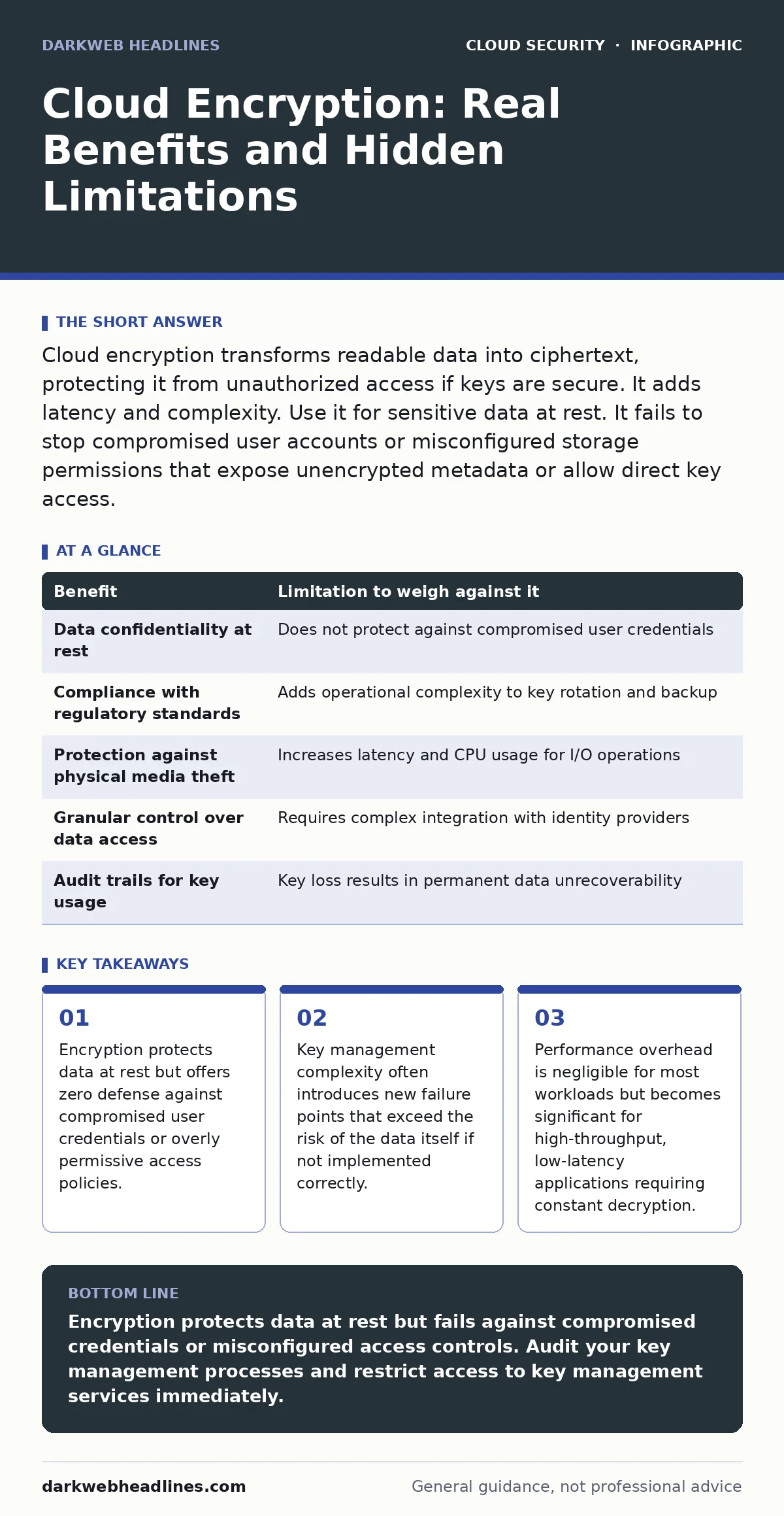
Cloud encryption transforms readable data into ciphertext, protecting it from unauthorized access if keys are secure. It adds latency and complexity. Use it for sensitive data at rest. It fails to stop compromised user accounts or misconfigured storage permissions that expose unencrypted metadata or allow direct key access.
What Cloud Encryption Actually Protects
Cloud encryption converts plaintext into ciphertext using mathematical algorithms and cryptographic keys. This process ensures that even if an attacker gains physical access to storage media or intercepts data packets, they cannot read the information without the corresponding decryption key. The primary benefit is data confidentiality at rest. This means your databases, object storage buckets, and virtual machine disks remain unreadable to anyone lacking the specific key material.
Encryption does not verify data integrity or authenticity by default. It only ensures secrecy. You must combine encryption with hashing or digital signatures to detect tampering. Many organizations assume encryption solves all security problems. It does not. An attacker with valid credentials can decrypt data on the fly. The system serves the request, decrypts the payload, and returns it. The encryption layer is transparent to authorized users and attackers who have stolen those credentials.
The Hidden Costs of Key Management
The complexity of encryption lies in key management, not the encryption algorithm itself. You must generate, store, rotate, and revoke keys securely. If you manage keys yourself, you inherit the burden of securing the key storage system. If you use a cloud provider’s managed key service, you cede control to that provider. The trade-off is convenience versus control. Managed services reduce operational overhead but increase reliance on the provider’s security posture.
Key rotation is a frequent source of operational failure. Rotating keys requires updating all systems that reference them. A single missed reference can cause application outages. You must audit dependencies before rotating. Automated rotation tools help, but they require correct configuration. Misconfigured automation can delete keys without backups, causing permanent data loss. This is a higher risk than most organizations anticipate.
Performance Overhead and Latency
Encryption and decryption consume CPU cycles. This adds latency to read and write operations. For most enterprise applications, this overhead is negligible. Modern processors include hardware acceleration for common algorithms like AES. However, high-frequency trading platforms, real-time gaming servers, and large-scale data analytics pipelines may notice degradation. You must benchmark your specific workload before enforcing encryption at the application layer.
Storage encryption usually happens at the infrastructure level. This is less visible to applications. The hypervisor or storage controller handles the cryptographic operations. This approach shifts the performance cost to the infrastructure provider. It is generally more efficient than application-level encryption. Application-level encryption provides better control over keys but requires you to manage the performance impact across your codebase.
Benefits and Limitations Table
| Benefit | Limitation to weigh against it |
|---|---|
| Data confidentiality at rest | Does not protect against compromised user credentials |
| Compliance with regulatory standards | Adds operational complexity to key rotation and backup |
| Protection against physical media theft | Increases latency and CPU usage for I/O operations |
| Granular control over data access | Requires complex integration with identity providers |
| Audit trails for key usage | Key loss results in permanent data unrecoverability |
When Encryption Is Worth It
Encrypt data that retains value if stolen. Customer personal information, financial records, and intellectual property fall into this category. The cost of a breach involving this data far exceeds the cost of implementing encryption. You should also encrypt data that must meet regulatory requirements. Laws often mandate encryption for specific data types. Non-compliance carries legal and financial risks.
Encryption is worth it when you share data with third parties. If you store data in a multi-tenant cloud environment, encryption ensures your data is isolated from other tenants at the storage level. Even if the provider’s internal systems are compromised, your data remains protected if you manage your own keys. This is known as bringing your own key. It shifts the trust model from the provider to your own key management infrastructure.
See also: Warning Signs of Orphaned Cloud Resources and How to Remediate Them · Cloud Detection and Response: 8 Practices for Faster Incident Resolution
When Encryption Is Not Worth It
Encrypting low-value, public data wastes resources. Blog posts, marketing images, and static website assets do not need encryption at rest. The risk of theft is minimal, and the performance overhead is unnecessary. Focus your efforts on data that causes harm if exposed. Prioritization is key. Encrypting everything dilutes your security focus and increases operational burden.
Encryption is not worth it if you cannot secure the keys. If your key management system is less secure than your storage, you have created a false sense of security. Attackers will target the keys. If your team lacks the expertise to manage keys securely, use a managed service. Do not attempt to build a custom key management solution unless you have dedicated cryptography experts. Custom implementations often contain subtle flaws that compromise security.
Integration With Access Controls
Encryption must work with identity and access management. You cannot rely on encryption alone. Access controls determine who can request decryption. If access controls are weak, encryption is irrelevant. You must enforce least privilege. Users should only have access to the data they need. Service accounts should have minimal permissions.
Consider the risk of cloud privilege escalation. An attacker who gains access to a low-privilege account may escalate privileges to access key management services. Once they control the keys, they can decrypt any data. You must monitor for unusual key usage patterns. Integrate your encryption strategy with cloud detection and response tools to alert on anomalous decryption requests. This creates a defense-in-depth approach.
Managing Exposed Interfaces
Encryption does not protect exposed interfaces. If you leave exposed Kubernetes dashboards or exposed Docker APIs open to the internet, attackers can interact with your containers directly. They can copy data from memory, bypassing storage encryption entirely. You must secure your management interfaces. Use network segmentation, firewalls, and strict authentication.
OAuth token abuse is another vector. If an attacker steals a valid token, they can access your application as a legitimate user. The application decrypts data for them. Encryption does not stop this. You must validate tokens, enforce short expiration times, and monitor for token theft. Secure the application layer as rigorously as the storage layer.
Key takeaways
- Encryption protects data at rest but offers zero defense against compromised user credentials or overly permissive access policies.
- Key management complexity often introduces new failure points that exceed the risk of the data itself if not implemented correctly.
- Performance overhead is negligible for most workloads but becomes significant for high-throughput, low-latency applications requiring constant decryption.
Encryption protects data at rest but fails against compromised credentials or misconfigured access controls. Audit your key management processes and restrict access to key management services immediately.
Frequently asked questions
Does cloud encryption protect against ransomware?
Cloud encryption prevents ransomware from encrypting your data again, but it does not stop ransomware from deleting or locking access to your files. You still need immutable backups.
Should I use application-level or infrastructure-level encryption?
Use infrastructure-level encryption for general data to reduce complexity. Use application-level encryption only for highly sensitive data where you need independent key control from the cloud provider.
How often should I rotate encryption keys?
Rotate keys annually or when personnel with access leave. Rotate immediately if you suspect a compromise. Automate rotation to prevent human error and ensure consistent security posture.
Can I recover data if I lose my encryption key?
No. If you lose the key and have no backup, the data is permanently unrecoverable. This is a fundamental property of strong encryption. Always maintain secure, offline backups of your keys.
How this guide was produced: written by the DarkWeb Headlines editorial team with AI assistance, checked against the public references listed below, and reviewed when the facts change. See our editorial policy or report an error.