Malicious Typosquatted Packages: 7 Mistakes That Invite Supply Chain Attacks
Most typosquatting infections occur because development workflows rely on visual package names and skip cryptographic verification of the source code signature.

Typosquatted packages mimic legitimate libraries with slight spelling errors. You avoid them by locking dependencies to specific hashes, using strict allowlists, and verifying publisher identities. Manual checks fail under pressure. Automated integrity checks and policy enforcement prevent the accidental installation of code that steals credentials or exfiltrates data.
Mistake 1: Relying on Visual Inspection of Package Names
Why it hurts: Human eyes struggle to distinguish subtle character swaps in long alphanumeric strings. A package named auth-module versus auth-modulе (with a Cyrillic 'e') looks identical in a terminal. You install the wrong artifact because the spelling error is invisible during a quick scan. The malicious code executes with the same permissions as the legitimate library, allowing immediate credential harvesting or data exfiltration.
The fix: Disable visual reliance entirely. Configure your dependency manager to require cryptographic verification. Use tools that validate the package content against a known good hash rather than trusting the name. Implement strict allowlists that block any package not explicitly approved in your organization’s internal registry. This removes the visual check from the equation.
Mistake 2: Using Floating Version Constraints
Why it hurts: Specifying a version range like >=1.0.0 tells the resolver to fetch the latest compatible release. If an attacker pushes a malicious version that satisfies this range, your build pulls it in automatically. You lose control over the exact code entering your environment. This mistake is common in continuous integration pipelines that prioritize speed over stability, leaving the door open for supply chain injection.
The fix: Pin every dependency to an exact version number. Better yet, pin to a specific cryptographic hash of the package content. This ensures that the exact bits you tested are the bits that run. When an update is needed, perform a deliberate review of the change. This process adds friction but prevents automated theft of your build integrity. See CWE weakness categories for details on injection flaws.
Mistake 3: Skipping Signature Verification
Why it hurts: Most package repositories do not enforce digital signatures by default. Without signature verification, anyone who can push to the registry can serve code that claims to be from the original author. You accept the package because it has a high download count or a familiar name. The missing signature means you have no cryptographic proof of origin. This gap allows attackers to impersonate trusted publishers with minimal effort.
The fix: Enforce mandatory signature verification in your build pipeline. Reject any package that lacks a valid signature from a known, trusted key. Use open standards for signing, such as Sigstore, to verify the identity of the publisher. If a package is unsigned, the build fails. This policy ensures that only code from verified sources enters your production environment.
Mistake 4: Ignoring Publisher Identity Changes
Why it hurts: Legitimate authors sometimes change their publishing keys or accounts. Attackers exploit this by registering similar names before the official account is created or after it is abandoned. You install a package from a new account that looks like the old one. The code is malicious because the identity link is broken. This mistake is common when projects transition between maintainers without clear documentation of the new signing keys.
The fix: Monitor the official channels of the libraries you use for announcements regarding key rotations or account changes. Update your trusted key store immediately when these changes occur. Do not trust new accounts until they are verified through an out-of-band method. This proactive approach prevents confusion during transitions and ensures you always pull from the correct source.
Mistake 5: Neglecting Internal Registry Scans
Why it hurts: Many organizations use an internal proxy or cache for public packages. If this internal registry is not scanned, malicious typosquatted packages can sit in your cache for months. You pull from the cache, believing it is safe because it is internal. The attack happens inside your trusted network, bypassing external security controls. This internal persistence makes detection difficult because the threat is already present in your development environment.
The fix: Implement dynamic application security testing (DAST) for your internal registry. Scan all cached packages for known vulnerabilities and malicious signatures. Purge any packages that fail the scan. Regular audits of the internal registry ensure that typosquatted packages do not accumulate. This step closes the gap between public exposure and internal deployment.
See also: Business Logic Vulnerability Response: Recovery and Prevention Steps
Mistake 6: Overlooking Transitive Dependencies
Why it hurts: You verify the top-level packages you install directly. You ignore the libraries those packages depend on. A typosquatted package often hides in the third or fourth layer of dependencies. It is invisible to your direct checks but executes when the application runs. This indirect inclusion is the most common vector for supply chain attacks. You believe your direct dependencies are safe, but the hidden layer compromises the entire build.
The fix: Map your full dependency tree. Verify the integrity of every transitive dependency, not just the root packages. Use tools that generate a software bill of materials (SBOM) to track all components. Enforce policies that block builds containing unverified transitive dependencies. This comprehensive view ensures that no hidden library can slip past your controls. See CVE monitoring for strategies on tracking vulnerabilities in complex trees.
Mistake 7: Failing to Restrict Install Sources
Why it hurts: Your build tools default to public registries. You allow developers to add new sources on the fly for convenience. An attacker convinces a developer to add a malicious registry that hosts a typosquatted version of a popular library. The build pulls from this new source because it is allowed. The malicious code installs without raising alarms because the source was technically permitted. This lack of restriction enables social engineering attacks against developers.
The fix: Lock down the list of allowed package sources. Only permit your internal registry and a curated list of trusted public repositories. Block any attempt to add new sources during the build process. Require administrative approval for any changes to the source configuration. This strict control prevents attackers from introducing malicious registries through social engineering or accidental misconfiguration.
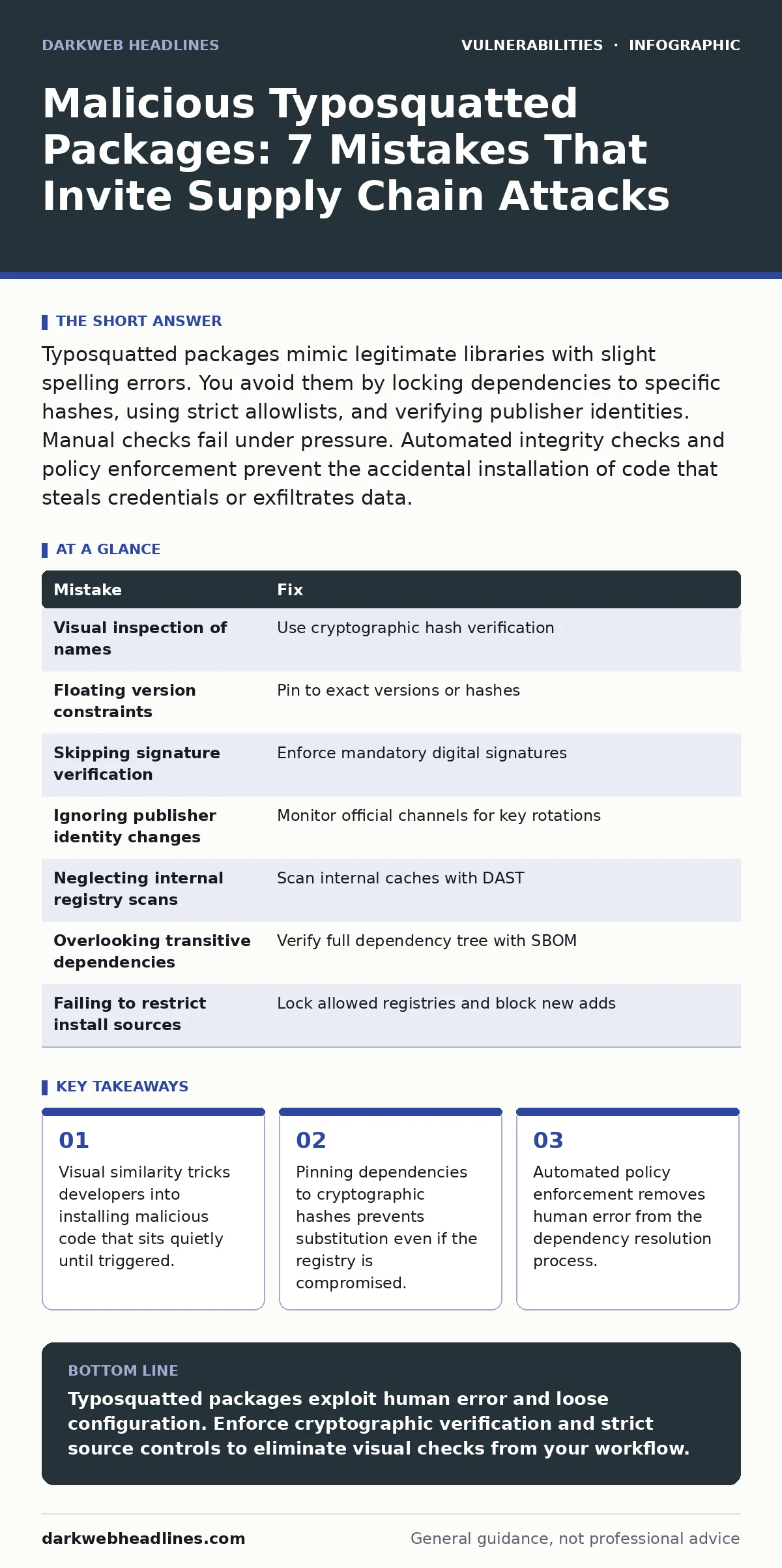
| Mistake | Fix |
|---|---|
| Visual inspection of names | Use cryptographic hash verification |
| Floating version constraints | Pin to exact versions or hashes |
| Skipping signature verification | Enforce mandatory digital signatures |
| Ignoring publisher identity changes | Monitor official channels for key rotations |
| Neglecting internal registry scans | Scan internal caches with DAST |
| Overlooking transitive dependencies | Verify full dependency tree with SBOM |
| Failing to restrict install sources | Lock allowed registries and block new adds |
Key takeaways
- Visual similarity tricks developers into installing malicious code that sits quietly until triggered.
- Pinning dependencies to cryptographic hashes prevents substitution even if the registry is compromised.
- Automated policy enforcement removes human error from the dependency resolution process.
Typosquatted packages exploit human error and loose configuration. Enforce cryptographic verification and strict source controls to eliminate visual checks from your workflow.
Frequently asked questions
How do I detect a typosquatted package in my current project?
Generate a software bill of materials and compare every package name and hash against a known good baseline. Look for subtle character differences in names and verify the publisher signatures.
Does using a private registry stop typosquatting attacks?
Only if the private registry is scanned and locked down. If the proxy caches malicious packages or allows external sources, the attack can still succeed through the internal channel.
Can automated tools prevent all supply chain attacks?
Automated tools reduce risk significantly by removing human error. They cannot prevent all attacks if the underlying keys or registries are compromised. Layered security remains necessary.
What is the difference between typosquatting and a compromised package?
Typosquatting uses a fake name to trick you into installing malicious code. A compromised package uses a real name but has been altered by an attacker who gained access to the publisher’s account.
How this guide was produced: written by the DarkWeb Headlines editorial team with AI assistance, checked against the public references listed below, and reviewed when the facts change. See our editorial policy or report an error.