CWE Weakness Categories: Structure, Hierarchy, and Practical Application
The CWE hierarchy functions as a standardized taxonomy that reveals how high-level design flaws cascade into specific, exploitable coding errors.

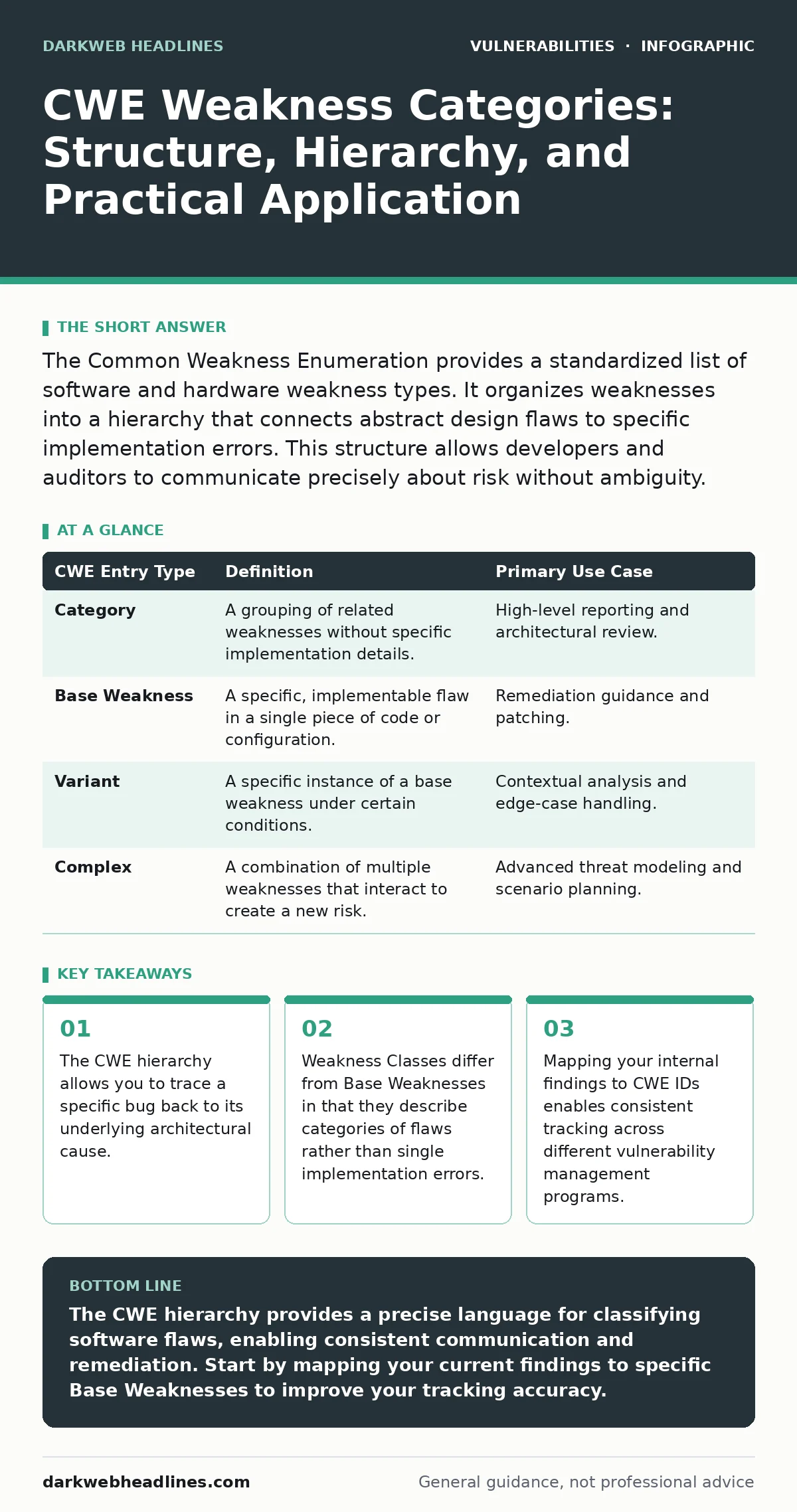
The Common Weakness Enumeration provides a standardized list of software and hardware weakness types. It organizes weaknesses into a hierarchy that connects abstract design flaws to specific implementation errors. This structure allows developers and auditors to communicate precisely about risk without ambiguity.
What exactly is the Common Weakness Enumeration?
The Common Weakness Enumeration is a community-standard dictionary of software and hardware weakness types. It provides a common language for describing flaws in code, configuration, and architecture. This standardization prevents confusion when different teams discuss the same defect using different terminology. You use it to classify a finding so that others can understand the nature of the risk immediately.
How does the CWE hierarchy function?
The CWE structure uses a parent-child relationship to connect broad concepts to specific instances. At the top are categories that describe high-level issues, such as memory management or authentication logic. As you move down the tree, the entries become more specific, describing the exact coding pattern that causes the flaw. This hierarchy helps you determine whether a fix requires a simple code change or a broader architectural review.
| CWE Entry Type | Definition | Primary Use Case |
|---|---|---|
| Category | A grouping of related weaknesses without specific implementation details. | High-level reporting and architectural review. |
| Base Weakness | A specific, implementable flaw in a single piece of code or configuration. | Remediation guidance and patching. |
| Variant | A specific instance of a base weakness under certain conditions. | Contextual analysis and edge-case handling. |
| Complex | A combination of multiple weaknesses that interact to create a new risk. | Advanced threat modeling and scenario planning. |
What is the difference between a Category and a Base Weakness?
A Category describes a group of weaknesses that share a common theme but lack specific implementation details. You cannot fix a Category directly because it is too abstract. A Base Weakness, however, describes a concrete flaw in a specific line of code or configuration setting. You fix a Base Weakness by applying a specific remediation technique. Understanding this distinction prevents you from wasting time trying to "fix" a high-level label instead of the actual bug.
Why use CWE IDs instead of custom descriptions?
CWE IDs provide a stable, universally recognized reference for a specific type of flaw. Custom descriptions often vary between teams, leading to miscommunication during incident response. When you reference a CWE ID, any security professional can look up the exact nature of the weakness and its known mitigations. This consistency is vital when correlating data across multiple security tools or when integrating with security advisories.
How do you map a custom bug to a CWE entry?
Start by identifying the root cause of the defect, not just the symptom. If a crash occurs because of a buffer overflow, the root cause is improper bounds checking. Search the CWE list for weaknesses related to memory management and bounds verification. Choose the most specific Base Weakness that matches your finding. Avoid selecting high-level Categories unless no specific Base Weakness fits the scenario.
See also: Cisco IOS XE Vulnerability Myths Debunked for Network Security · Vulnerability Management Definition and Process
What are the limitations of relying solely on CWE?
CWE describes the weakness, but it does not describe the exploit or the impact. A single CWE entry can manifest in vastly different ways depending on the application logic and environment. It also does not account for business context, such as whether the affected code is exposed to the internet. You must combine CWE classification with other frameworks to understand the full risk profile.
How does CWE relate to other security standards?
CWE often serves as the foundation for other standards, such as the Open Web Application Security Project Top Ten. While those lists highlight the most prevalent risks, CWE provides the granular details for each. You can map a high-level OWASP finding to multiple specific CWE entries to guide your remediation efforts. This linkage allows you to address both the broad trend and the specific technical defect.
Can CWE help with zero-day vulnerabilities?
CWE helps classify zero-day vulnerabilities after they are discovered and analyzed. It does not predict them, but it provides the framework for understanding why the flaw existed. By reviewing the CWE entries associated with recent zero-days, you can identify patterns in your own codebase. This proactive review might reveal similar weaknesses that have not yet been exploited.
Why is the hierarchy important for developers?
The hierarchy helps developers understand the relationship between their code and the system architecture. It shows how a small coding error can contribute to a larger systemic failure. This perspective encourages developers to think about the broader impact of their changes. It also helps in prioritizing fixes, as weaknesses higher in the hierarchy often affect more components.
How do you handle weaknesses that don't fit neatly into CWE?
Some flaws are unique to specific technologies or legacy systems and may not have a direct CWE match. In these cases, choose the closest Base Weakness and add context to your report. You can also create a mapping within your organization to link internal categories to the nearest CWE entry. This ensures that even unique flaws are tracked consistently with industry standards.
Key takeaways
- The CWE hierarchy allows you to trace a specific bug back to its underlying architectural cause.
- Weakness Classes differ from Base Weaknesses in that they describe categories of flaws rather than single implementation errors.
- Mapping your internal findings to CWE IDs enables consistent tracking across different vulnerability management programs.
The CWE hierarchy provides a precise language for classifying software flaws, enabling consistent communication and remediation. Start by mapping your current findings to specific Base Weaknesses to improve your tracking accuracy.
Frequently asked questions
Is CWE maintained by a commercial company?
No, CWE is a public standard maintained by the MITRE Corporation as a public service. It is developed through a community consensus process rather than by a single vendor.
How often is the CWE list updated?
The list is updated regularly to reflect new weakness types and evolving technology. You should check for updates when starting new projects or reviewing your security posture.
Can I use CWE for hardware vulnerabilities?
Yes, CWE includes weaknesses for both software and hardware. Hardware weaknesses often relate to physical design flaws or firmware issues, which are categorized similarly to software defects.
Does finding a CWE entry mean my system is vulnerable?
Not necessarily. Finding a weakness type in your code means the potential for exploitation exists. Whether it is actually exploitable depends on the context, input validation, and other defensive measures in place.
How this guide was produced: written by the DarkWeb Headlines editorial team with AI assistance, checked against the public references listed below, and reviewed when the facts change. See our editorial policy or report an error.