Detecting OAuth Token Abuse: Signals, Logs, and Hidden Risks
Identify compromised access tokens by analyzing scope anomalies, impossible travel patterns, and silent API calls that bypass traditional perimeter defenses.
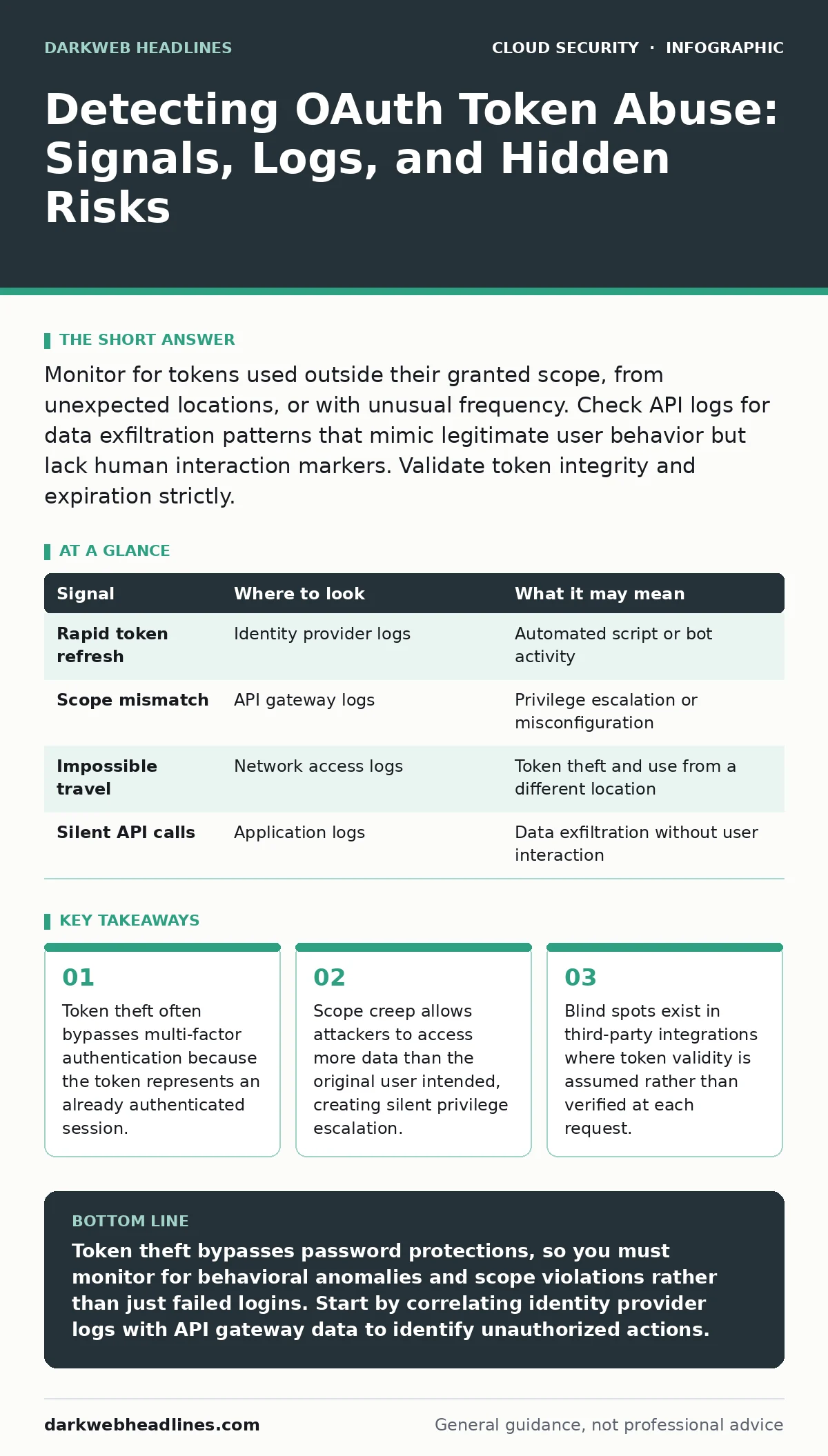
Monitor for tokens used outside their granted scope, from unexpected locations, or with unusual frequency. Check API logs for data exfiltration patterns that mimic legitimate user behavior but lack human interaction markers. Validate token integrity and expiration strictly.
The Nature of the Token Threat
OAuth tokens act as digital keys that allow applications to access resources on behalf of a user without handling their password. When an attacker steals these tokens, they do not need to break into the user's account again. They simply present the valid token to the service provider. This makes detection difficult because the authentication event already occurred and was successful. The attack happens at the authorization layer, not the authentication layer.
You must shift your focus from who is logging in to what the logged-in session is doing. Traditional security tools often flag failed login attempts. They rarely flag successful ones that behave strangely. A stolen token looks like a legitimate user to the identity provider. Your detection strategy must rely on behavioral anomalies and scope validation.
Signal Detection in Identity Logs
The first place to look is the identity provider logs. These records show when tokens are issued, refreshed, or revoked. Look for a sudden spike in token issuance for a single user or application. This can indicate a brute-force attempt against the token endpoint or a misconfigured client that requests excessive tokens.
Check for tokens being used immediately after issuance. Legitimate users often have a delay between authentication and first API call. Attackers using automated scripts act instantly. Also, monitor for token revocation failures. If a user logs out but their token continues to be used, your session management is flawed. This gap allows attackers to persist even after the user attempts to secure their account.
| Signal | Where to look | What it may mean |
|---|---|---|
| Rapid token refresh | Identity provider logs | Automated script or bot activity |
| Scope mismatch | API gateway logs | Privilege escalation or misconfiguration |
| Impossible travel | Network access logs | Token theft and use from a different location |
| Silent API calls | Application logs | Data exfiltration without user interaction |
Analyzing Scope and Privilege Mismatch
Every OAuth token carries a scope, which defines what actions the holder can perform. A token granted for reading emails should not be able to delete files. Attackers often exploit applications that request excessive scopes. They steal the token and use it to perform actions outside the user's intent.
You need to map every token to its granted scope. Then, compare the API requests made with that token against the scope definition. If a token with "read-only" access attempts a "write" operation, the API should reject it. If it does not, you have a critical authorization flaw. This mismatch is a clear indicator of abuse or poor security design.
Behavioral Anomalies in API Traffic
API logs provide a detailed view of how tokens are used. Look for patterns that deviate from normal user behavior. Humans browse slowly and click randomly. Scripts access endpoints sequentially and rapidly. If a token accesses every endpoint in a specific order, it is likely automated.
Pay attention to data volume. A token that downloads large amounts of data in a short period is suspicious. Compare this against the baseline for that user or application type. Also, check for access to sensitive endpoints that the user rarely visits. Sudden interest in financial records or personal data often signals an attacker exploring the account.
The Blind Spot of Third-Party Integrations
Many organizations rely on third-party services that use OAuth to access their data. These services hold tokens on behalf of your users. If a third-party service is compromised, its stored tokens become targets. You often have no visibility into how these external services use your tokens.
This creates a significant blind spot. Your logs show a valid token from a trusted client ID. You cannot see that the client has been compromised. To mitigate this, enforce short token lifetimes. Use refresh tokens that require re-authentication for high-risk actions. Regularly audit third-party applications and revoke access to those that are unused or untrusted.
See also: Prevent Exposed Kubernetes Dashboards: A Security Checklist
Detecting Token Replay and Injection
Token replay attacks involve an attacker capturing a valid token and reusing it. This is common in man-in-the-middle attacks on unsecured networks. To detect this, monitor for duplicate requests with the same token from different IP addresses or user agents.
Token injection involves an attacker inserting a forged token into a request. This usually fails if your signature verification is strict. However, if your system accepts unsigned tokens for testing, attackers may exploit this. Ensure that production environments strictly enforce token signing and validation. Reject any token that lacks a valid signature or has an invalid issuer claim.
Common Blind Spots in Detection
One common blind spot is the assumption that multi-factor authentication prevents token theft. MFA secures the login process, but once the token is issued, MFA is bypassed. Attackers steal the token after MFA is complete. Your detection must focus on post-authentication behavior.
Another blind spot is the lack of correlation between identity logs and application logs. Identity logs show token issuance. Application logs show token usage. Without correlating these two data sources, you miss the full picture. You see a valid login but not the malicious action. Integrate these logs into a unified security information and event management system.
Tools and Techniques for Monitoring
You do not need expensive proprietary tools to detect token abuse. Standard security information and event management platforms can parse OAuth logs. Configure alerts for the signals discussed above. Use rule-based engines to flag scope mismatches and impossible travel.
For deeper analysis, use behavioral analytics. These tools learn normal user patterns and flag deviations. They can detect subtle anomalies that rule-based systems miss. Ensure your logging infrastructure captures all necessary fields, including token scope, IP address, user agent, and timestamp. Without this data, even the best tools cannot help you.
Conclusion of Detection Strategy
Detecting OAuth token abuse requires a shift from identity-centric to behavior-centric monitoring. You must validate tokens at every step of their lifecycle. Look for scope violations, automated patterns, and third-party risks. By correlating identity and application logs, you uncover the silent threats that bypass traditional defenses.
Key takeaways
- Token theft often bypasses multi-factor authentication because the token represents an already authenticated session.
- Scope creep allows attackers to access more data than the original user intended, creating silent privilege escalation.
- Blind spots exist in third-party integrations where token validity is assumed rather than verified at each request.
Token theft bypasses password protections, so you must monitor for behavioral anomalies and scope violations rather than just failed logins. Start by correlating identity provider logs with API gateway data to identify unauthorized actions.
Frequently asked questions
How do I know if an OAuth token has been stolen?
Look for usage from unusual locations, rapid automated requests, or actions outside the token's granted scope.
Does multi-factor authentication prevent token theft?
No, MFA secures the login but does not protect the token once it is issued and stolen.
What is the biggest risk with third-party OAuth apps?
If the third party is compromised, attackers can use their stored tokens to access your data without your knowledge.
How often should I rotate OAuth tokens?
Use short-lived access tokens and require refresh tokens for continued access to limit the window of abuse.
How this guide was produced: written by the DarkWeb Headlines editorial team with AI assistance, checked against the public references listed below, and reviewed when the facts change. See our editorial policy or report an error.