Unauthorized Access Prevention Checklist for Systems
Preventing unauthorized access requires controlling identity, limiting data exposure, and verifying integrity across every layer of your digital infrastructure.

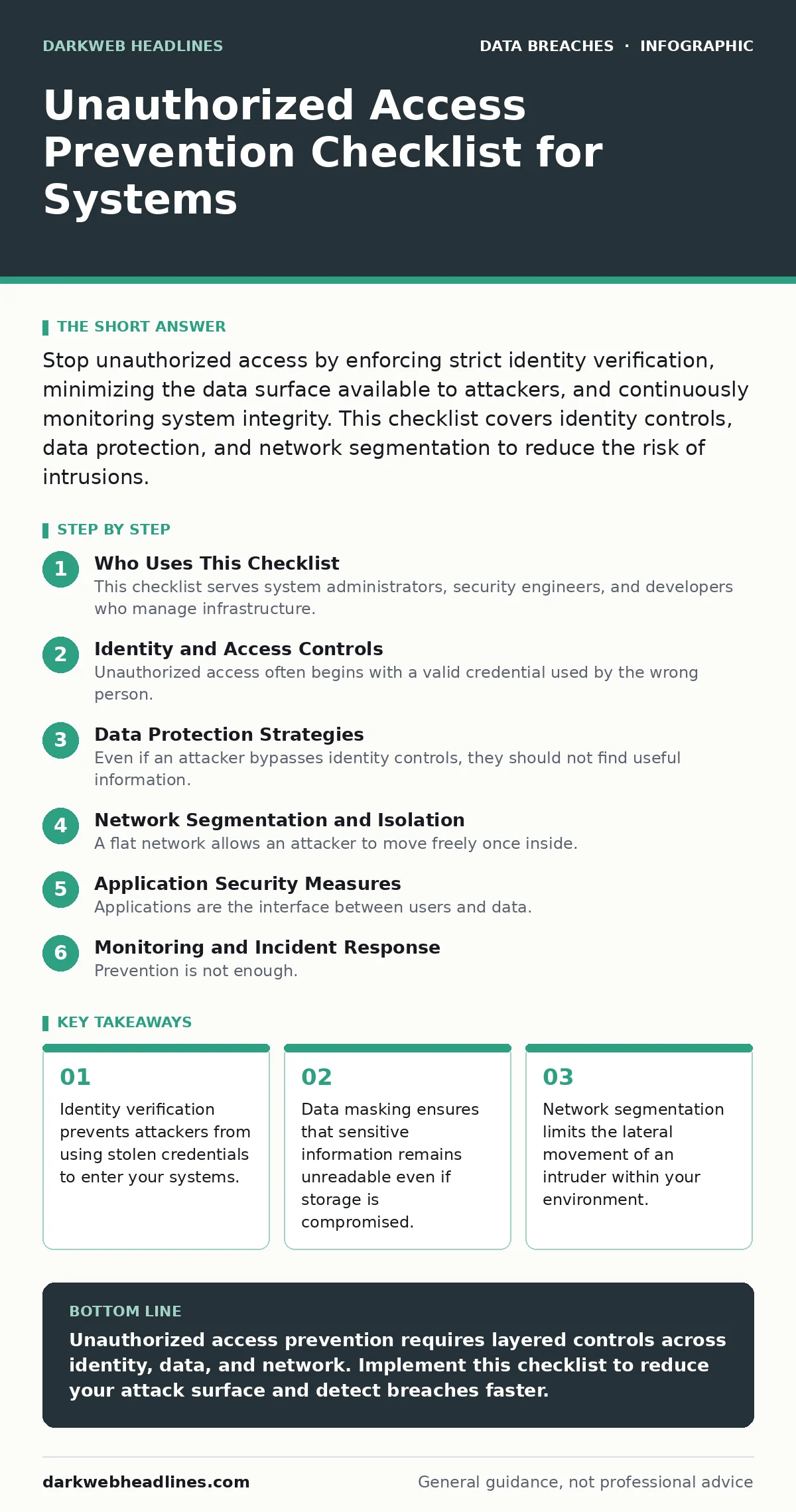
Stop unauthorized access by enforcing strict identity verification, minimizing the data surface available to attackers, and continuously monitoring system integrity. This checklist covers identity controls, data protection, and network segmentation to reduce the risk of intrusions.
Who Uses This Checklist
This checklist serves system administrators, security engineers, and developers who manage infrastructure. You use it to audit your current defenses against unauthorized access. The goal is not perfection but risk reduction. Each item represents a specific control that stops a common attack vector. You apply these controls to servers, applications, and databases. The process is iterative. You review these items regularly as your systems change.
Identity and Access Controls
Unauthorized access often begins with a valid credential used by the wrong person. You must verify who is accessing your systems. Standard passwords are insufficient because they can be guessed or stolen. You need stronger methods to prove identity.
- Multi-factor authentication: Requires two forms of verification, making stolen passwords useless alone.
- Least privilege access: Grants users only the permissions they need, limiting damage from compromised accounts.
- Session timeout policies: Ends inactive sessions, reducing the window for hijacked connections.
- Passwordless login options: Removes the weakest link by using cryptographic keys instead of memorized secrets.
- Regular access reviews: Ensures former employees and inactive accounts are removed from the system.
Identity management is the first line of defense. If you cannot prove who a user is, you cannot control what they do. You must also consider how credentials are stored. Credential dumps often contain hashed passwords that attackers can crack. Using strong hashing algorithms with unique salts makes these dumps far less useful to attackers.
Data Protection Strategies
Even if an attacker bypasses identity controls, they should not find useful information. You protect data by making it unreadable without proper authorization. This is distinct from access control, which stops entry. Data protection assumes entry might happen.
- Encryption at rest: Scrambles stored data, rendering it useless without the decryption key.
- Encryption in transit: Protects data moving between systems from interception on the network.
- Data masking techniques: Hides sensitive personal data in non-production environments to prevent leaks.
- Key management rotation: Regularly changes encryption keys to limit the value of any single compromised key.
- Database access logging: Records who queries data, creating an audit trail for forensic analysis.
Data scraping is a common method for attackers to gather information for targeted attacks. By masking data in development and testing environments, you reduce the value of any data that might leak from those systems. You must also ensure that backups are encrypted. A backup is often a secondary target because it may lack the same security controls as the primary system.
Network Segmentation and Isolation
A flat network allows an attacker to move freely once inside. You divide your network into smaller segments to limit this movement. This is called segmentation. Each segment has its own security controls. If one segment is breached, the others remain protected.
- Virtual LAN configuration: Separates network traffic logically, isolating different types of devices.
- Firewall rule auditing: Ensures only necessary traffic flows between segments, blocking unauthorized paths.
- Microsegmentation for servers: Applies security policies to individual workloads, not just the network perimeter.
- Guest network isolation: Keeps untrusted devices separate from internal corporate resources.
- Intrusion detection systems: Monitors traffic for suspicious patterns that indicate unauthorized access attempts.
Segmentation adds complexity to your network management. You must balance security with usability. Over-segmentation can break applications that rely on cross-network communication. You test connectivity regularly to ensure business functions work while maintaining security boundaries. Dark web monitoring can alert you to credentials that might be used to bypass these network controls.
Application Security Measures
Applications are the interface between users and data. Vulnerabilities in code allow attackers to bypass controls. You must secure the application layer to prevent unauthorized access to functionality. This involves testing and hardening the code itself.
- Input validation checks: Rejects malformed data that could exploit application logic flaws.
- Output encoding: Prevents injection attacks by treating user data as text, not code.
- API rate limiting: Stops automated tools from brute-forcing endpoints or scraping data.
- Dependency scanning: Identifies vulnerable libraries in your software supply chain.
- Error handling standardization: Prevents detailed error messages from revealing system internals.
Doxxing often relies on information leaked through poorly secured applications. By validating input and encoding output, you reduce the risk of exposing sensitive information. You must also secure your APIs. APIs are often exposed to the internet and can be a direct path to unauthorized access if not properly authenticated and authorized.
See also: Stop Credential Dumps: Practical Prevention Measures That Actually Work · Data Classification: How Labeling Information Reduces Breach Impact
Monitoring and Incident Response
Prevention is not enough. You must detect unauthorized access when it occurs. Monitoring provides visibility into your systems. You look for anomalies that indicate a breach. This allows you to respond quickly and limit damage.
- Centralized log aggregation: Collects logs from all systems in one place for easier analysis.
- Anomaly detection alerts: Notifies you of unusual behavior, such as login attempts from new locations.
- Incident response plan: Defines steps to take when unauthorized access is detected.
- Regular penetration testing: Simulates attacks to find weaknesses before real attackers do.
- Backup integrity verification: Ensures backups are not corrupted or compromised by ransomware.
Data leaks can occur silently over time. Regular monitoring helps you spot these leaks early. You must also have a plan for when prevention fails. An incident response plan ensures you know who to call and what to do. This reduces the time to containment and minimizes the impact of the breach.
Maintenance and Review
Security is not a one-time task. You must maintain your controls over time. Systems change, and new threats emerge. You review your checklist regularly to ensure it remains effective.
- Quarterly access reviews: Checks for privilege creep and unnecessary permissions.
- Patch management schedule: Applies security updates to close known vulnerabilities.
- Configuration baseline audits: Ensures systems remain hardened against default settings.
- Vendor risk assessments: Evaluates third-party services that have access to your data.
- Employee security training: Educates users on recognizing phishing and social engineering attacks.
Consistent maintenance ensures your defenses remain strong. You update your configurations as new best practices emerge. You also review your third-party vendors. They may have access to your data and must meet your security standards. This comprehensive approach reduces the overall risk of unauthorized access.
Key takeaways
- Identity verification prevents attackers from using stolen credentials to enter your systems.
- Data masking ensures that sensitive information remains unreadable even if storage is compromised.
- Network segmentation limits the lateral movement of an intruder within your environment.
Unauthorized access prevention requires layered controls across identity, data, and network. Implement this checklist to reduce your attack surface and detect breaches faster.
Frequently asked questions
How often should I review my access controls?
Review access controls at least quarterly or whenever there is a significant change in staff or system architecture.
Is encryption enough to prevent unauthorized access?
Encryption protects data confidentiality but does not prevent unauthorized login or system compromise. You need identity controls too.
What is the first step in preventing unauthorized access?
The first step is implementing multi-factor authentication for all user accounts to verify identity beyond just passwords.
How do I know if my network is properly segmented?
Test lateral movement between segments. If you cannot move from one segment to another without explicit permission, segmentation is working.
How this guide was produced: written by the DarkWeb Headlines editorial team with AI assistance, checked against the public references listed below, and reviewed when the facts change. See our editorial policy or report an error.