Data Inventory Errors: 6 Misunderstandings That Leave Secrets Exposed
Most teams mistake a server list for a data inventory, leaving unstructured files and shadow IT assets completely unmapped and vulnerable to theft.

A data inventory is not a hardware catalog. It is a living map of every information asset, its location, owner, and sensitivity level. Misunderstanding this leads to blind spots where sensitive personal data hides in unmonitored storage, bypassing all security controls.
Misreading: The Server List Is the Inventory
Correct reading: A list of servers, databases, and cloud buckets is infrastructure inventory, not data inventory. You know where the boxes are, but you do not know what is inside them. Security controls protect the perimeter of the box, not the content. If you treat the infrastructure list as your data map, you assume that securing the server secures the data. This assumption fails when developers store credentials in local configuration files or when employees save sensitive personal data to personal cloud drives. You must identify the specific datasets, not just the containers.
Imagine an organization that secures its primary database with strict access controls but ignores the backup logs stored on a developer’s laptop. The database is safe, but the logs contain the same sensitive information. The breach occurs through the laptop because the inventory stopped at the server. You need to map the data itself, including its copies, backups, and temporary files. This requires scanning for patterns, not just listing hardware. The difference is the distinction between protecting the vault and protecting the gold bars inside.
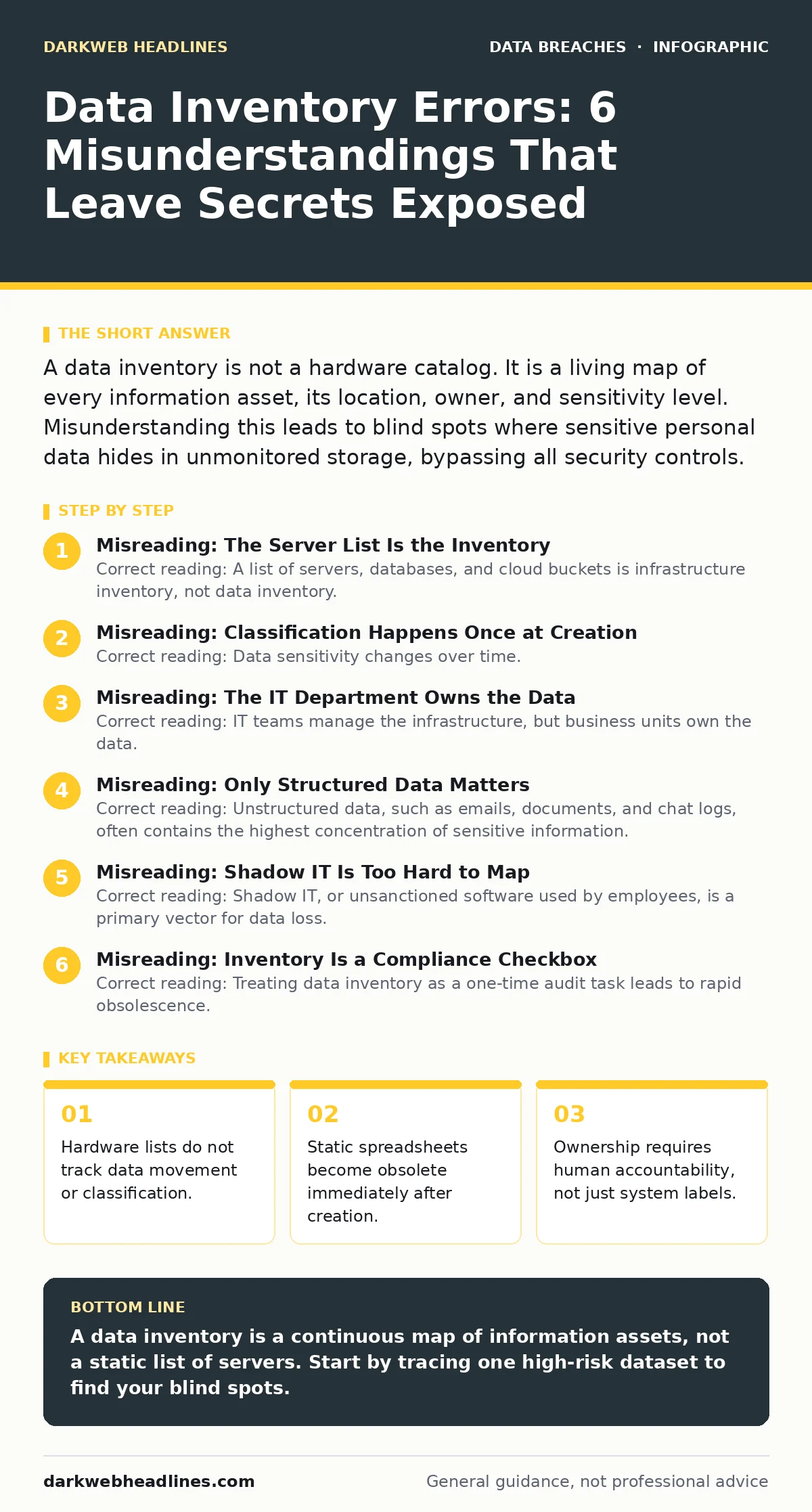
Misreading: Classification Happens Once at Creation
Correct reading: Data sensitivity changes over time. Information that is public today may become sensitive tomorrow, or vice versa. A static classification label applied at creation does not account for data aggregation, context shifts, or retention policy expirations. When you classify data once, you create a false sense of permanence. You must implement continuous classification mechanisms that re-evaluate data based on its current context and age.
Suppose a customer’s order history is low sensitivity individually. When aggregated with health records from another system, it becomes highly sensitive. If your inventory treats the order data as low risk forever, you fail to apply necessary controls. This aggregation risk is a common blind spot. You must define rules that trigger re-classification when data moves between systems or when new data is combined with existing records. This dynamic approach ensures that your protection levels match the actual risk, not just the original intent.
Misreading: The IT Department Owns the Data
Correct reading: IT teams manage the infrastructure, but business units own the data. Assigning data ownership to IT creates a disconnect between the value of the information and the people who understand its context. IT staff can enforce technical controls, but they cannot determine if a specific dataset is critical for business operations or if it can be deleted. You must assign human data owners from the business side who are accountable for the data’s lifecycle.
Imagine a marketing team collecting user preferences. IT sees this as a database table. The marketing director sees it as customer trust. If IT decides to archive this data without consulting the owner, they may violate privacy expectations or lose business intelligence. You need a clear chain of custody. The data owner defines the sensitivity and retention rules. IT implements the technical safeguards. This separation of duties ensures that security decisions are informed by business reality. Without a named human owner, data becomes orphaned and unprotected.
Misreading: Only Structured Data Matters
Correct reading: Unstructured data, such as emails, documents, and chat logs, often contains the highest concentration of sensitive information. Teams focus on databases because they are easier to scan, but attackers target unstructured files because they are harder to protect. You must include file shares, email servers, and collaboration platforms in your inventory. Ignoring these sources leaves massive gaps in your visibility.
Suppose a contractor sends a contract containing financial details via email. This data is not in a database. It is in an inbox. If your inventory only covers SQL databases, this email is invisible to your security tools. You must use discovery tools that can scan unstructured content for patterns like credit card numbers or social security numbers. This requires more processing power and generates more false positives, but it is necessary. The hidden cost of ignoring unstructured data is a breach that bypasses your primary defenses entirely.
Misreading: Shadow IT Is Too Hard to Map
Correct reading: Shadow IT, or unsanctioned software used by employees, is a primary vector for data loss. Assuming you cannot map it because you do not control the software is a failure of due diligence. You can map shadow IT by monitoring network traffic, analyzing cloud API usage, and interviewing staff. You must identify where data goes when it leaves your controlled environment.
Imagine an employee using a free project management tool to share client lists. The tool is not in your inventory. The client list is now hosted on an external server with unknown security practices. You must treat this as a data exfiltration event. By monitoring egress traffic and cloud service integrations, you can identify these unauthorized repositories. You do not need to shut them down immediately, but you must know they exist. This visibility allows you to assess the risk and apply controls, such as data masking or tokenization, before a breach occurs.
See also: Unauthorized Access Prevention Checklist for Systems · What Does Dark Web Monitoring Mean: Detecting Stolen Data Early
Misreading: Inventory Is a Compliance Checkbox
Correct reading: Treating data inventory as a one-time audit task leads to rapid obsolescence. Compliance requires a snapshot, but security requires a continuous process. Data moves, changes, and accumulates daily. A static report is useless after a week. You must automate the discovery and mapping process to keep the inventory current. This shifts the focus from passing an audit to maintaining operational security.
Suppose you complete a thorough inventory for a compliance audit. Six months later, new applications are deployed, and data flows change. Your inventory is now wrong. You must integrate inventory tools into your development lifecycle. This ensures that new data assets are mapped as they are created. This continuous approach reduces the risk of unknown data accumulating in blind spots. It also supports the principle of least privilege by ensuring that access rights are reviewed against current data maps.
How to Validate Your Map
Correct reading: A valid data inventory connects every data asset to a human owner and a technical control. You must verify this connection regularly. Start by selecting a single high-risk dataset. Trace its flow from creation to deletion. Identify every system it touches, every person who accesses it, and every copy that exists. If you cannot trace it fully, your inventory is incomplete.
This exercise reveals hidden dependencies and unauthorized copies. It also highlights where data masking or tokenization should be applied to reduce risk. You do not need to map every byte of data at once. Start with the most sensitive assets. Expand outward. This iterative approach builds a reliable foundation. It also prepares you for incidents. When a data leak occurs, a accurate inventory allows you to determine exactly what was lost and who needs to be notified.
Key takeaways
- Hardware lists do not track data movement or classification.
- Static spreadsheets become obsolete immediately after creation.
- Ownership requires human accountability, not just system labels.
- Unstructured data often contains the highest risk value.
A data inventory is a continuous map of information assets, not a static list of servers. Start by tracing one high-risk dataset to find your blind spots.
Frequently asked questions
How often should I update my data inventory?
You should update it continuously. Automated tools should scan for changes daily, while human reviews should occur quarterly to validate ownership and classification.
What if I find data I did not know existed?
Treat it as a new asset. Classify it, assign an owner, and apply appropriate security controls immediately. Document it in your inventory to prevent future blind spots.
Does data inventory help with credential dumps?
Yes. By mapping where credentials are stored, you can ensure they are not exposed in plain text. It helps you identify where tokenization should replace raw credentials.
How does this relate to doxxing prevention?
A thorough inventory identifies where personally identifiable information is stored. You can then apply stricter access controls and data masking to prevent unauthorized exposure.
How this guide was produced: written by the DarkWeb Headlines editorial team with AI assistance, checked against the public references listed below, and reviewed when the facts change. See our editorial policy or report an error.