Who Is Responsible for Data Leaks: Accountability and Prevention
Responsibility for data leaks often shifts from external attackers to internal process failures, making organizational culture the primary defense against exposure.

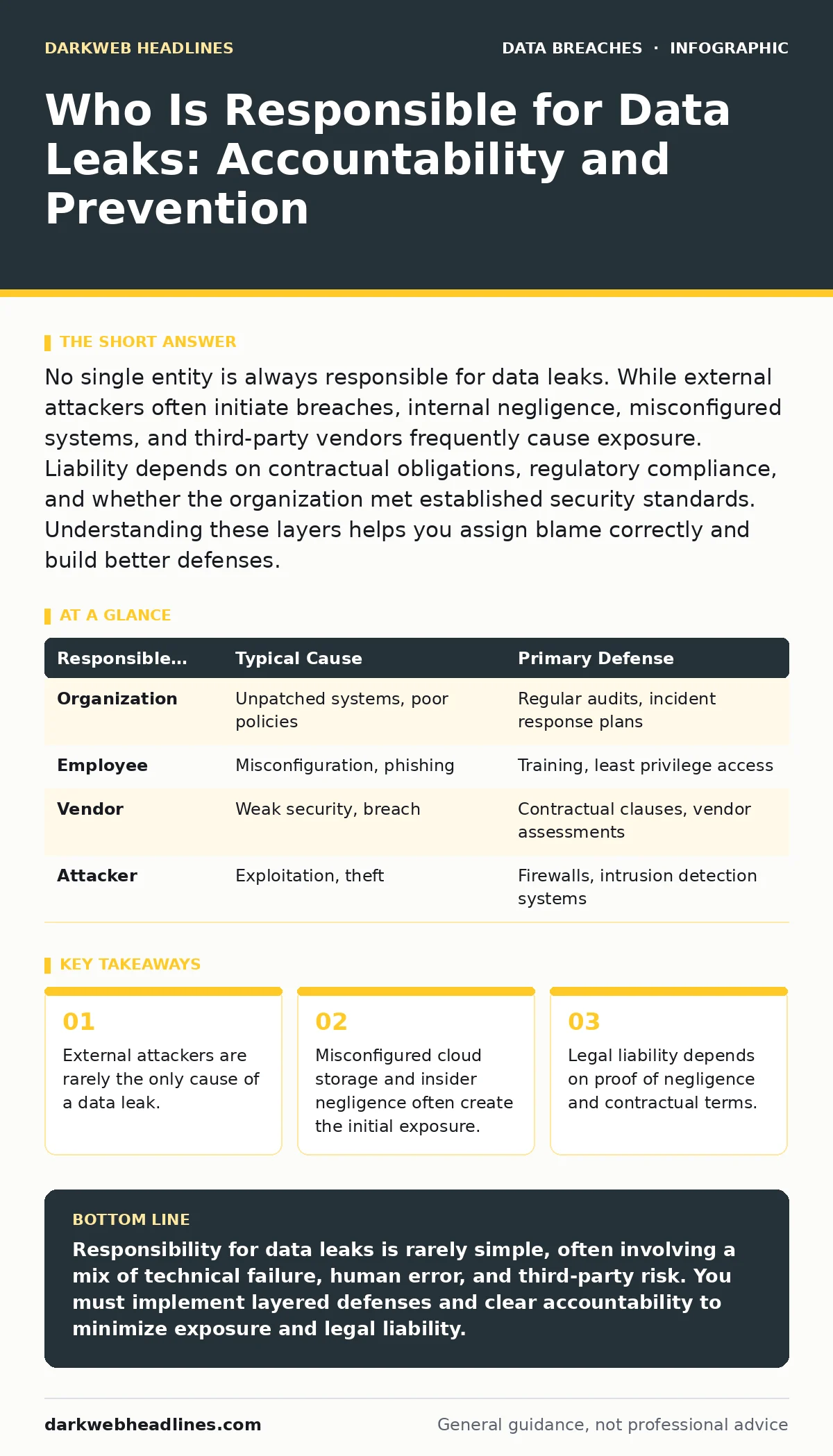
No single entity is always responsible for data leaks. While external attackers often initiate breaches, internal negligence, misconfigured systems, and third-party vendors frequently cause exposure. Liability depends on contractual obligations, regulatory compliance, and whether the organization met established security standards. Understanding these layers helps you assign blame correctly and build better defenses.
Who is responsible for data leaks?
Responsibility for data leaks is shared among the organization that owned the data, the individuals who mishandled it, and sometimes third-party vendors. There is no single villain in every scenario. You must look at the chain of custody to determine who failed their duty of care. If an attacker exploits an unpatched server, the organization responsible for maintenance bears the cost. If an employee sends a file to the wrong recipient, the employee and their training program share the fault.
What causes external data leaks?
External threats cause data leaks through direct attacks on infrastructure or social engineering of staff. Hackers exploit vulnerabilities in software to gain unauthorized access. They may use phishing to trick employees into revealing credentials. Once inside, they exfiltrate data to sell or destroy it. The organization remains responsible for securing its perimeter, even when the attacker is sophisticated. You cannot blame the thief entirely if the door was left unlocked.
How do internal errors cause leaks?
Internal errors cause data leaks through human mistake and process failure. Employees often misconfigure cloud storage buckets, making private data public. They may send sensitive personal data to the wrong email address. Developers sometimes commit code containing passwords to public repositories. These are not malicious acts, but they result in exposure. The organization is responsible for implementing checks that catch these mistakes before data leaves the secure environment.
What is the role of third parties?
Third parties cause data leaks when vendors or partners fail to secure shared information. Organizations often outsource IT support, payroll, or customer service. These vendors gain access to your data to perform their jobs. If their security is weak, your data is exposed. You remain legally responsible for the data, even if the vendor caused the leak. This is why you must vet partners and include strict security requirements in contracts.
How does legal liability work?
Legal liability for data leaks depends on negligence and regulatory compliance. Courts look at whether the organization took reasonable steps to protect data. If you ignored known vulnerabilities or failed to train staff, you are liable. Regulations may impose fines for non-compliance regardless of intent. Victims can sue for damages if they suffered harm. Insurance may cover some costs, but it does not erase reputational damage or criminal charges for gross negligence.
| Responsible Party | Typical Cause | Primary Defense |
|---|---|---|
| Organization | Unpatched systems, poor policies | Regular audits, incident response plans |
| Employee | Misconfiguration, phishing | Training, least privilege access |
| Vendor | Weak security, breach | Contractual clauses, vendor assessments |
| Attacker | Exploitation, theft | Firewalls, intrusion detection systems |
See also: Unauthorized Access Prevention Checklist for Systems · What Does Dark Web Monitoring Mean: Detecting Stolen Data Early
What technical controls prevent leaks?
Technical controls prevent data leaks by restricting access and monitoring movement. Encryption ensures that stolen data remains unreadable without keys. Access controls limit who can view or export files based on role. Data loss prevention tools scan outgoing traffic for sensitive patterns. These tools reduce risk but do not eliminate it. You must configure them correctly and update them regularly. A misconfigured tool can create blind spots that attackers exploit.
How do you manage accidental exposure?
Accidental data disclosure happens when information is shared with unintended recipients. This often occurs via email or cloud collaboration tools. You can reduce this risk by enforcing strict naming conventions and approval workflows. Training helps staff recognize when they are about to send sensitive information. Regular audits of shared folders identify files that should not be public. You must balance ease of use with security to ensure staff do not bypass controls.
What steps follow a confirmed leak?
Immediate action limits damage after a confirmed leak. You must isolate affected systems to stop further exfiltration. Notify affected individuals and regulators as required by law. Conduct a forensic investigation to determine the scope and cause. Review and update security policies to prevent recurrence. Transparency builds trust, even when the news is bad. Hiding the leak usually worsens legal and reputational consequences.
How do you build long-term resilience?
Long-term resilience requires a culture of security and continuous improvement. You must treat security as a business enabler, not just a cost. Regular training keeps staff aware of new threats. Automated monitoring detects anomalies before they become major incidents. You should also review your data inventory and mapping to ensure you only keep data you need. Less data means less risk. This approach reduces the impact of any future leak.
Key takeaways
- External attackers are rarely the only cause of a data leak.
- Misconfigured cloud storage and insider negligence often create the initial exposure.
- Legal liability depends on proof of negligence and contractual terms.
- Technical controls must align with human behavior to prevent recurrence.
Responsibility for data leaks is rarely simple, often involving a mix of technical failure, human error, and third-party risk. You must implement layered defenses and clear accountability to minimize exposure and legal liability.
Frequently asked questions
Can an employee be fired for causing a data leak?
Yes, if the employee acted with gross negligence or violated clear security policies, they may face termination. However, the organization also shares responsibility for providing adequate training and tools.
Does insurance cover all costs of a data leak?
Insurance may cover legal fees, notification costs, and some recovery expenses, but it rarely covers reputational damage or regulatory fines. Policies vary significantly, so you must review terms carefully.
How long does it take to detect a data leak?
Detection time varies widely depending on monitoring capabilities and the sophistication of the attacker. Some leaks are found immediately, while others remain hidden for months. Continuous monitoring reduces this window.
What is the difference between a breach and a leak?
A breach involves unauthorized access to systems, while a leak refers to the exposure of data. A breach may not result in a leak if data is not exfiltrated. A leak can occur without a breach if data is accidentally published.
How this guide was produced: written by the DarkWeb Headlines editorial team with AI assistance, checked against the public references listed below, and reviewed when the facts change. See our editorial policy or report an error.