Doxxing: How Attackers Find You and How to Stop It
Doxxing relies on aggregating fragmented public records rather than hacking secure servers, making visibility the primary vector for exposure.

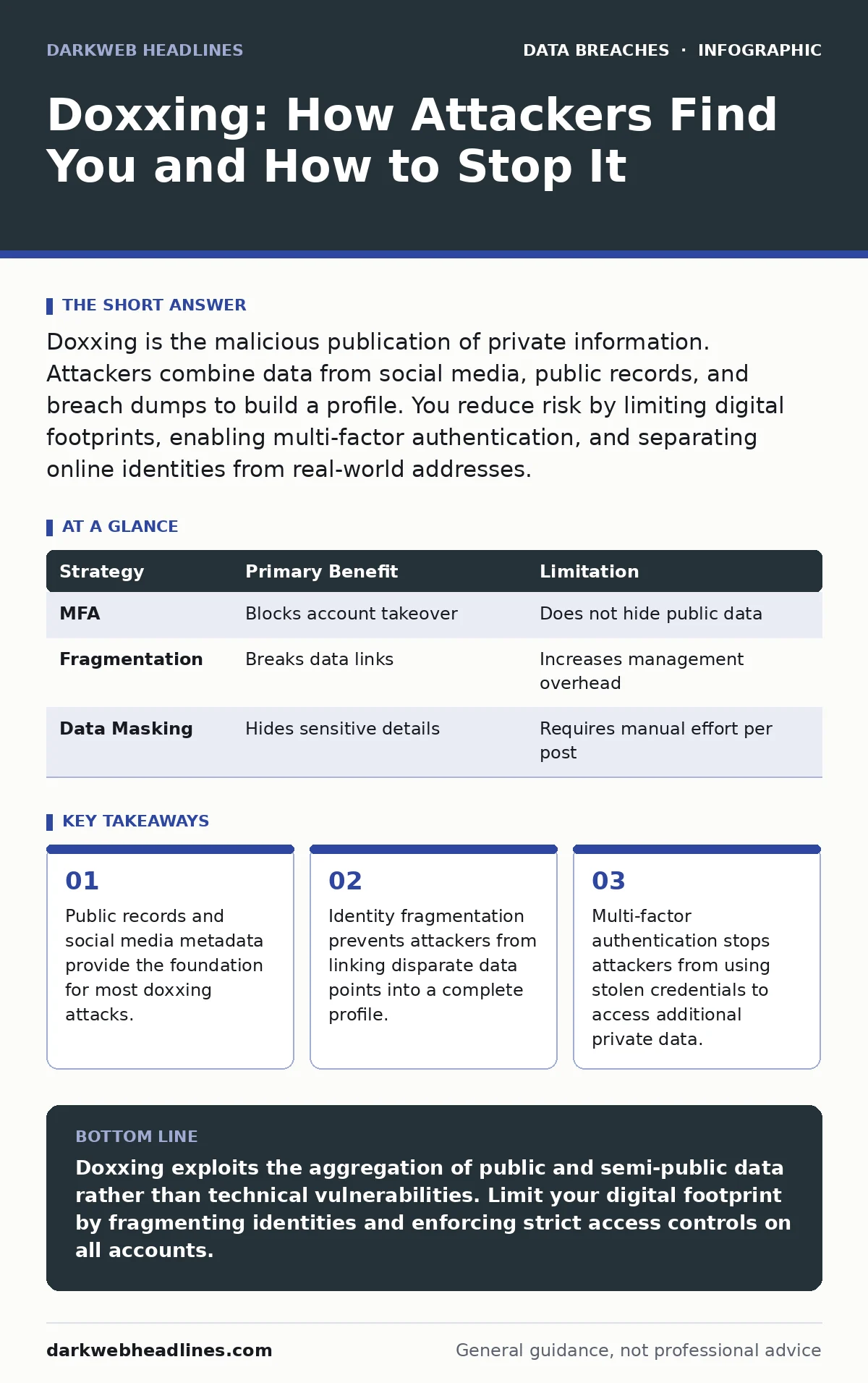
Doxxing is the malicious publication of private information. Attackers combine data from social media, public records, and breach dumps to build a profile. You reduce risk by limiting digital footprints, enabling multi-factor authentication, and separating online identities from real-world addresses.
What exactly is doxxing?
Doxxing is the act of researching and publishing private or identifying information about an individual without their consent. This information typically includes home addresses, phone numbers, email addresses, and employer details. The goal is often harassment, intimidation, or facilitating physical harm. Unlike simple privacy leaks, doxxing involves intentional aggregation of data from multiple sources to create a comprehensive dossier on a specific target.
How do attackers gather this information?
Attackers rarely hack a single secure system to obtain this data. Instead, they use open-source intelligence techniques to aggregate fragments from public records, social media profiles, and previous credential exposure events. They cross-reference usernames across platforms to link professional accounts with personal ones. This method exploits the fact that people reuse identifiers and share consistent biographical details across different services.
Why do people reuse usernames?
Reusing usernames creates a direct link between your professional identity and your personal life. Attackers use username enumeration tools to check if a handle exists on hundreds of sites. If you use the same name for your banking, gaming, and social media accounts, an attacker can map your entire digital presence. This linkage allows them to find private data on one platform and apply it to another, bypassing privacy settings that might isolate single accounts.
What role do public records play?
Public records such as property deeds, voter registrations, and court documents are legally accessible and often contain precise location data. These records are not encrypted and are frequently scraped by data brokers. Even if you secure your online accounts, this static data remains available. Attackers use this foundational data to verify other information they find online, creating a verified target profile that is difficult to dispute or remove.
Can multi-factor authentication stop doxxing?
Multi-factor authentication prevents account takeover, which is a common secondary step in doxxing campaigns. Once an attacker has basic details, they may try to log into your email or social media to harvest more private data. MFA blocks this access even if they have your password. However, MFA does not remove data that is already public or stored in third-party databases. It protects your active accounts, not your historical footprint.
See also: Who Is Responsible for Data Leaks: Accountability and Prevention · What Does Dark Web Monitoring Mean: Detecting Stolen Data Early
How does data classification help?
Data classification involves labeling information based on its sensitivity and required protection level. For personal data, this means treating contact details and financial information as high-sensitivity assets. You should apply stricter sharing settings to these categories. This mental model helps you avoid posting sensitive details in contexts that appear casual but are permanently archived. Proper classification reduces the amount of high-value data available to aggregators.
What is identity fragmentation?
Identity fragmentation is the practice of using distinct usernames, email addresses, and profiles for different activities. This strategy breaks the links that attackers use to build a complete profile. Suppose you use one email for shopping and another for professional networking. An attacker who compromises one will not easily find the other. This approach increases the effort required for an attacker to correlate your various digital footprints, often causing them to abandon the target.
| Strategy | Primary Benefit | Limitation |
|---|---|---|
| MFA | Blocks account takeover | Does not hide public data |
| Fragmentation | Breaks data links | Increases management overhead |
| Data Masking | Hides sensitive details | Requires manual effort per post |
Does deleting old posts help?
Deleting old posts reduces the surface area for data aggregation, but it does not guarantee removal. Search engines and web archives often cache content long after the original post is deleted. Additionally, if other users have quoted or shared your content, those copies remain. You must also request removal from data broker sites that scrape and resell your information. This process is repetitive because brokers re-list data regularly.
How do I respond if I am targeted?
If you are targeted, document all instances of the published information and report them to the hosting platforms. Do not engage with the attacker or post rebuttals that generate more attention. Contact your internet service provider to discuss blocking specific IP addresses if harassment escalates to physical threats. You should also enable strict privacy settings on all remaining accounts and consider using dark web monitoring services to detect further credential exposure.
What is the long-term impact?
The long-term impact of doxxing extends beyond immediate harassment. It can lead to professional repercussions, identity theft, and persistent anxiety. The data remains on the internet indefinitely, requiring ongoing management. You must maintain a disciplined approach to data inventory and mapping to track where your information resides. Regular audits of your online presence are necessary to catch new exposures from breaches or data broker updates.
Key takeaways
- Public records and social media metadata provide the foundation for most doxxing attacks.
- Identity fragmentation prevents attackers from linking disparate data points into a complete profile.
- Multi-factor authentication stops attackers from using stolen credentials to access additional private data.
Doxxing exploits the aggregation of public and semi-public data rather than technical vulnerabilities. Limit your digital footprint by fragmenting identities and enforcing strict access controls on all accounts.
Frequently asked questions
Can I sue someone for doxxing me?
Legal recourse varies by jurisdiction and depends on whether the publication violates specific privacy laws or constitutes harassment. Consult a legal professional to understand your rights in your specific location.
Does using a VPN prevent doxxing?
A VPN hides your IP address from websites, but it does not remove personal data you have already shared publicly. It protects your location during browsing, not your historical digital footprint.
Should I delete all my social media accounts?
Deleting accounts reduces exposure but may not remove cached data. It is often more effective to lock down privacy settings and fragment identities than to abandon platforms entirely, depending on your professional needs.
How often should I check for new data leaks?
You should periodically review your online presence and use monitoring tools to detect new exposures. There is no fixed schedule, but quarterly reviews are reasonable for maintaining data inventory and mapping accuracy.
How this guide was produced: written by the DarkWeb Headlines editorial team with AI assistance, checked against the public references listed below, and reviewed when the facts change. See our editorial policy or report an error.