Credential Exposure: Meaning, Sources, and Real-World Impact
Credential exposure rarely stems from a single hack; it usually results from reused passwords colliding with unrelated data breaches and automated scraping tools.

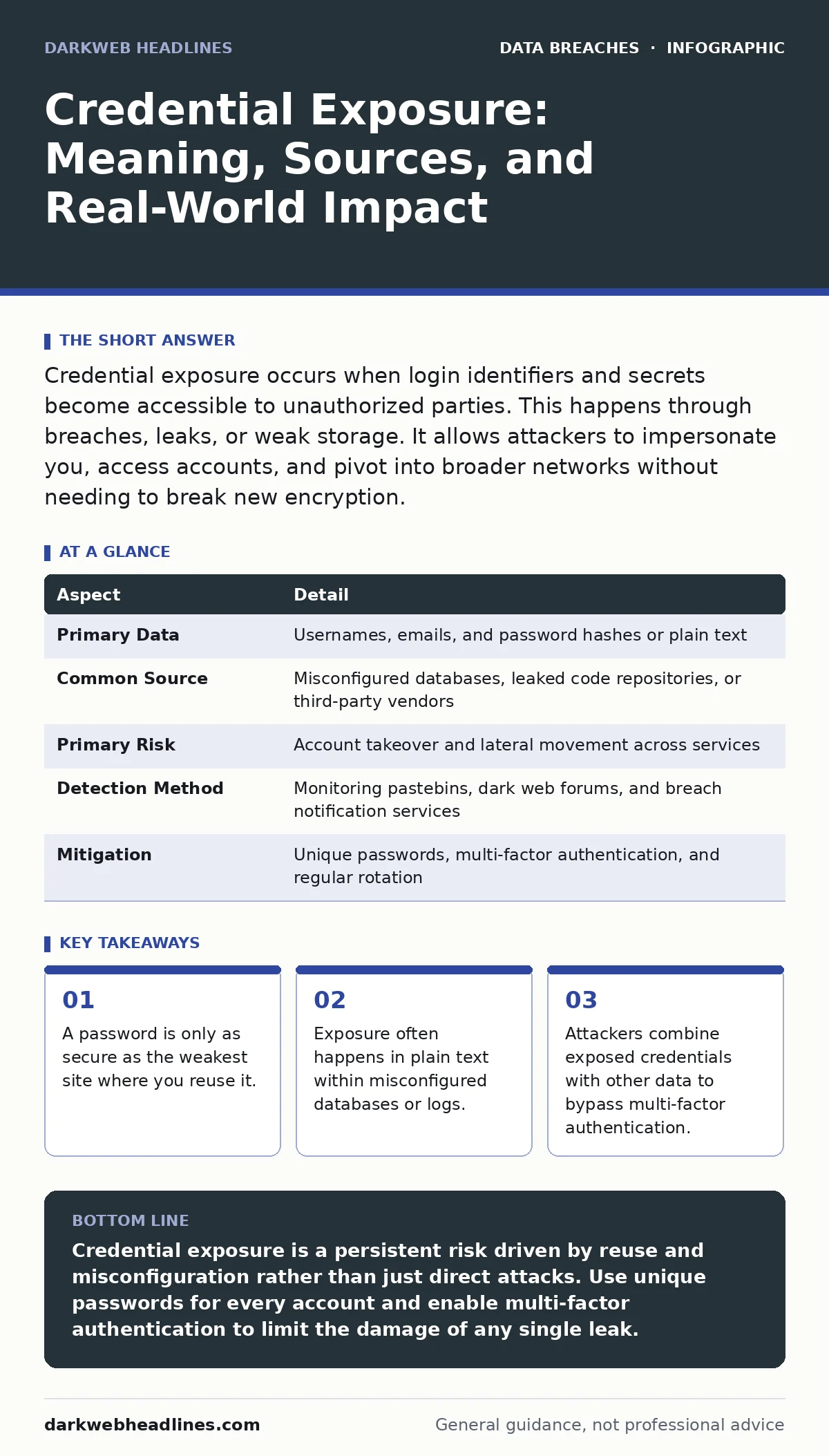
Credential exposure occurs when login identifiers and secrets become accessible to unauthorized parties. This happens through breaches, leaks, or weak storage. It allows attackers to impersonate you, access accounts, and pivot into broader networks without needing to break new encryption.
The Library Card Analogy
Imagine you use the same library card to check out books at every branch in the city. If someone steals that single card, they do not just get access to one shelf. They gain entry to every room, every archive, and every restricted section connected to that card. Credential exposure works exactly like this. Your username and password are the card. When they appear in a public database, the lock on every door you opened with that combination is effectively broken.
Most people think of security as a wall. They build high walls around their home computer. But credential exposure shows that the wall is irrelevant if the key to the door is sitting on a public table. The breach did not happen at your house. It happened at the library branch three towns over where you reused that same card.
Defining the Mechanism
Credential exposure is the state where authentication data becomes visible to entities that should not have access. This data usually includes usernames, email addresses, and passwords. Sometimes it includes security answers or tokens. The exposure is not always a dramatic hack. It can be a configuration error, a developer mistake, or a careless upload.
The term comes from the practice of storing authentication data. Systems need to verify who you are. To do this, they store a reference of your secret. If that reference is stored poorly, it becomes exposed. Exposure is different from a breach. A breach is the event of breaking in. Exposure is the resulting state where the secrets are available to be read. One leads to the other, but they are distinct concepts.
| Aspect | Detail |
|---|---|
| Primary Data | Usernames, emails, and password hashes or plain text |
| Common Source | Misconfigured databases, leaked code repositories, or third-party vendors |
| Primary Risk | Account takeover and lateral movement across services |
| Detection Method | Monitoring pastebins, dark web forums, and breach notification services |
| Mitigation | Unique passwords, multi-factor authentication, and regular rotation |
Where Exposure Happens in Practice
You might assume exposure only happens when hackers break into a company. In reality, many exposures are accidental. A developer might commit a configuration file to a public code repository. That file contains database passwords. Another team might upload a customer list to a cloud storage bucket with public read permissions. These are not attacks. They are mistakes.
See our guide on misconfigured cloud storage leaks for details on how default settings often allow public access to sensitive buckets. These settings are the default state for many cloud services. If you do not explicitly lock them down, the world can read them. This is where a significant portion of credential exposure originates. It is not a sophisticated intrusion. It is a lack of basic configuration hygiene.
The Role of Reuse and Scraping
The most dangerous aspect of credential exposure is reuse. If your password for a forum appears in a leak, attackers will try that same password on your email, bank, and work accounts. This is called credential stuffing. Attackers use automated tools to test millions of username-password pairs against login pages.
This process relies on data scraping. Scrapers collect information from various sources. They might harvest email lists from social media profiles. They might download leaked databases from underground forums. They then combine this data to create targeted attack lists. The more places you use the same password, the larger the target surface you create.
Readers should understand data classification to know which credentials are most valuable. Not all accounts are equal. A gaming account is less critical than a financial one. However, attackers use low-value accounts to gain trust or as stepping stones. They do not care about the value of the initial account. They care about the access it provides to other systems.
What People Usually Get Wrong
Many users believe that if their computer is clean, they are safe. This is incorrect. Credential exposure is external to your device. It happens in the cloud, in third-party servers, and in public archives. Your local antivirus cannot protect you from a password that was leaked five years ago on a forum you no longer visit.
Another common mistake is assuming that complex passwords are enough. If you use a complex password but reuse it, you are still exposed. Complexity does not mitigate reuse. Uniqueness is the primary defense. A simple password that is unique to one site is safer than a complex password used everywhere.
See also: Cyber Espionage Myths: Why State Actors Fail and How They Actually Operate · Authorization Bypass Vulnerabilities Explained for Beginners
The Hidden Cost of Exposure
The immediate cost of credential exposure is account takeover. But the hidden cost is identity fragmentation. When a credential is exposed, it often comes with other data. Your name, your address, your phone number. Attackers combine these pieces to create a full profile of you.
This profile allows for social engineering. An attacker can call your bank and answer security questions because they have your data from a different leak. This is why credential dumps are so valuable. They are not just lists of passwords. They are dossiers of human behavior and information.
See our guide on accidental data disclosure to understand how small leaks of personal information can compound over time. Each small leak adds a piece to the puzzle. Eventually, the puzzle is complete enough for an attacker to impersonate you convincingly. This is a slow, cumulative risk that is hard to detect until it is too late.
Managing Exposure Day to Day
You cannot prevent all exposure. You can only reduce the impact. The first step is to assume every password you have ever used is already exposed. This mindset shift changes how you manage access. You stop relying on memory and start relying on tools.
Use a password manager. It generates unique, random passwords for every site. You do not need to remember them. The manager does. This breaks the link between one breach and your other accounts. If one site is compromised, the unique password is useless elsewhere.
The Principle of Least Privilege
Once you have secured your personal accounts, consider how you handle credentials at work or in projects. The principle of least privilege states that a user or system should only have the access necessary to perform its function. No more, no less.
If a service account only needs to read a database, it should not have write access. If a developer only needs to deploy code, they should not have access to production logs. Limiting the scope of credentials reduces the damage if they are exposed.
See our guide on data masking to learn how to hide sensitive data in non-production environments. Developers often need to test with real data structures. They do not need the real secrets. Masking replaces real credentials with fake ones that look real. This prevents exposure during development and testing.
Key takeaways
- A password is only as secure as the weakest site where you reuse it.
- Exposure often happens in plain text within misconfigured databases or logs.
- Attackers combine exposed credentials with other data to bypass multi-factor authentication.
Credential exposure is a persistent risk driven by reuse and misconfiguration rather than just direct attacks. Use unique passwords for every account and enable multi-factor authentication to limit the damage of any single leak.
Frequently asked questions
Does changing my password after a breach stop exposure?
Changing the password stops future use of the old credential, but it does not remove the old one from existing databases. Attackers may have already saved it.
Are password managers safe if they get breached?
Password managers use strong encryption. If breached, attackers get encrypted data, not plain text. However, your master password must be unique and strong.
Can I tell if my email has been exposed?
You can check breach notification services that aggregate known leaks. If your email appears, assume your password for that service is compromised.
Does two-factor authentication prevent credential exposure?
No, it does not prevent the exposure of the password. It prevents the attacker from using that exposed password to log in without the second factor.
How this guide was produced: written by the DarkWeb Headlines editorial team with AI assistance, checked against the public references listed below, and reviewed when the facts change. See our editorial policy or report an error.