What Does Dark Web Monitoring Mean: Detecting Stolen Data Early
Dark web monitoring scans hidden networks for your compromised credentials, revealing exposure before attackers exploit your accounts for unauthorized access or financial gain.

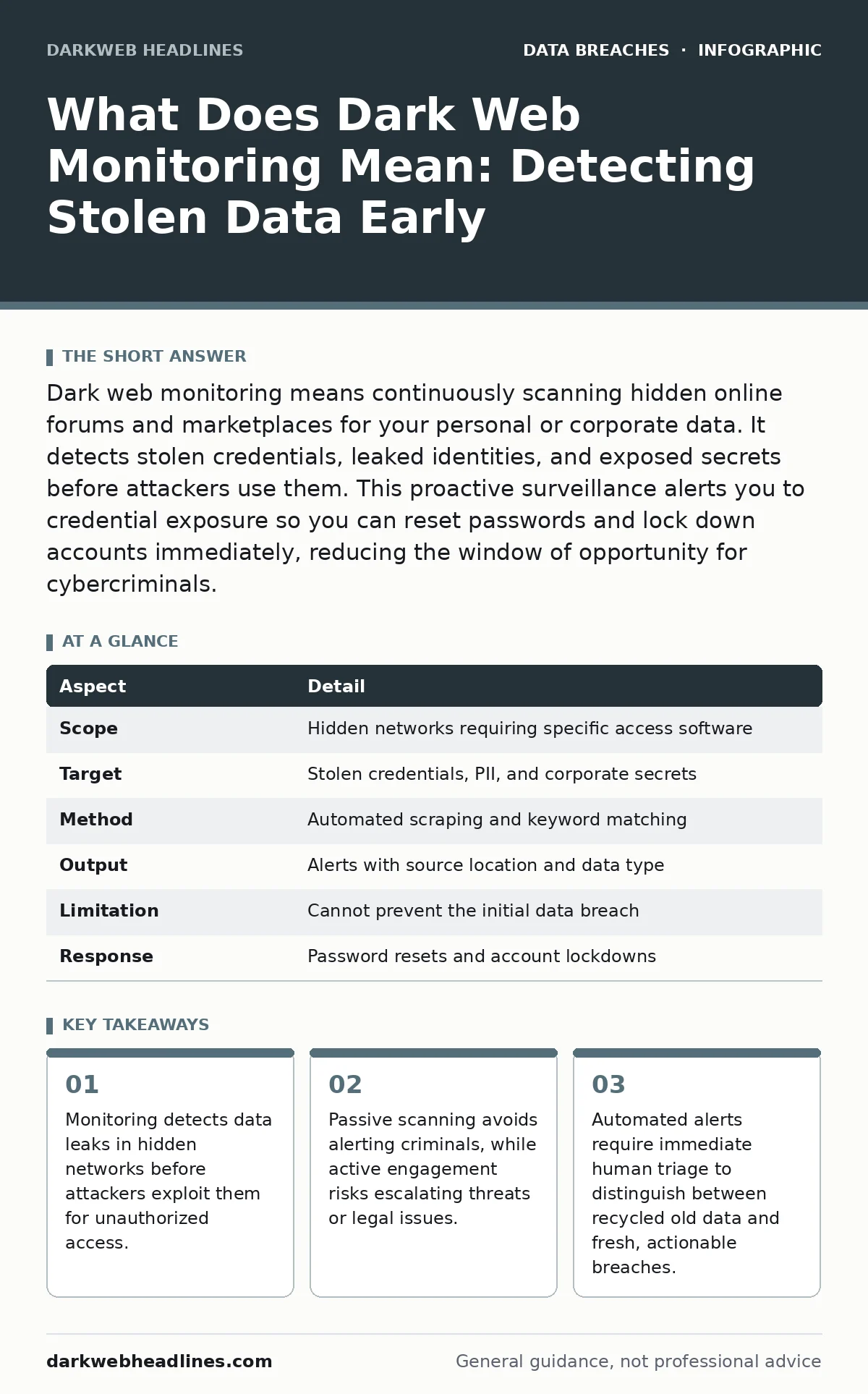
Dark web monitoring means continuously scanning hidden online forums and marketplaces for your personal or corporate data. It detects stolen credentials, leaked identities, and exposed secrets before attackers use them. This proactive surveillance alerts you to credential exposure so you can reset passwords and lock down accounts immediately, reducing the window of opportunity for cybercriminals.
What Does Dark Web Monitoring Mean
Dark web monitoring means scanning hidden, encrypted parts of the internet for your personal or organizational data. It searches for stolen credentials, leaked documents, and exposed sensitive personal data that criminals post on private forums or marketplaces. This process does not prevent the initial theft. It detects the aftermath. You receive alerts when your information appears in these hidden spaces.
This gives you time to react before attackers use the data. The goal is early detection. Early detection limits damage. It transforms a silent leak into a visible alert. You can then take specific actions to protect your accounts and identity. This is different from general internet scanning. The dark web requires special access tools and techniques to reach.
| Aspect | Detail |
|---|---|
| Scope | Hidden networks requiring specific access software |
| Target | Stolen credentials, PII, and corporate secrets |
| Method | Automated scraping and keyword matching |
| Output | Alerts with source location and data type |
| Limitation | Cannot prevent the initial data breach |
| Response | Password resets and account lockdowns |
How Dark Web Monitoring Works
The process begins with access. Standard browsers cannot reach these hidden networks. Monitoring services use specialized software to connect to these layers. They crawl forums, chat rooms, and marketplaces. This crawling is passive. The service reads public posts without interacting. Interaction can alert sellers that their data is being watched. This might cause them to delete the listing or move it.
The service collects this data and stores it. It then compares the collected data against your known information. This includes email addresses, domain names, and specific file hashes. If there is a match, the system flags it. It does not just flag the match. It analyzes the context. Is the data part of a large dump? Is it being sold? This context helps determine the urgency.
Imagine a company uses a monitoring service. The service finds an email address from the company on a forum. The forum post lists a password. The service checks if this password matches any known compromised lists. It does. It sends an alert. The IT team sees the alert. They force a password reset for that user. They also check if that password was used elsewhere.
This stops the attacker from using the same credential on other systems. This is credential exposure. Monitoring reveals this exposure. It turns a hidden risk into a managed incident. Without monitoring, the attacker might sit on this credential for months. They could wait for a specific target to log in. Then they would steal more data. Monitoring breaks this chain.
Who Dark Web Monitoring Affects
Individuals face identity theft risks. Their Social Security numbers, bank details, and health records can appear. This leads to financial fraud and identity hijacking. Companies face operational risks. Their employee credentials and intellectual property can be stolen. This leads to unauthorized access and data leaks. Both groups need monitoring. The scale differs. Individuals monitor their own data. Companies monitor their domain and employee data.
Employees are often the weakest link. They reuse passwords. Monitoring helps companies see where employees have exposed credentials. It allows the company to enforce security policies. It supports the principle of least privilege. If a credential is leaked, access should be removed. Monitoring provides the signal to remove that access. It affects everyone who has an online presence. The more data you share, the more you need monitoring.
What People Usually Get Wrong
Many believe monitoring prevents breaches. It does not. It only detects leaked data. Prevention requires strong security practices. Monitoring is a detection tool. Another mistake is assuming all alerts are critical. Many alerts are false positives. They are old data or recycled credentials. Not all leaked data is fresh. Some data sits on forums for years. You must triage alerts.
Look for recent posts. Look for active selling. Look for specific context. Old data is less urgent. Fresh data is high risk. Another error is ignoring the human element. Alerts require action. If you do not act, monitoring is useless. You must have a response plan. You must know who resets passwords. You must know who contacts affected users. Monitoring without response is just noise.
The Hidden Costs of Monitoring
Monitoring is not free. It costs money for the service. It costs time for analysis. Small teams struggle with volume. They receive hundreds of alerts. They cannot check each one. This leads to missed threats. Large teams have better tools. They can automate triage. But automation has limits. It can miss subtle context. A human must review complex cases. Another cost is legal risk. Some monitoring services use aggressive tactics.
They might interact with criminals. This can violate laws in some jurisdictions. It can also escalate conflicts. Criminals may target the monitor. They might steal more data to retaliate. You must choose a provider carefully. They should use passive methods. They should not engage. They should not store data insecurely. The provider becomes a target. If they are breached, your data is at risk.
See also: Doxxing: How Attackers Find You and How to Stop It · Data Inventory Errors: 6 Misunderstandings That Leave Secrets Exposed
What To Do About Detected Data
When an alert arrives, act quickly. First, verify the data. Is it yours? Is it recent? If yes, change the password immediately. Use a unique password. Do not reuse it. Check for other accounts using that password. Change those too. Enable multi-factor authentication. This adds a layer of security. Even if the password is stolen, the attacker needs the second factor. For companies, review access logs.
Look for unusual activity. Check if the account was accessed from strange locations. If so, lock the account. Investigate further. Contact the affected user. Tell them what happened. Advise them on steps to take. Document the incident. Update your security policies. If the data is sensitive personal data, you may need to report it. Follow local laws. Transparency builds trust. Hiding breaches destroys it.
Integrating Monitoring Into Security
Monitoring should not stand alone. It must fit into your broader strategy. Combine it with data classification. Know what data is sensitive. Monitor that data closely. Use data scraping tools to find exposed data on the surface web too. The dark web is not the only place. Public sites can also leak data. Use all sources. Integrate monitoring with your incident response plan. Define clear steps for each type of alert.
Train your staff. They need to know how to react. They need to know who to contact. Regular drills help. They keep skills sharp. Review your monitoring coverage. Are you missing key domains? Are you missing key employee emails? Update your scope regularly. Security is ongoing. Monitoring is part of that cycle. It provides visibility. Visibility enables control. Control reduces risk.
Key takeaways
- Monitoring detects data leaks in hidden networks before attackers exploit them for unauthorized access.
- Passive scanning avoids alerting criminals, while active engagement risks escalating threats or legal issues.
- Automated alerts require immediate human triage to distinguish between recycled old data and fresh, actionable breaches.
Frequently asked questions
Does dark web monitoring protect my computer from viruses?
No, it does not protect against malware or viruses. It only detects if your personal data has been stolen and posted online. You still need antivirus software and firewalls for device protection.
Can I do dark web monitoring myself?
It is difficult for individuals. Accessing these networks requires specialized tools and skills. Most people should use commercial services. These services have the resources and expertise to scan effectively and safely.
How long does it take to get an alert?
Alerts can appear within hours or days of data being posted. Some services offer real-time alerts. Others provide daily or weekly reports. The speed depends on the service and the scanning frequency.
Is dark web monitoring legal?
Yes, monitoring is legal. However, accessing these networks without authorization can be risky. Use reputable services that operate within legal boundaries. Do not attempt to access these sites yourself unless you are trained.
How this guide was produced: written by the DarkWeb Headlines editorial team with AI assistance, checked against the public references listed below, and reviewed when the facts change. See our editorial policy or report an error.