What Is Sensitive Personal Data: Definition, Risks, and Protection
Sensitive personal data carries a hidden cost because its exposure often triggers mandatory legal audits and long-term identity monitoring requirements that standard data loss does not impose.

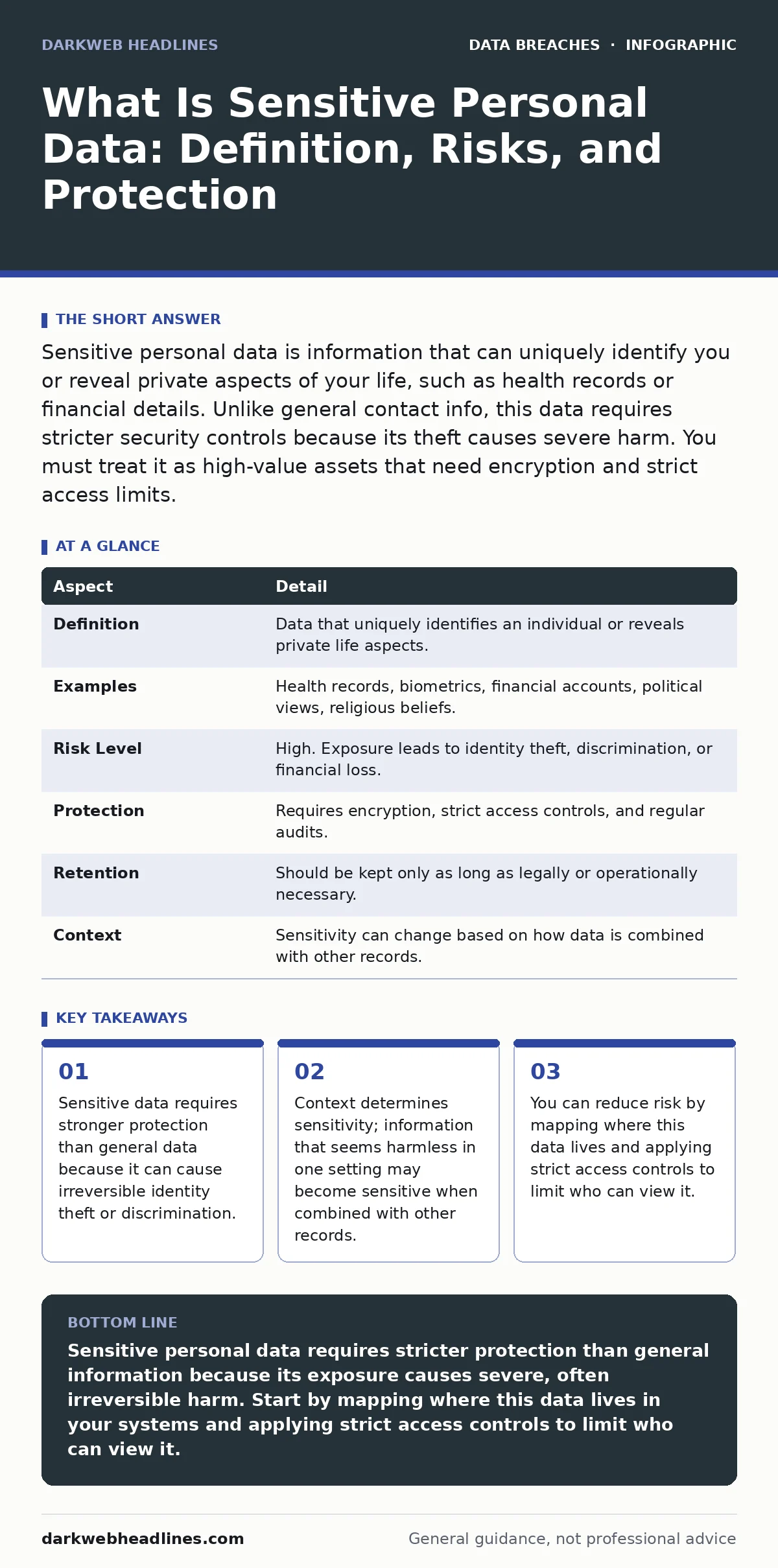
Sensitive personal data is information that can uniquely identify you or reveal private aspects of your life, such as health records or financial details. Unlike general contact info, this data requires stricter security controls because its theft causes severe harm. You must treat it as high-value assets that need encryption and strict access limits.
The Core Definition of Sensitive Personal Data
Sensitive personal data is any information that, if disclosed, could cause significant harm to the individual it describes. This category extends beyond basic contact details to include health records, biometric identifiers, genetic information, political opinions, religious beliefs, and precise financial account numbers. The defining characteristic is the potential for damage. If a stranger obtains your email address, the risk is low. If they obtain your social security number or medical history, the risk is catastrophic. You must distinguish between general personal information and sensitive personal data because the latter demands higher security standards.
Consider a library catalog. The title and author of a book are public facts. The checkout record showing who borrowed it and when is private. Sensitive personal data is like a record of what medical books a person borrowed, combined with their identity. This combination reveals private health conditions. The harm comes from the linkage, not just the data point itself.
| Aspect | Detail |
|---|---|
| Definition | Data that uniquely identifies an individual or reveals private life aspects. |
| Examples | Health records, biometrics, financial accounts, political views, religious beliefs. |
| Risk Level | High. Exposure leads to identity theft, discrimination, or financial loss. |
| Protection | Requires encryption, strict access controls, and regular audits. |
| Retention | Should be kept only as long as legally or operationally necessary. |
| Context | Sensitivity can change based on how data is combined with other records. |
How Sensitive Data Works in Digital Systems
Data sensitivity is not an inherent property of the text itself but a function of its context and combination. A single data point, like a zip code, is rarely sensitive. This concept is known as re-identification. Systems that store data in silos often fail to see these connections. A marketing database might hold your preferences, while a separate system holds your transaction history. When these systems are linked, or when one is breached, the resulting profile becomes highly sensitive.
You must understand that data aggregation increases risk. Attackers do not always steal sensitive data directly. They often steal general data and then purchase or scrape additional data from other sources to build a complete profile. This process, known as data enrichment, turns low-risk information into high-risk sensitive personal data. Your security strategy must account for this linkage. Storing data in isolated segments reduces the value of any single breach.
Who Is Affected by Data Exposure
Every individual interacts with systems that collect sensitive personal data. Students submit identification for enrollment. Employees provide tax information for payroll. Patients share medical history for treatment. The impact of exposure varies by the type of data lost. Financial data leads to immediate monetary loss. Health data can lead to long-term discrimination in insurance or employment. Biometric data, such as fingerprints or facial recognition templates, is particularly dangerous because you cannot change your biology like you can a password.
Organizations also face severe consequences. They must comply with data protection laws that impose heavy fines for mishandling sensitive information. Beyond fines, they lose customer trust. A breach of sensitive data often triggers mandatory notifications to affected individuals and regulatory bodies. This leads to legal battles and reputational damage that can last for years. You must recognize that the cost of a breach is not just the immediate theft but the long-term liability.
What People Usually Get Wrong
Many people believe that anonymizing data removes its sensitivity. This is a common mistake. True anonymization is difficult. If data can be re-identified through linkage with other public datasets, it remains sensitive. Another misconception is that deleting data from a server removes the risk. Data often exists in backups, logs, or cached systems. You must ensure that deletion is permanent and covers all copies.
Another error is assuming that encryption alone provides sufficient protection. Encryption protects data at rest and in transit, but it does not control who accesses the data once it is decrypted. If an authorized user accesses data they should not see, encryption offers no help. You need both encryption and strict access controls. Access controls ensure that only the right people can view the data, and only for the right reasons.
Practical Steps to Protect Your Data
Protecting sensitive personal data starts with identification. You cannot protect what you do not know exists. Perform a data inventory and mapping exercise to locate where sensitive data resides. Identify every system, database, and file that contains this information. Document who has access and why. This map becomes the foundation of your security strategy. It reveals unnecessary data storage and excessive access permissions.
Once identified, apply the principle of least privilege. Grant access only to those who need it to perform their jobs. Limit the duration of access. Use multi-factor authentication to verify identities before granting access. Encrypt data at rest and in transit. Regularly audit access logs to detect unusual activity. If a user accesses data outside their normal pattern, investigate immediately. These steps reduce the attack surface and limit the damage of any potential breach.
See also: Unauthorized Access Prevention Checklist for Systems · Who Is Responsible for Data Leaks: Accountability and Prevention
Common Mistakes in Data Handling
One frequent error is sharing sensitive data via unsecured channels. Email is not inherently secure. Sending health records or financial details via standard email exposes them to interception. Use secure file transfer protocols or encrypted messaging platforms. Another mistake is retaining data longer than necessary. Every day you keep sensitive data, you increase the risk of exposure. Establish retention policies that automatically delete data when it is no longer needed.
Developers often introduce vulnerabilities by logging sensitive data. Application logs should never contain passwords, credit card numbers, or health information. If a log file is compromised, the sensitive data is exposed. You must configure logging systems to mask or exclude sensitive fields. Regular code reviews can catch these errors before they reach production.
Navigating Related Security Concepts
Understanding sensitive personal data requires familiarity with related security practices. When you suspect your credentials have been stolen, you may need to check for credential dumps on dark web forums. These dumps often contain combinations of usernames and passwords. If your financial data is exposed, you might consider credit freezes to prevent new accounts from being opened in your name. This blocks unauthorized access to your credit profile.
For organizations, data classification is the process of categorizing data based on its sensitivity. This helps apply the right level of protection. Data masking involves replacing sensitive data with fictional but realistic information, allowing for testing without exposing real details. If you are concerned about broader exposure, understanding data leaks helps you recognize patterns of unauthorized data release. These concepts work together to create a defense-in-depth strategy.
Long-Term Strategies for Data Security
Security is not a one-time task. It requires continuous monitoring and improvement. Regularly review your data inventory to account for new systems and data types. Update access controls as employees change roles. Train staff on recognizing phishing attempts and handling sensitive data correctly. Human error is a leading cause of data breaches. A well-trained team is your first line of defense.
Stay informed about changes in data protection laws. Regulations evolve, and your compliance requirements may change. Adapt your policies to meet new standards. By treating sensitive personal data as a high-value asset, you reduce risk and build trust. This approach protects individuals and organizations from the severe consequences of data exposure.
Key takeaways
- Sensitive data requires stronger protection than general data because it can cause irreversible identity theft or discrimination.
- Context determines sensitivity; information that seems harmless in one setting may become sensitive when combined with other records.
- You can reduce risk by mapping where this data lives and applying strict access controls to limit who can view it.
Sensitive personal data requires stricter protection than general information because its exposure causes severe, often irreversible harm. Start by mapping where this data lives in your systems and applying strict access controls to limit who can view it.
Frequently asked questions
Is email address considered sensitive personal data?
Generally, an email address alone is not considered highly sensitive. However, when combined with other data like passwords or purchase history, it becomes part of a sensitive profile. Treat it as personal information that requires basic protection.
How do I know if my data has been exposed?
You can monitor credit reports for unusual activity and use identity theft protection services. These services alert you if your personal information appears in known data leaks or credential dumps.
What is the difference between a data leak and a data breach?
A data breach is an incident where unauthorized access occurs. A data leak is the unintended release of data. A breach can lead to a leak, but a leak can also happen through accidental misconfiguration without a malicious attack.
Can I delete my sensitive data from the internet?
You can request deletion from many services, but complete removal is difficult. Data may persist in backups, archives, or third-party databases. Focus on limiting what you share and securing what remains.
How this guide was produced: written by the DarkWeb Headlines editorial team with AI assistance, checked against the public references listed below, and reviewed when the facts change. See our editorial policy or report an error.