Stop Credential Dumps: Practical Prevention Measures That Actually Work
Changing passwords does not stop credential dumps because attackers already possess the static secret before you update it, rendering reactive changes useless.

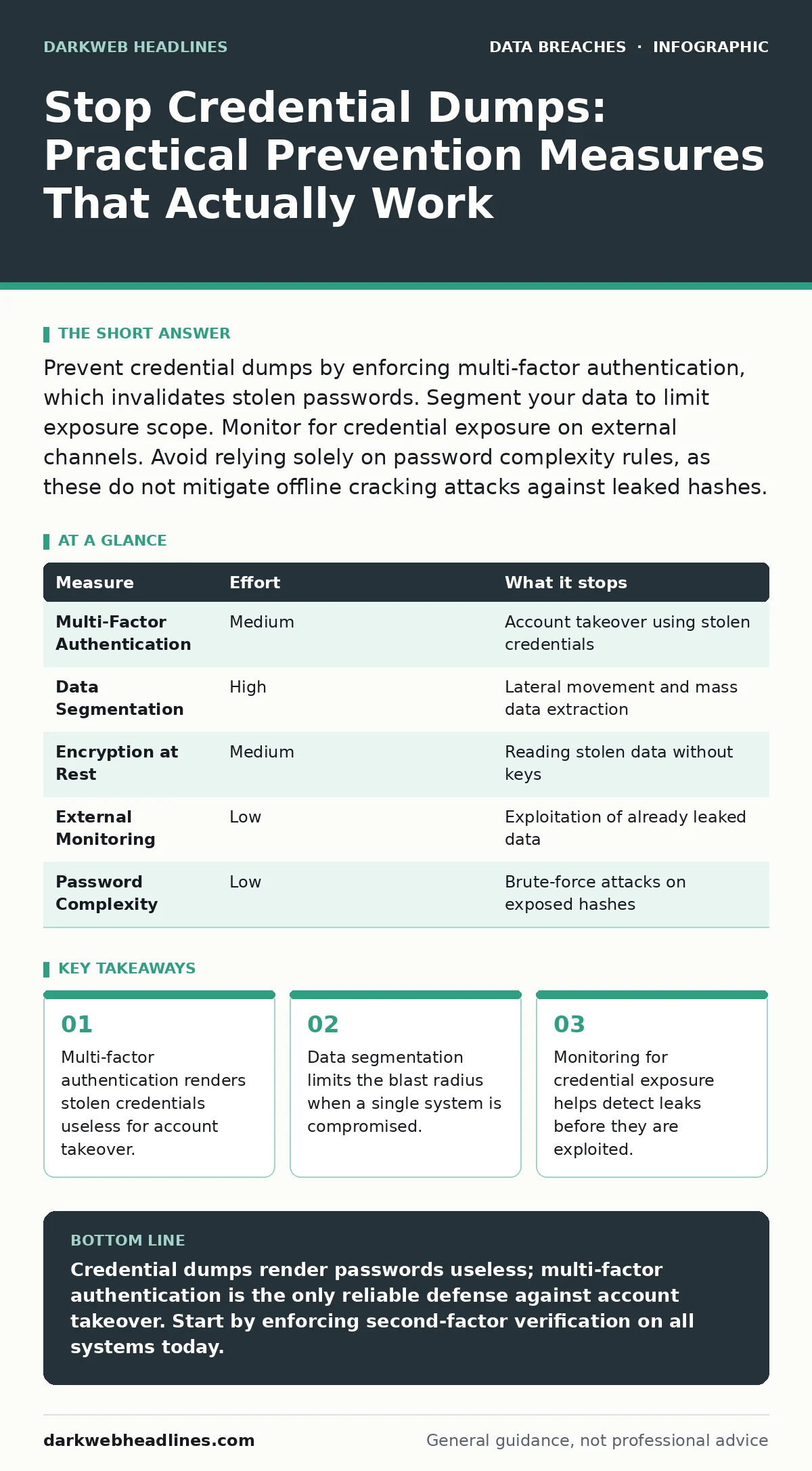
Prevent credential dumps by enforcing multi-factor authentication, which invalidates stolen passwords. Segment your data to limit exposure scope. Monitor for credential exposure on external channels. Avoid relying solely on password complexity rules, as these do not mitigate offline cracking attacks against leaked hashes.
The Reality of Stored Credentials
Most organizations assume that if their internal systems are secure, their credentials are safe. This assumption fails when attackers target the storage layer rather than the authentication layer. Credential dumps occur when adversaries extract user identity data from databases, memory, or configuration files. This data often includes usernames, password hashes, or even plaintext secrets.
Once an attacker possesses this data, the breach has technically occurred. The subsequent steps involve offline processing, where the attacker uses high-performance hardware to crack the hashes. Your defenses at this stage are limited to how well you protected the storage and how quickly you can invalidate the compromised secrets.
Multi-Factor Authentication as a Hard Stop
Multi-factor authentication requires a second form of verification, such as a time-based code or a hardware key, in addition to a password. This is the single most effective measure against credential dumps. Even if an attacker obtains your password hash and cracks it, they cannot access the account without the second factor.
Imagine an attacker steals a database containing millions of password hashes. They spend weeks cracking them. When they attempt to log in, the system rejects the request because the second factor is missing. The stolen data becomes worthless for immediate account takeover.
This measure does not prevent the theft of the data itself. The attacker still has your hash. However, it removes the utility of that data for the most common attack vector: account takeover. You must enforce this across all critical systems, not just administrative consoles.
Data Segmentation and Least Privilege
If you cannot stop the data from being stolen, you must limit what is stolen. Data segmentation involves separating sensitive information from general operational data. This ensures that a breach in one area does not grant access to the entire credential store.
Apply the principle of least privilege to your database access. Application servers should only access the specific tables they need, and they should not have the ability to export large datasets. If an attacker compromises a web application, they should not automatically gain access to the central identity provider.
This approach increases the effort required for an attacker. They must move laterally through the network to reach the high-value credential stores. Each hop presents an opportunity for detection and blocking. It does not eliminate risk, but it drastically reduces the value of a single point of compromise.
Encryption at Rest and Key Management
Encrypting data at rest ensures that if an attacker steals the database files, they cannot read the contents without the encryption keys. This is standard practice, but it is often implemented incorrectly. Using the same key for all databases defeats the purpose of segmentation.
Key management is the hidden cost of encryption. If the keys are stored on the same server as the data, an attacker who compromises the server can extract both. You must separate key storage from data storage. Use a dedicated hardware security module or a managed key service that enforces strict access controls.
Monitoring for External Exposure
You cannot always prevent data from leaving your environment. Data scraping tools constantly search for exposed files on public repositories, misconfigured cloud storage leaks, and accidental data disclosure on forums. You must monitor for your own data in these spaces.
Set up alerts for your domain name, email addresses, and unique identifiers on these external platforms. When you detect exposure, you can act before the data is widely distributed. This is a reactive measure, but it reduces the window of opportunity for attackers.
This monitoring complements internal controls. It catches failures in your prevention strategy. It does not replace the need for strong internal security, but it provides an early warning system for breaches that have already occurred.
See also: Data Masking Limits: Benefits, Blind Spots, and When to Skip It · Data Classification: How Labeling Information Reduces Breach Impact
The Limits of Password Complexity
For years, organizations have relied on complex password rules to prevent breaches. These rules require users to include uppercase letters, numbers, and symbols. This approach does not work against credential dumps.
When attackers obtain password hashes, they use brute-force or dictionary attacks. Complex passwords slow down these attacks slightly, but they do not stop them. Modern cracking hardware can test billions of combinations per second. A complex password may take longer to crack, but it will eventually be broken if the hash is exposed.
Measures That Remove Risk
The following table ranks measures by how much risk they remove from credential dump scenarios.
| Measure | Effort | What it stops |
|---|---|---|
| Multi-Factor Authentication | Medium | Account takeover using stolen credentials |
| Data Segmentation | High | Lateral movement and mass data extraction |
| Encryption at Rest | Medium | Reading stolen data without keys |
| External Monitoring | Low | Exploitation of already leaked data |
| Password Complexity | Low | Brute-force attacks on exposed hashes |
Immediate Action Items
You must prioritize measures that invalidate stolen data. Multi-factor authentication is the highest priority. Ensure it is enabled for all user accounts, especially those with access to sensitive data.
Next, review your database access controls. Ensure that application accounts have only the permissions they need. Remove any administrative access that is not strictly required for daily operations.
Finally, begin monitoring for your data on external platforms. Use automated tools to scan for exposed files and credentials. This allows you to respond to leaks before they are widely exploited.
- Enable multi-factor authentication for all critical accounts.
- Audit database permissions and apply the principle of least privilege.
- Set up alerts for external exposure of your credentials.
Key takeaways
- Multi-factor authentication renders stolen credentials useless for account takeover.
- Data segmentation limits the blast radius when a single system is compromised.
- Monitoring for credential exposure helps detect leaks before they are exploited.
Credential dumps render passwords useless; multi-factor authentication is the only reliable defense against account takeover. Start by enforcing second-factor verification on all systems today.
Frequently asked questions
Does changing passwords after a breach help?
Changing passwords helps only if the attacker has not yet cracked the hashes. If the hashes are already cracked, changing passwords is too late. Multi-factor authentication is required to stop access.
How do I know if my credentials were dumped?
You may not know immediately. Monitoring for credential exposure on external platforms is the primary way to detect leaks. Look for alerts from security services or search for your domain in public repositories.
Is encryption enough to protect credentials?
No. Encryption protects the data at rest, but if the keys are compromised, the data is readable. Encryption must be combined with strict key management and access controls to be effective.
What is the difference between a credential dump and a data scrape?
A credential dump involves stealing data from your internal systems. Data scraping involves collecting publicly available data from the internet. Both result in exposed credentials, but the source differs.
How this guide was produced: written by the DarkWeb Headlines editorial team with AI assistance, checked against the public references listed below, and reviewed when the facts change. See our editorial policy or report an error.