Data Masking Limits: Benefits, Blind Spots, and When to Skip It
Data masking hides sensitive content by replacing it with fictional data, yet it fails to protect against system-level access or logical inference attacks that bypass the visual layer.

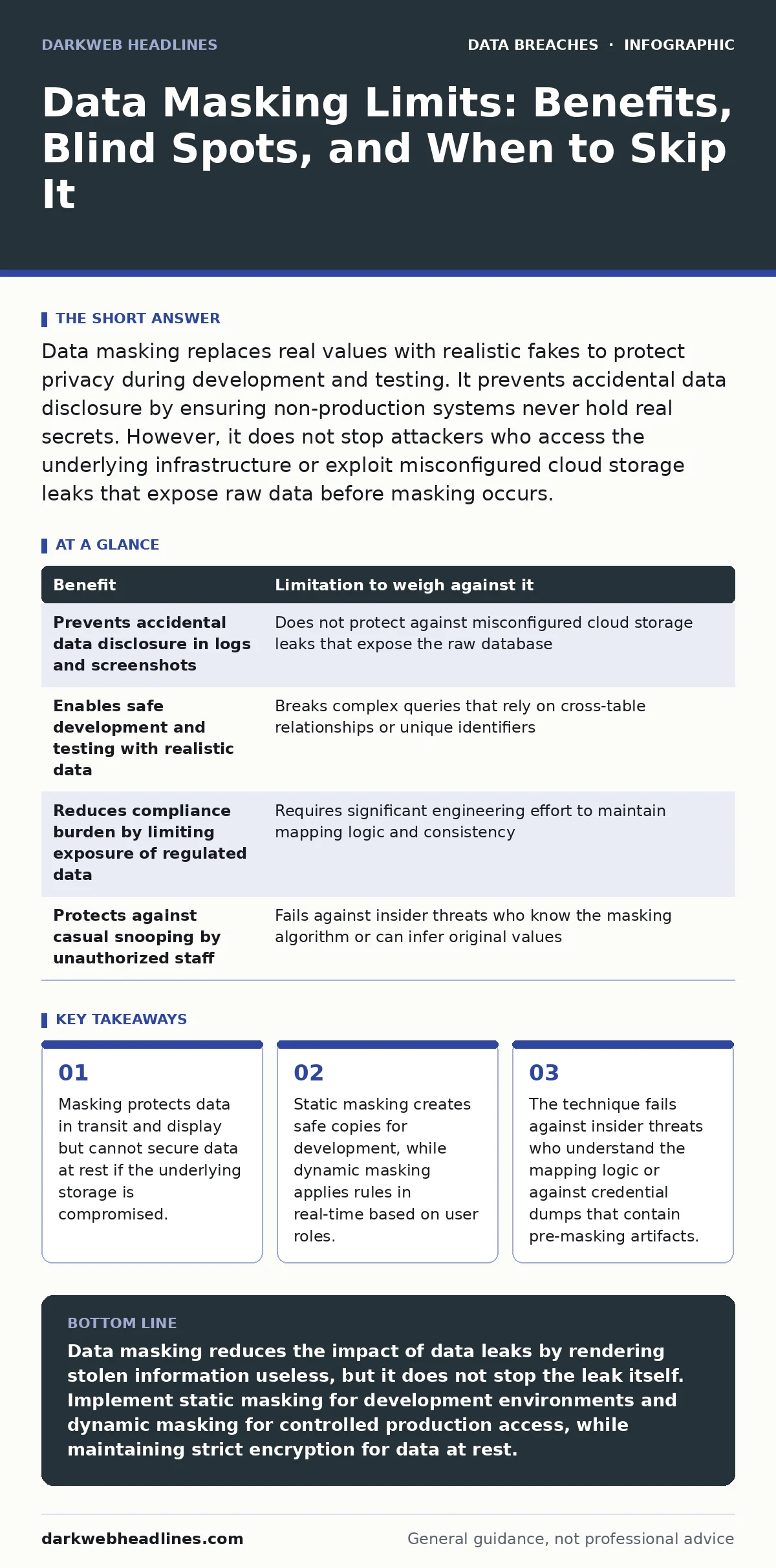
Data masking replaces real values with realistic fakes to protect privacy during development and testing. It prevents accidental data disclosure by ensuring non-production systems never hold real secrets. However, it does not stop attackers who access the underlying infrastructure or exploit misconfigured cloud storage leaks that expose raw data before masking occurs.
The Mechanics of Value Replacement
Data masking is a security technique that replaces sensitive data with realistic but fictitious content. The goal is to preserve the format and functional integrity of the data while removing its association with any real individual or entity. When you mask a credit card number, for instance, the system might generate a new number that passes all validation checks but does not link to an actual bank account.
This process differs from encryption. Encryption allows authorized parties to reverse the process and retrieve the original data using a key. Masking is often one-way. Once the data is masked, the original value is typically destroyed or stored separately in a highly restricted environment. This distinction matters because masking aims to reduce the attack surface by ensuring that even if data is stolen, it is useless to the attacker.
Static Versus Dynamic Approaches
There are two primary methods for applying these transformations: static and dynamic. Static masking occurs before data is loaded into a non-production environment. You take a copy of your production database, run it through a masking engine, and load the sanitized version into your testing servers. This is useful for developers who need large datasets to test software performance without accessing live customer records.
Dynamic masking, by contrast, occurs at the point of access. The data remains in its original form in the database. When a user queries the system, the application layer intercepts the request and checks the user’s permissions. If the user lacks clearance, the system returns masked values in real-time. If the user has clearance, they see the raw data. This method ensures that production systems always hold the truth, but it adds computational overhead to every query.
The choice between these methods depends on your infrastructure and risk tolerance. Static masking isolates risk completely by keeping real data off test servers. Dynamic masking keeps data current but requires strict identity management to ensure the right people see the right data.
The Hidden Cost of Context Loss
A major limitation of data masking is the destruction of context. Many analytical tools rely on relationships between data points. If you mask a user’s location and their transaction history independently, you may break the correlation between them. A fraud detection algorithm might fail because it can no longer see that a specific user suddenly made a purchase in a country they have never visited.
This loss of correlation makes masked data less valuable for training machine learning models. If the synthetic data does not perfectly mimic the statistical distribution of the real data, the models trained on it will perform poorly in production. You must carefully balance privacy with data utility. Over-masking renders data useless for analysis. Under-masking leaves identifiable patterns that an attacker could exploit through re-identification attacks.
Benefits and Limitations Table
| Benefit | Limitation to weigh against it |
|---|---|
| Prevents accidental data disclosure in logs and screenshots | Does not protect against misconfigured cloud storage leaks that expose the raw database |
| Enables safe development and testing with realistic data | Breaks complex queries that rely on cross-table relationships or unique identifiers |
| Reduces compliance burden by limiting exposure of regulated data | Requires significant engineering effort to maintain mapping logic and consistency |
| Protects against casual snooping by unauthorized staff | Fails against insider threats who know the masking algorithm or can infer original values |
When It Is Worth It
You should implement data masking when you must share data with third parties or external developers. Sharing raw customer data with a vendor for testing is a high-risk activity. If that vendor suffers a breach, your data is exposed. Masking ensures that the vendor gets the functional behavior of the data without the liability of holding real secrets. This is particularly critical for regulated industries where privacy laws are strict.
It is also worth it for internal development environments. Developers often need large datasets to test how software behaves under load. Giving them access to production data violates the principle of least privilege. By providing them with a masked copy, you allow them to do their jobs effectively without granting them access to live secrets. This reduces the risk of credential exposure if a developer’s workstation is compromised.
Static masking is the preferred method here. It creates a clear boundary between production and non-production. You can audit the masking process to ensure no real data slipped through. This provides a verifiable safety net for your development lifecycle.
See also: Stop Credential Dumps: Practical Prevention Measures That Actually Work · Data Classification: How Labeling Information Reduces Breach Impact
When It Is Not Worth It
Data masking is not worth it if you are trying to protect data at rest in a single, controlled environment. If your database is properly encrypted and access is strictly controlled, adding a masking layer adds complexity without significantly reducing risk. The masking logic itself becomes a target. Attackers may try to reverse-engineer the mapping to find patterns.
It is also not worth it for real-time operational decisions that require absolute accuracy. If a customer service agent needs to verify a payment, masking the last four digits of a card number might be helpful for privacy, but masking the entire number prevents them from doing their job. In these cases, dynamic masking with precise role-based access control is better than static masking. You need the real data to function, so you must protect access rather than obscure content.
The Myth of Absolute Anonymity
A common misconception is that masking makes data anonymous. This is rarely true. If an attacker combines masked data with other publicly available information, they may be able to re-identify individuals. This is known as a linkage attack. For example, if you mask names but keep zip codes and birth dates, an attacker can cross-reference this with voter registration records to find the original identity.
You must treat masked data as sensitive. Just because a name is replaced with "John Doe" does not mean the record is safe. The surrounding metadata may still reveal too much. Always apply data classification policies to determine what fields need masking. Do not assume that removing direct identifiers is enough. You must also consider quasi-identifiers that can be used to narrow down the pool of potential identities.
Integrating With Broader Security
Data masking works best when combined with other security measures. It does not replace the need for strong access controls or encryption. It is one layer in a defense-in-depth strategy. You should also monitor for data scraping attempts that might try to collect enough masked records to reverse the process.
Regular audits are necessary to ensure the masking rules are still effective. As your data schema evolves, new fields may be added that contain sensitive information. If your masking engine is not updated, these new fields will be exposed. Automate the discovery of sensitive data to ensure that your masking rules keep pace with your data changes.
Key takeaways
- Masking protects data in transit and display but cannot secure data at rest if the underlying storage is compromised.
- Static masking creates safe copies for development, while dynamic masking applies rules in real-time based on user roles.
- The technique fails against insider threats who understand the mapping logic or against credential dumps that contain pre-masking artifacts.
Data masking reduces the impact of data leaks by rendering stolen information useless, but it does not stop the leak itself. Implement static masking for development environments and dynamic masking for controlled production access, while maintaining strict encryption for data at rest.
Frequently asked questions
Does data masking protect against SQL injection attacks?
No, masking does not prevent SQL injection. It only changes the data returned. If an attacker injects code, they can still manipulate the database structure or extract metadata, even if the values are masked.
Can masked data be unmasked later?
Typically, no. Static masking is a one-way process designed to destroy the link to the original data. Dynamic masking is reversible because it only hides the view, but the underlying data remains unchanged.
How does masking differ from data tokenization?
Tokenization replaces sensitive data with a unique token that can be reversed using a secure vault. Masking replaces data with realistic but fake values that cannot be reversed to the original. Tokenization is better for payment processing where you need to reverse the transaction.
Is data masking required by GDPR or HIPAA?
These regulations require protecting personal data but do not mandate specific technical controls. Masking is a recommended best practice to meet the requirement of minimizing data exposure, but you can use other methods like encryption or pseudonymization.
How this guide was produced: written by the DarkWeb Headlines editorial team with AI assistance, checked against the public references listed below, and reviewed when the facts change. See our editorial policy or report an error.