What Is Tokenization in Banking: Protecting Payment Data
Tokenization replaces sensitive payment details with useless random strings, ensuring that stolen data cannot be used to make fraudulent transactions even if attackers breach the system.
Tokenization in banking substitutes sensitive account numbers with non-sensitive equivalents called tokens. These tokens hold no mathematical relationship to the original data. Attackers who steal tokens cannot reverse them into real numbers. This method protects your financial information during online and mobile payments without slowing down transaction processing speeds.
The Core Mechanism of Payment Security
Imagine handing a courier a sealed envelope containing your house keys. The courier delivers the envelope to the bank vault. The bank generates a unique receipt number and gives that number to the store. The store uses the receipt to request payment. If a thief intercepts the receipt, they have only a piece of paper with a number that means nothing to them. They cannot open your door. This analogy describes how tokenization works in banking systems. It separates the sensitive data from the transaction process entirely.
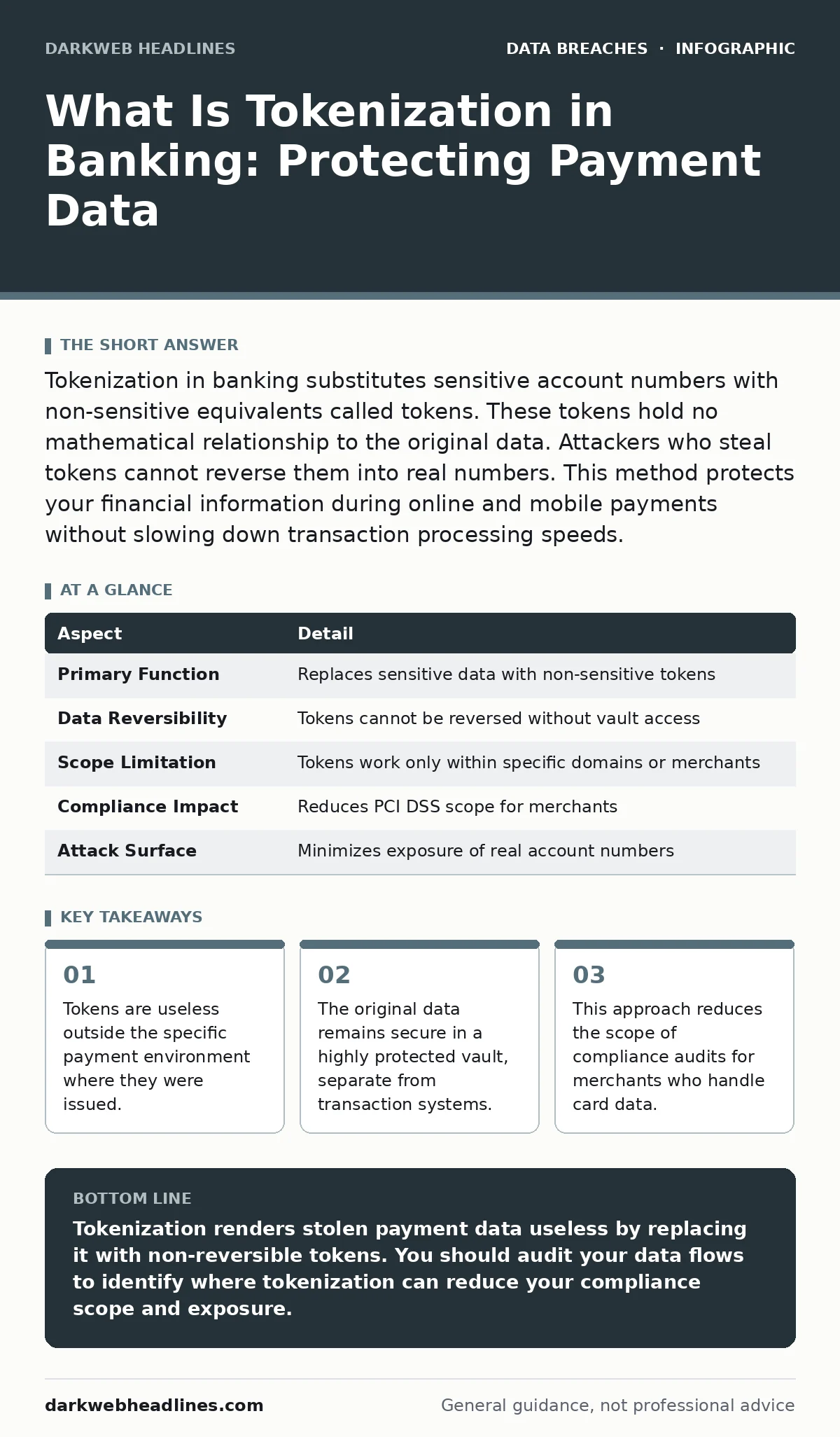
Tokenization replaces sensitive data, such as a Primary Account Number (PAN), with a surrogate value called a token. This token serves as a placeholder during transactions. The original data is stored securely in a dedicated system known as a token vault. The vault is the only place where the mapping between the token and the real account number exists. When a payment is processed, the token is sent to the payment network. The network converts the token back to the original number only within its secure environment. This conversion happens in milliseconds. The merchant never sees the actual card number.
| Aspect | Detail |
|---|---|
| Primary Function | Replaces sensitive data with non-sensitive tokens |
| Data Reversibility | Tokens cannot be reversed without vault access |
| Scope Limitation | Tokens work only within specific domains or merchants |
| Compliance Impact | Reduces PCI DSS scope for merchants |
| Attack Surface | Minimizes exposure of real account numbers |
What Is Tokenization in Banking for Consumers
You benefit from this technology every time you use a mobile wallet or an online shopping cart. When you add a card to a digital payment app, the app sends the card details to the token service provider. The provider returns a device-specific token. This token is tied to your specific phone or computer. If someone steals your physical phone, they cannot use the stored payment credentials on a different device. The token is invalid elsewhere. This constraint adds a layer of security that static card numbers do not provide.
The process ensures that your real account number never leaves the secure environment of the payment network or the token vault. Merchants store only the token in their databases. If a merchant suffers a data breach, the attackers retrieve only useless tokens. They cannot use these tokens to charge your account. This protection extends to recurring payments and subscriptions. The token remains valid for the specific merchant but cannot be reused by other parties. You maintain control over which entities can initiate charges.
How Tokenization Differs from Encryption
Many people confuse tokenization with encryption. Both methods protect sensitive data, but they operate differently. Encryption transforms data using a mathematical algorithm and a key. The encrypted data can be reversed back to the original value if you possess the correct decryption key. If an attacker steals both the encrypted data and the key, they can read the information. Tokenization does not use a mathematical relationship. The token is a randomly generated value. There is no algorithm to reverse it. The only way to get the original data is to query the token vault.
This distinction matters for security architecture. Encryption protects data at rest and in transit. It is useful for securing databases and communication channels. Tokenization protects data by making it irrelevant to attackers. It limits the value of stolen information. In a banking context, tokenization is preferred for payment processing because it reduces the risk of key management failures. You do not need to worry about protecting decryption keys in the same way. The token itself is the security boundary.
Who Is Affected by Tokenization Standards
Merchants, payment processors, and financial institutions all interact with tokenization services. For merchants, adopting tokenization reduces the complexity of maintaining compliance with security standards. Because they do not store sensitive card data, their audit scope shrinks. They focus on securing the tokens rather than the original numbers. This shift lowers operational costs and reduces the risk of non-compliance penalties. Payment processors act as the bridge between the merchant and the token vault. They ensure that tokens are formatted correctly and transmitted securely.
Financial institutions issue the tokens and manage the vaults. They bear the responsibility for the security of the mapping table. If the vault is compromised, the entire tokenization model fails. Therefore, banks invest heavily in securing these systems. They use multi-factor authentication, strict access controls, and continuous monitoring. Consumers are affected indirectly. They experience faster checkout processes and enhanced fraud protection. They do not need to change their behavior. The security happens in the background. The only visible change is the use of digital wallets and one-click payment options.
Common Misconceptions About Data Protection
People often believe that tokenization eliminates the need for other security measures. This is incorrect. Tokenization protects the data value, but it does not prevent unauthorized access to systems. Attackers can still disrupt services, steal customer identities, or damage reputations. You must combine tokenization with strong network security, intrusion detection, and regular audits. Tokenization is a specific tool for protecting payment data, not a universal shield against all cyber threats.
Another misconception is that tokens are permanent. Tokens can be revoked. If you lose your device or suspect fraud, you can request a new token. The old token becomes invalid immediately. This revocation process is a feature, not a bug. It allows you to cut off compromised credentials without changing your actual bank account number. You maintain continuity of service while neutralizing the threat. Understanding this dynamic helps you manage your digital financial life more effectively.
See also: Stop Credential Dumps: Practical Prevention Measures That Actually Work · Data Classification: How Labeling Information Reduces Breach Impact
Integrating Tokenization with Broader Security
Tokenization works best when combined with other data protection strategies. For instance, data classification helps identify which information requires tokenization. Not all data needs this level of protection. You apply tokenization to high-value targets like payment credentials. Lower-risk data might only need encryption or data masking. This tiered approach optimizes security spending. It ensures that resources are focused where the risk is highest.
Monitoring for data leaks is also critical. Even if the leaked data consists of tokens, the breach indicates a vulnerability in your perimeter. Attackers may use the breach as a stepping stone to other systems. Dark web monitoring can alert you if stolen tokens appear in illicit markets. While the tokens themselves are harmless, their presence signals a successful intrusion. You can then investigate the root cause and reinforce defenses. This proactive stance prevents future incidents.
Steps to Implement Tokenization Safely
You should start by assessing your current data handling processes. Identify all points where sensitive payment data enters your system. Map the flow of this data from entry to storage. Determine which components have direct access to the original numbers. This visibility is necessary for planning the tokenization rollout. You cannot protect what you cannot see. A clear data inventory ensures that no sensitive information is left behind.
Next, select a token service provider that meets industry standards. Verify their security certifications and audit reports. Ensure that their vault is isolated from your primary network. Configure the integration so that tokens are generated and returned seamlessly. Test the process thoroughly before going live. Monitor transaction success rates and error logs. Address any issues immediately. Once live, maintain strict access controls to the token vault. Limit who can view the mapping table. Regularly review these permissions to prevent insider threats.
Managing Risks Beyond Tokenization
Tokenization does not address all forms of fraud. It protects against data theft, but it does not stop social engineering or account takeover attacks. Attackers may trick users into revealing authentication codes or passwords. These credentials allow access to the account regardless of tokenization. You must educate users about phishing and social engineering tactics. Implement multi-factor authentication to add an extra layer of verification. This combination ensures that even if credentials are stolen, the attacker cannot proceed without the second factor.
Additionally, consider credit freezes for high-risk accounts. This measure prevents new accounts from being opened in your name. It complements tokenization by protecting your identity from misuse. Tokenization secures the payment data, while credit freezes secure your credit profile. Both measures work together to provide a holistic defense. You reduce the impact of breaches and limit the avenues for fraud. This layered approach is more effective than relying on a single technology.
Key takeaways
- Tokens are useless outside the specific payment environment where they were issued.
- The original data remains secure in a highly protected vault, separate from transaction systems.
- This approach reduces the scope of compliance audits for merchants who handle card data.
Tokenization renders stolen payment data useless by replacing it with non-reversible tokens. You should audit your data flows to identify where tokenization can reduce your compliance scope and exposure.
Frequently asked questions
Can tokens be reversed by hackers?
No, tokens are randomly generated values with no mathematical link to the original data. Reversing them requires access to the secure token vault, which is heavily protected and isolated from public networks.
Does tokenization replace the need for encryption?
No, tokenization and encryption serve different purposes. Encryption protects data in transit and at rest using keys, while tokenization replaces data with worthless surrogates. Both are often used together for layered security.
What happens if I lose my device with a stored token?
You can revoke the specific token associated with that device. The token becomes invalid immediately, preventing unauthorized use. You can then generate a new token for your replacement device without changing your bank account.
Is tokenization required by law?
Tokenization is not explicitly mandated by law in most jurisdictions. However, it helps organizations comply with data protection regulations by minimizing the storage and exposure of sensitive personal data, reducing legal and financial liabilities.
How this guide was produced: written by the DarkWeb Headlines editorial team with AI assistance, checked against the public references listed below, and reviewed when the facts change. See our editorial policy or report an error.