Data Classification: How Labeling Information Reduces Breach Impact
Classification does not stop attackers from entering your network; it stops them from finding the data worth stealing once they are inside.

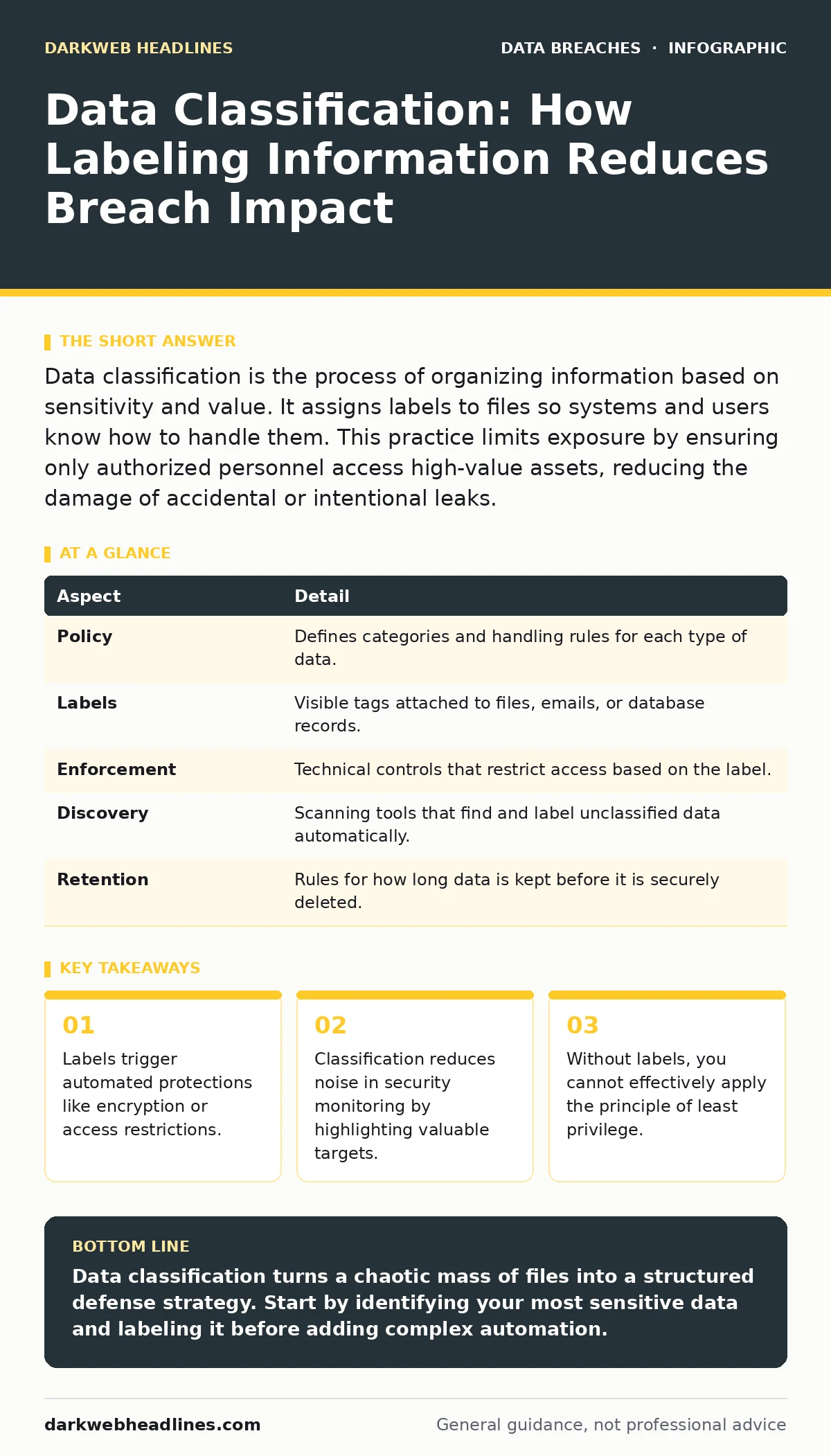
Data classification is the process of organizing information based on sensitivity and value. It assigns labels to files so systems and users know how to handle them. This practice limits exposure by ensuring only authorized personnel access high-value assets, reducing the damage of accidental or intentional leaks.
The Library Analogy
Imagine a library where every book sits on the same shelf. A child looking for a comic book might accidentally pull down a ledger containing private financial records. The library did not lock the ledger, but it also did not mark it as restricted. In digital systems, this lack of distinction creates risk. You cannot protect what you do not distinguish from the rest.
Data classification solves this by sorting information into categories. It tells you which files are public, which are internal, and which are highly sensitive. This sorting allows you to apply different levels of protection to different files. You do not waste resources locking down every single document. Instead, you focus your defenses on the data that actually matters.
What Classification Actually Solves
The primary problem classification solves is visibility. In most organizations, the majority of data has low value. Only a small fraction contains secrets that could cause harm if exposed. Without classification, security tools treat all data as equal. This creates alert fatigue for analysts and wastes storage on unnecessary encryption.
Classification creates a map of your data assets. It identifies the crown jewels. When an attacker breaches your perimeter, they are searching for specific high-value items. If you have classified your data, you can detect when those specific items are accessed. You can also prevent them from leaving the network. This turns a blind security posture into a targeted defense.
The Core Components
A working classification system relies on three parts: policy, labels, and enforcement. The policy defines the categories. It answers the question of what constitutes sensitive information. Labels are the tags applied to files or databases. They carry the policy decision into the technical environment. Enforcement is the automation that acts on those labels.
Policy without labels is just a document on a shelf. Labels without enforcement are mere suggestions. You need all three to create a functional barrier. For example, a policy might state that customer health records are confidential. The label marks those records as such. The enforcement mechanism then encrypts them and blocks unauthorized downloads.
| Aspect | Detail |
|---|---|
| Policy | Defines categories and handling rules for each type of data. |
| Labels | Visible tags attached to files, emails, or database records. |
| Enforcement | Technical controls that restrict access based on the label. |
| Discovery | Scanning tools that find and label unclassified data automatically. |
| Retention | Rules for how long data is kept before it is securely deleted. |
Where It Fits in Defense
Classification is the foundation for other security measures. It does not work in isolation. It feeds into access control systems. It informs data masking strategies. It guides incident response teams during a breach. Without classification, these other controls are blunt instruments.
Consider the principle of least privilege. This principle states that users should only have access to the data they need to do their jobs. You cannot implement this if you do not know which data is sensitive. Classification provides the context needed to grant precise permissions. It also helps prevent accidental data disclosure by users who do not realize they are handling sensitive information.
Common Misconceptions
Many people believe classification is a one-time project. They label their data once and forget about it. This is a critical error. Data changes. Users create new files. Mergers bring in new systems. A static classification system becomes outdated quickly. You must treat classification as an ongoing process.
Another mistake is relying solely on manual labeling. Users are busy and often ignore prompts to classify files. This leads to inconsistent tagging. Automated tools that scan content for patterns, such as credit card numbers or social security numbers, are necessary. They ensure that sensitive data is labeled even when users fail to do so. This reduces the risk of misconfigured cloud storage leaks where sensitive files are accidentally made public.
See also: Data Masking Limits: Benefits, Blind Spots, and When to Skip It · Stop Credential Dumps: Practical Prevention Measures That Actually Work
The Hidden Costs of Ignoring It
The cost of not classifying data is not just a potential breach. It is also operational inefficiency. When all data is treated as high-priority, security teams spend time investigating false positives. They chase shadows instead of real threats. This wastes budget and slows down business operations.
Furthermore, regulatory compliance often requires specific handling for certain types of data. If you cannot identify where that data lives, you cannot prove compliance. Auditors will ask for evidence of controls. Without classification, you cannot provide that evidence. This can lead to fines and legal issues, even if no breach occurred.
Practical Application
Suppose a developer needs to test a new application. They request a copy of the production database. Without classification, the system grants access to the entire database. The developer now has access to real customer names and addresses. If their laptop is stolen, that data is exposed.
With classification, the system recognizes the database contains personally identifiable information. It triggers a data masking routine. The developer receives a copy with names and addresses replaced by fake data. The application still works for testing. The sensitive data remains protected. This scenario illustrates how classification enables business functions while maintaining security.
Integration with Other Controls
Classification must work with other security layers. It complements data scraping protections by identifying what is worth scraping. It supports credential exposure prevention by ensuring that code repositories containing secrets are labeled and scanned. It also helps mitigate the impact of credential dumps by limiting what an attacker can do with stolen login details.
If an attacker obtains credentials, they can log in as a legitimate user. If that user has access to all data, the breach is total. If classification restricts access, the attacker sees only what that user is allowed to see. They may find public files, but they will not find the sensitive records. This containment limits the damage significantly.
Key takeaways
- Labels trigger automated protections like encryption or access restrictions.
- Classification reduces noise in security monitoring by highlighting valuable targets.
- Without labels, you cannot effectively apply the principle of least privilege.
Data classification turns a chaotic mass of files into a structured defense strategy. Start by identifying your most sensitive data and labeling it before adding complex automation.
Frequently asked questions
How do I choose between three or four classification levels?
Start with three: Public, Internal, and Confidential. Add more levels only if you have specific regulatory requirements that demand finer distinctions. Simplicity improves adoption.
Does classification protect data in transit?
Not directly. Classification labels do not encrypt data. However, they can trigger encryption policies for data moving between systems. The label tells the system when to apply transport security.
Can automated tools misclassify data?
Yes. Automated tools use pattern matching. They may flag a test number as a real credit card. You need a validation process to review automated labels, especially for high-sensitivity categories.
How does this relate to data masking?
Classification identifies which data needs masking. Masking is the technique used to obscure that data. You classify first to determine what is sensitive, then apply masking to hide the sensitive parts from unauthorized users.
How this guide was produced: written by the DarkWeb Headlines editorial team with AI assistance, checked against the public references listed below, and reviewed when the facts change. See our editorial policy or report an error.