Credit Freezes for Small Business: Protecting Employee Identities
Credit freezes stop new account openings for employees, blocking identity theft even when your internal systems suffer a data breach.

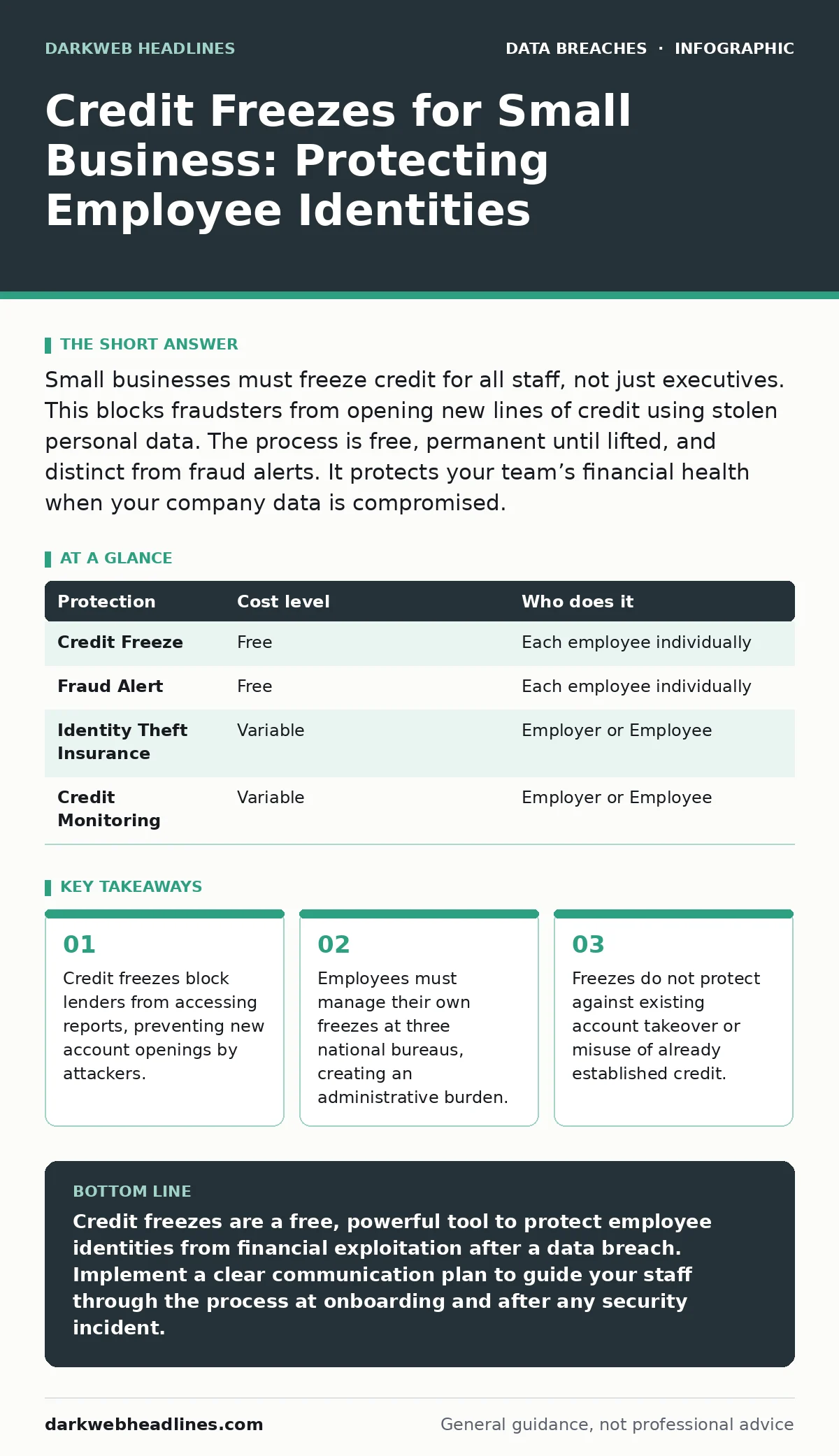
Small businesses must freeze credit for all staff, not just executives. This blocks fraudsters from opening new lines of credit using stolen personal data. The process is free, permanent until lifted, and distinct from fraud alerts. It protects your team’s financial health when your company data is compromised.
The Mechanics of Identity Theft at Scale
When a small business is breached, attackers rarely target the corporate bank account directly. They look for Personally Identifiable Information (PII) that has long-term value. Social security numbers, dates of birth, and addresses allow criminals to open new credit lines, utility accounts, or cell phone contracts. This is distinct from credential exposure, where stolen passwords grant access to existing systems. A credit freeze addresses the latter stage of the attack chain: the financial exploitation of stolen identity data.
A credit freeze, also known as a security freeze, restricts access to your credit report. Lenders cannot view your report to evaluate a new application. Without this view, they cannot approve new credit. This mechanism is free and legally mandated at the three major credit bureaus. It is not a fraud alert, which only lasts for a short period and may be ignored by some lenders. A freeze is a hard stop.
Why Small Businesses Must Act
Large enterprises have dedicated security operations centers. Small businesses often rely on a single IT administrator or an external provider. This creates a blind spot. You may secure your servers and encrypt your databases, but you cannot control what happens when an employee’s personal data leaves your network. If your company suffers from misconfigured cloud storage leaks, employee data may be exposed to the public internet.
The cost of identity theft for an employee is high. It involves hours of phone calls, disputed charges, and long-term damage to credit scores. If your staff is distracted by financial recovery, your business productivity suffers. More importantly, if employees trust that the company protects their personal data, morale remains stable. Ignoring this step shifts the burden of recovery entirely onto the individual, damaging the employer-employee relationship.
The Administrative Reality of Freezes
Implementing credit freezes for a team is not a technical task. It is an administrative one. There is no central button to freeze credit for multiple people. Each employee must contact the three national credit bureaus individually. They must provide proof of identity and receive a unique PIN or password for each bureau. These credentials allow them to temporarily lift the freeze when they apply for legitimate credit.
This process creates a hidden cost. You must communicate the necessity of the freeze clearly. You must provide instructions that are easy to follow. You must ensure that employees keep their PINs secure. If an employee loses their PIN, the recovery process can be slow and frustrating. This is a trade-off: high protection for the individual comes with high administrative friction for the organization.
| Protection | Cost level | Who does it |
|---|---|---|
| Credit Freeze | Free | Each employee individually |
| Fraud Alert | Free | Each employee individually |
| Identity Theft Insurance | Variable | Employer or Employee |
| Credit Monitoring | Variable | Employer or Employee |
What You Can Delegate
You cannot delegate the act of placing the freeze. That must be done by the account holder. However, you can delegate the communication and support. Your IT provider or HR department can create a standard operating procedure. They can draft the emails, create step-by-step guides, and set up a help desk ticket category for freeze-related questions.
Do not ask your IT team to place the freezes for you. This is a legal and privacy violation. Instead, ask them to verify that your internal data handling practices reduce the risk of accidental data disclosure. If you practice data classification correctly, sensitive PII is marked and stored separately. This limits the blast radius if a breach occurs. You can also delegate the monitoring of external threats. Your provider should watch for signs of credential dumps that might contain your company’s email domains.
Questions for Your IT Provider
When discussing identity protection with your service provider, ask specific questions. Do not accept vague assurances. You need to know how they handle the data that could lead to identity theft.
- How do you store employee tax documents and social security numbers?
- What is your protocol for detecting and responding to misconfigured cloud storage leaks?
- Do you provide training on recognizing phishing attempts that target personal data?
- How do you ensure the principle of least privilege is applied to access sensitive HR files?
- What is your process for notifying employees if their personal data is compromised?
See also: Data Scraping Risks and Protection for Small Businesses · Unauthorized Access Prevention Checklist for Systems
The Limits of Protection
A credit freeze does not protect against all threats. It only stops new accounts from being opened. It does nothing if an attacker uses a stolen credit card number to make purchases. It does not help if an attacker accesses an existing bank account using stolen credentials. This is why credit freezes must be part of a broader strategy.
Consider data masking in your internal systems. If developers need to test with real-world data, they should use masked versions that hide sensitive identifiers. This reduces the risk of accidental data disclosure during software development. Also, be aware of data scraping, where attackers collect information from public websites to build profiles. A freeze helps, but it does not remove the data from the web.
Integrating with Broader Security
Credit freezes are a reactive measure for identity data. They must be combined with proactive security controls. Ensure that your network uses strong authentication. Implement multi-factor authentication for all accounts. This reduces the risk of credential exposure. If attackers cannot access your systems, they cannot steal the data needed to bypass a freeze.
Regularly review your access logs. Look for unusual activity that might indicate a breach. If you see signs of unauthorized access, assume that data has been exfiltrated. Notify employees immediately and remind them to check their credit reports. This rapid response minimizes the window of opportunity for attackers.
Maintaining the Program
A credit freeze is not a one-time task. Employees will need to lift the freeze when they apply for mortgages, car loans, or new credit cards. They must be able to do this quickly. Provide them with a simple reference card that lists the contact information for the three bureaus and reminds them to use their PINs.
Periodically remind employees to check their credit reports for errors. Errors can damage their credit score just as much as fraud. If an employee sees an unfamiliar account, they should dispute it immediately. This vigilance complements the freeze by catching issues that the freeze did not prevent.
Key takeaways
- Credit freezes block lenders from accessing reports, preventing new account openings by attackers.
- Employees must manage their own freezes at three national bureaus, creating an administrative burden.
- Freezes do not protect against existing account takeover or misuse of already established credit.
Credit freezes are a free, powerful tool to protect employee identities from financial exploitation after a data breach. Implement a clear communication plan to guide your staff through the process at onboarding and after any security incident.
Frequently asked questions
Does a credit freeze affect my business credit score?
No. A credit freeze only affects personal credit reports. Business credit scores are separate and are not impacted by personal freezes.
Can I freeze credit for my employees remotely?
No. Each employee must place their own freeze. You can provide instructions and support, but you cannot act on their behalf.
How long does it take to lift a freeze?
It can be immediate if done online or by phone with the correct PIN. By mail, it can take several business days.
Do I need to freeze credit with all three bureaus?
Yes. Lenders may check any of the three major bureaus. If you only freeze one, attackers can use the others.
How this guide was produced: written by the DarkWeb Headlines editorial team with AI assistance, checked against the public references listed below, and reviewed when the facts change. See our editorial policy or report an error.