Real-Time Protection for Small Business: Low-Cost Defense Strategies
Real-time monitoring shifts security from reactive cleanup to immediate containment, stopping threats before they encrypt files or exfiltrate data.

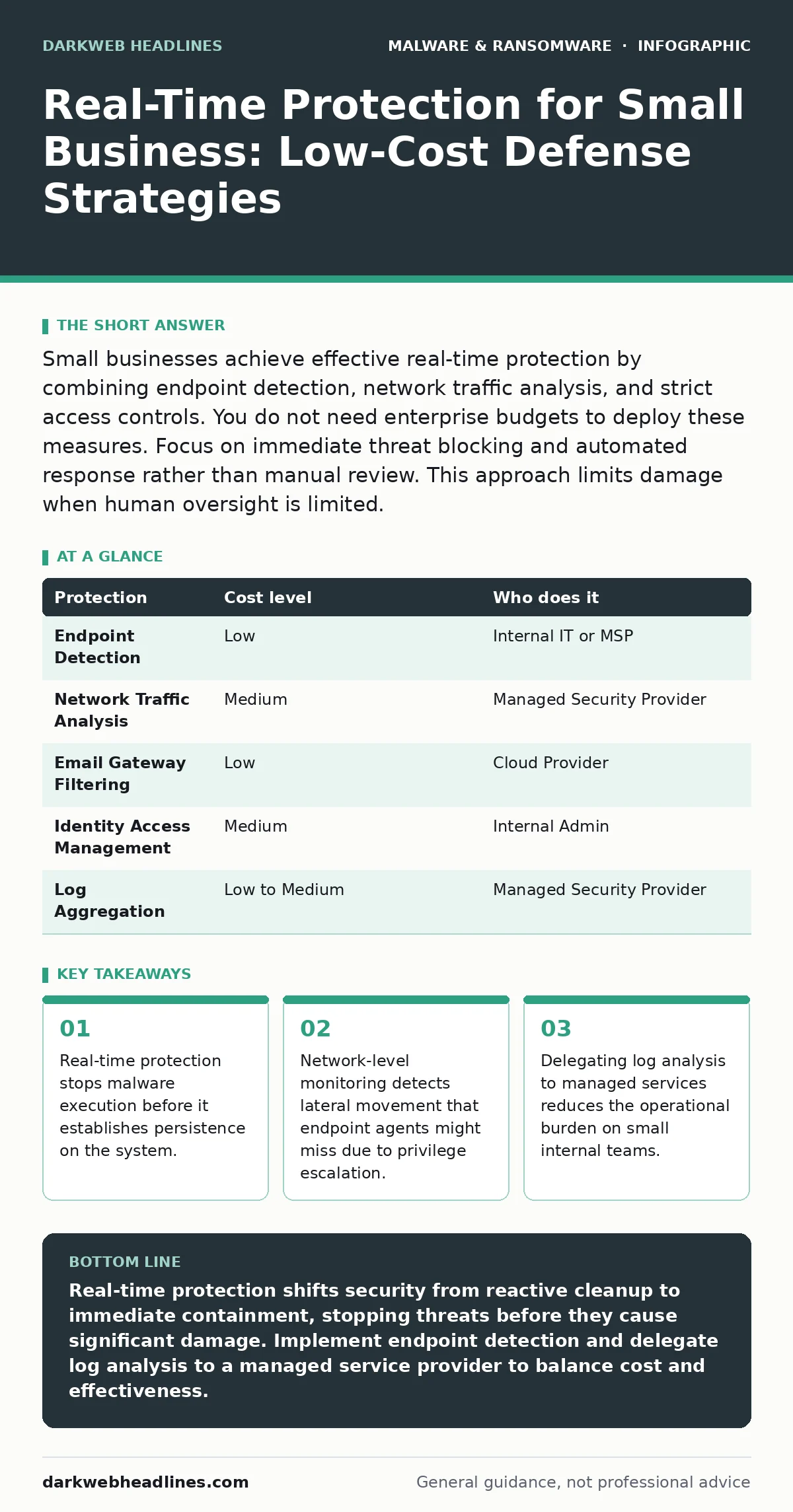
Small businesses achieve effective real-time protection by combining endpoint detection, network traffic analysis, and strict access controls. You do not need enterprise budgets to deploy these measures. Focus on immediate threat blocking and automated response rather than manual review. This approach limits damage when human oversight is limited.
Why Immediate Response Matters at Small Scale
Small organizations lack the depth of personnel required for lengthy incident response. When a threat actor breaches a small network, they often scan for valuable data or encryption targets within minutes. Real-time protection provides the immediate friction required to disrupt this timeline. Without continuous monitoring, detection relies on symptoms like system slowdowns or user reports. These indicators appear only after the malware has already executed its payload.
The primary advantage of real-time protection is containment. It prevents a single compromised workstation from becoming a launchpad for broader network intrusion. In a small environment, every device holds sensitive data. Protecting the perimeter is insufficient because insiders and remote workers bypass traditional firewalls. Endpoint-level monitoring ensures that execution policies apply regardless of physical location.
Affordable Detection Mechanisms
You do not need expensive hardware appliances to achieve continuous monitoring. Modern software solutions leverage cloud-based signatures and behavioral analysis to detect threats. These tools scan file activity, process creation, and registry modifications as they happen. The cost structure is typically subscription-based, scaling with the number of endpoints rather than the complexity of the infrastructure.
Behavioral analysis is particularly valuable for small teams. Unlike signature-based detection, which requires a known database of threats, behavioral analysis looks for suspicious actions. For example, a word processor attempting to execute code or access the network is highly unusual. The system flags this anomaly in real time. This method catches zero-day attacks that have no known signature yet.
Open standards for security information and event management allow smaller tools to integrate with larger frameworks. You can start with basic endpoint detection and response capabilities. These tools provide visibility into what is happening on each device. They alert administrators when a process attempts to disable security software or modify system files.
| Protection | Cost level | Who does it |
|---|---|---|
| Endpoint Detection | Low | Internal IT or MSP |
| Network Traffic Analysis | Medium | Managed Security Provider |
| Email Gateway Filtering | Low | Cloud Provider |
| Identity Access Management | Medium | Internal Admin |
| Log Aggregation | Low to Medium | Managed Security Provider |
The Hidden Cost of Manual Review
Real-time protection generates alerts. The hidden cost is the time required to triage these alerts. If your system flags every minor anomaly, your team will suffer from alert fatigue. They will begin ignoring warnings, which defeats the purpose of the protection. You must tune your detection rules to reduce noise while maintaining coverage.
Imagine a system that alerts on every failed login attempt. A user forgetting their password twice creates two alerts. A brute-force attack creates thousands. Without automated filtering, the administrator cannot distinguish between human error and a targeted attack. This is where the concept of dynamic malware analysis becomes relevant. Understanding how threats behave helps you prioritize which alerts require immediate human intervention.
To manage this cost, you should automate the response to known threats. If a file matches a known ransomware signature, the system should delete it and isolate the host automatically. Human review should be reserved for ambiguous cases. This balance ensures that your limited resources are focused on genuine risks rather than false positives.
What to Delegate to External Providers
Small businesses cannot maintain 24/7 security operations centers. You should delegate log analysis and threat hunting to managed security service providers. These providers use specialized tools to correlate events across multiple sources. They have the expertise to distinguish between benign activity and sophisticated attacks.
Delegation does not mean abdication. You must retain control over your security policies and access rights. The provider monitors the environment, but you decide who has access to critical data. This separation of duties reduces the risk of insider threats. It also ensures that your internal team focuses on business operations rather than constant surveillance.
Consider the complexity of macro security settings. Configuring these correctly requires deep knowledge of office applications. A provider can manage these configurations across your organization. They ensure that macros are disabled by default and only enabled for trusted sources. This reduces the attack surface without requiring your staff to become experts in application security.
Building a Layered Defense
Real-time protection is most effective when combined with other security measures. Network segmentation limits the spread of malware. If one device is compromised, the threat cannot easily move to other parts of the network. This containment strategy reduces the impact of a breach.
Identity and access management ensures that users have only the permissions they need. Principle of least privilege means that even if credentials are stolen, the attacker has limited access. You should integrate this with multi-factor authentication to prevent credential stuffing attacks.
Email remains a primary vector for initial infection. A robust email gateway filters out phishing attempts and malicious attachments before they reach the user. This reduces the likelihood of a user accidentally triggering a threat. It complements endpoint protection by stopping the attack at the entry point.
See also: Credit Freezes for Small Business: Protecting Employee Identities · Detect Process Injection: Signals, Logs, and Hidden Blind Spots
Questions to Ask IT Providers
When selecting a partner for real-time protection, you must verify their capabilities. Ask specific questions to ensure they can meet your needs. Do not accept vague answers about "comprehensive security." You need concrete details about their monitoring and response processes.
- What is the average time to detect and respond to a confirmed threat?
- How do you handle false positives to prevent alert fatigue?
- Can you provide examples of how you have contained ransomware attacks?
- What is your process for updating detection signatures and behavioral rules?
- How do you integrate with our existing identity and access management systems?
- What is your protocol for communicating incidents to our management team?
- Do you offer offline backups as part of your service, or is that separate?
Understanding these details allows you to compare providers objectively. It ensures that you are paying for actual protection rather than just software licenses. The goal is to find a partner who acts as an extension of your team.
Integrating with Existing Practices
Real-time protection must work with your current workflows. If it requires significant changes to how your staff operates, adoption will be low. You should choose solutions that integrate seamlessly with your existing tools. This includes email clients, file storage, and collaboration platforms.
Consider the risks associated with malicious browser extensions. These can bypass some endpoint protections by operating within the browser sandbox. Real-time monitoring should include browser activity. It should flag unusual data exfiltration or unauthorized API calls. This adds a layer of protection against web-based threats.
Finally, ensure that your backup strategy is independent of your real-time protection. If a threat compromises your monitoring system, it may also target your backups. Offline backups provide a recovery path that is immune to online attacks. This ensures business continuity even in the event of a severe breach.
Key takeaways
- Real-time protection stops malware execution before it establishes persistence on the system.
- Network-level monitoring detects lateral movement that endpoint agents might miss due to privilege escalation.
- Delegating log analysis to managed services reduces the operational burden on small internal teams.
Real-time protection shifts security from reactive cleanup to immediate containment, stopping threats before they cause significant damage. Implement endpoint detection and delegate log analysis to a managed service provider to balance cost and effectiveness.
Frequently asked questions
Does real-time protection slow down computer performance?
Modern solutions are optimized for minimal resource usage. They run in the background and only intervene when suspicious activity is detected. You may notice slight overhead, but it is generally negligible for business operations.
Can real-time protection stop all ransomware attacks?
No security measure guarantees complete protection. Real-time protection significantly reduces the risk by blocking execution and isolating infected devices. However, user error and zero-day vulnerabilities can still bypass these controls.
How often should I review my real-time protection settings?
You should review your settings quarterly or after any significant change in your business processes. Threat tactics evolve, and your detection rules must adapt. Regular reviews ensure that your defenses remain effective and do not disrupt legitimate work.
Is cloud-based real-time protection secure?
Cloud-based solutions use encryption to protect data in transit and at rest. They benefit from centralized updates and global threat intelligence. However, you must ensure that your provider follows strict security standards and compliance requirements.
How this guide was produced: written by the DarkWeb Headlines editorial team with AI assistance, checked against the public references listed below, and reviewed when the facts change. See our editorial policy or report an error.