Detect Process Injection: Signals, Logs, and Hidden Blind Spots
Process injection hides malicious code inside legitimate processes, making traditional signature-based detection fail until memory analysis reveals the anomaly.

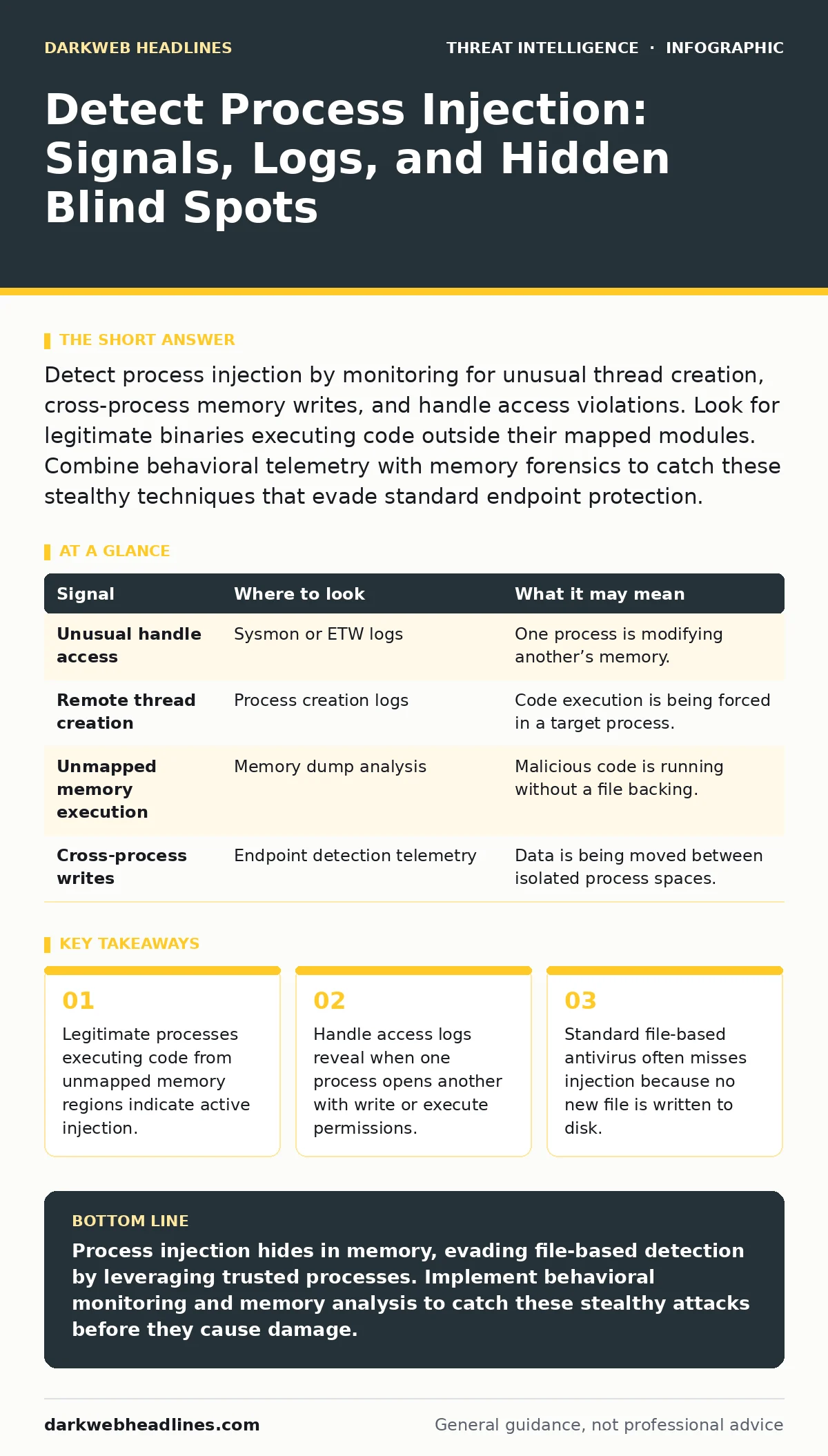
Detect process injection by monitoring for unusual thread creation, cross-process memory writes, and handle access violations. Look for legitimate binaries executing code outside their mapped modules. Combine behavioral telemetry with memory forensics to catch these stealthy techniques that evade standard endpoint protection.
The Mechanism of Stealth
Process injection allows an attacker to execute malicious code within the address space of a legitimate running process. This technique bypasses user account control prompts and avoids creating new process entries that might trigger alerts. The attacker writes their payload into the memory of a trusted application, such as a browser or system utility. They then force that application to execute the injected code as if it were its own.
This method relies on the operating system’s multitasking capabilities. Modern operating systems isolate processes to prevent interference. Injection breaks this isolation by gaining access to another process’s memory. The malicious code runs under the security context of the host process. This means it inherits the host’s privileges and network connections.
Imagine a scenario where a compromised script modifies a system update service. The service continues to run normally, but now it also sends data to an external server. To an observer looking at process lists, nothing appears wrong. The service is still the same executable with the same digital signature. The threat is invisible at the file level.
Signals in Process Creation Logs
The first sign of injection often appears in process creation logs. However, you must look beyond the parent-child relationship. Standard logging records which process started which. Injection often uses existing processes, so no new creation event occurs. You must correlate creation events with subsequent behavior.
Look for processes that spawn child processes with unexpected command lines. A browser launching a command shell is unusual. A system utility starting a network service is suspicious. These deviations from normal behavior patterns are early indicators. You should also watch for short-lived processes that appear and disappear quickly. These may be droppers that inject code and then terminate to avoid detection.
Memory and Handle Access Anomalies
The most reliable evidence of injection lies in memory access logs. You need to monitor for cross-process memory writes. This occurs when one process writes data to the memory space of another. The operating system uses handles to manage access to objects. A handle with write or execute permissions allows modification.
Monitoring tools can log when a process opens a handle to another process. Look for high-privilege processes opening handles to low-privilege ones with write access. This is rare in normal operations. Also, watch for writes to memory regions that are not mapped to any loaded module. Legitimate code usually resides in mapped sections of memory. Code running from unmapped memory is a hallmark of injection.
| Signal | Where to look | What it may mean |
|---|---|---|
| Unusual handle access | Sysmon or ETW logs | One process is modifying another’s memory. |
| Remote thread creation | Process creation logs | Code execution is being forced in a target process. |
| Unmapped memory execution | Memory dump analysis | Malicious code is running without a file backing. |
| Cross-process writes | Endpoint detection telemetry | Data is being moved between isolated process spaces. |
Behavioral Indicators in Network Traffic
Network traffic analysis can reveal injection when the host process behaves unexpectedly. A web browser should not be sending encrypted data to an unknown IP address on a non-standard port. A printer service should not be communicating with a cloud storage provider. These mismatches between process identity and network activity are red flags.
You must map network connections to the specific process making them. Standard firewalls often only see the port and IP. They do not always identify the originating process. Endpoint detection platforms provide this mapping. Look for processes that establish connections shortly after a memory modification event. This timing correlation strengthens the case for injection.
Command and control traffic often mimics legitimate protocols to avoid detection. The injected code may use DNS or HTTP to exfiltrate data. You must inspect the content of these communications. Anomalies in domain name query patterns or HTTP headers can reveal the presence of a beacon. The beacon is the injected code reporting back to the attacker.
Blind Spots in Traditional Detection
Traditional security tools have significant blind spots regarding process injection. Antivirus software primarily scans files on disk. Since injection occurs in memory, no new file is created. The malicious code exists only in RAM. When the process ends, the code disappears without a trace. This makes file-based detection ineffective.
Another blind spot is the use of legitimate system tools. Attackers often use built-in utilities like PowerShell or Windows Management Instrumentation. These tools are designed to be flexible and powerful. When used for injection, they look like normal administrative tasks. Distinguishing between legitimate administration and malicious abuse requires deep behavioral analysis.
PowerShell abuse is particularly common because of its scripting capabilities. Attackers can download and execute code directly in memory. This technique leaves no file artifacts. You must monitor for encoded commands and unusual script blocks. The complexity of these scripts often obfuscates their intent. Static analysis of the script text may fail to reveal the malicious payload.
See also: Initial Access Broker Response: Containment and Recovery Steps · How SOC Playbooks Work: Mechanism, Limits, and Execution
Tools for Deep Inspection
Detecting injection requires tools that can see into memory and system calls. Endpoint detection and response platforms are essential. They monitor system calls in real-time. This allows them to catch the act of injection as it happens. Look for platforms that support behavioral detection rather than just signature matching.
Memory forensics tools are also valuable. They can capture snapshots of system memory. These snapshots allow you to analyze running processes and loaded modules. You can identify injected code by looking for anomalies in memory structures. This is a post-incident technique but is crucial for understanding the full scope of an attack.
Log management systems help correlate events across different sources. You need to combine process logs, network logs, and security alerts. A single log entry may not be suspicious. But when correlated with other events, a pattern emerges. This holistic view is necessary to detect sophisticated injection attacks.
Threat intelligence feeds can provide context for observed behaviors. They offer indicators of compromise such as known malicious IPs or domains. Integrating these feeds into your detection rules helps identify known attack patterns. However, you must also develop custom rules for new and unknown threats.
Building a Detection Strategy
A robust detection strategy combines multiple layers of defense. Start by enabling detailed logging on your endpoints. Ensure that handle access and process creation events are recorded. Configure your SIEM to alert on anomalies in these logs. Set baselines for normal behavior and flag deviations.
Next, implement memory monitoring where possible. This is computationally expensive but provides the deepest visibility. Use it on critical systems where the risk is highest. Combine this with network traffic analysis to catch the results of injection. Look for processes that should not be communicating externally.
Regularly review and update your detection rules. Attackers constantly evolve their techniques. What works today may fail tomorrow. Stay informed about new injection methods. Participate in threat intelligence sharing communities. Learn from others’ experiences to improve your own defenses.
Key takeaways
- Legitimate processes executing code from unmapped memory regions indicate active injection.
- Handle access logs reveal when one process opens another with write or execute permissions.
- Standard file-based antivirus often misses injection because no new file is written to disk.
Process injection hides in memory, evading file-based detection by leveraging trusted processes. Implement behavioral monitoring and memory analysis to catch these stealthy attacks before they cause damage.
Frequently asked questions
Can antivirus software detect process injection?
Traditional antivirus struggles with injection because it focuses on files. Modern endpoint detection platforms use behavioral analysis to spot the memory modifications characteristic of injection.
How do I distinguish legitimate debugging from injection?
Legitimate debugging usually involves known development tools and occurs in controlled environments. Injection often involves unexpected processes accessing each other’s memory in production environments.
Is process injection reversible?
The injected code is lost when the process terminates. However, the damage caused by the executed code remains. You must remediate the system and remove any persistent mechanisms the attacker installed.
Why is memory forensics important for injection?
Memory forensics captures the state of running processes. It reveals code and data that never touched the disk, providing evidence of injection that file-based tools miss.
How this guide was produced: written by the DarkWeb Headlines editorial team with AI assistance, checked against the public references listed below, and reviewed when the facts change. See our editorial policy or report an error.