Threat Intelligence Feeds: 10 FAQs on Quality, Noise, and Integration
Most feeds fail because they deliver raw indicators without context, forcing teams to build custom filters that drain analyst time and obscure true threat patterns.

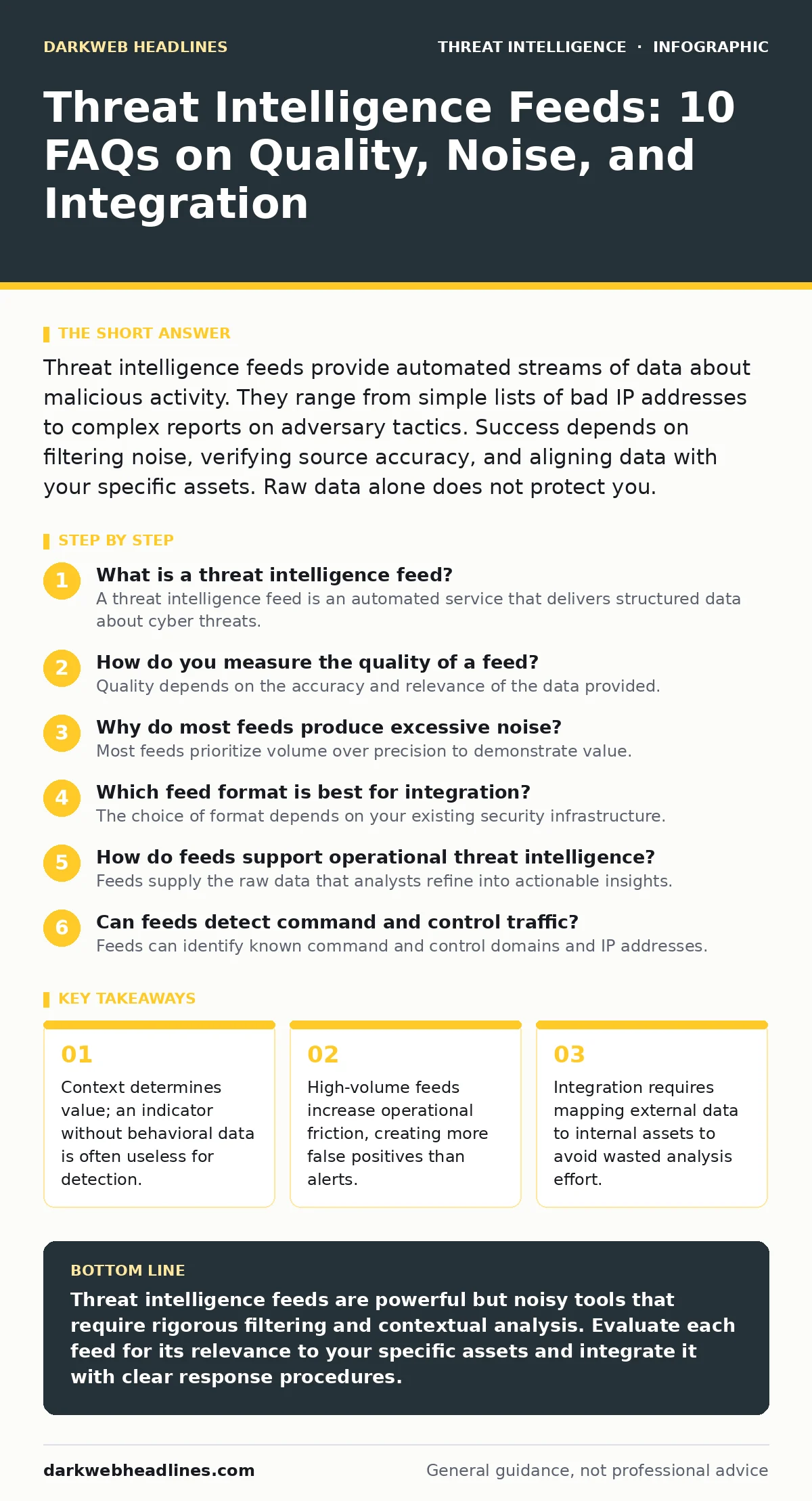
Threat intelligence feeds provide automated streams of data about malicious activity. They range from simple lists of bad IP addresses to complex reports on adversary tactics. Success depends on filtering noise, verifying source accuracy, and aligning data with your specific assets. Raw data alone does not protect you.
What is a threat intelligence feed?
A threat intelligence feed is an automated service that delivers structured data about cyber threats. This data typically includes indicators of compromise, such as malicious IP addresses, domain names, or file hashes. Feeds allow security tools to update their rules automatically. They range from free community lists to expensive commercial services. The core function is to provide external context for internal security monitoring.
How do you measure the quality of a feed?
Quality depends on the accuracy and relevance of the data provided. A high-quality feed has a low false-positive rate and includes metadata about the threat actor. You must verify that the indicators align with your organization's technology stack. If a feed reports on Linux exploits but you only run Windows servers, the data is irrelevant. Contextual data, such as the attack technique used, adds significant value.
Why do most feeds produce excessive noise?
Most feeds prioritize volume over precision to demonstrate value. They often aggregate data from multiple sources without verifying its current relevance. This creates a high signal-to-noise ratio that overwhelms security teams. Analysts spend more time filtering false positives than investigating real threats. This fatigue leads to alert blindness, where genuine alerts are ignored.
Which feed format is best for integration?
The choice of format depends on your existing security infrastructure. STIX and TAXII are open standards for sharing cyber threat intelligence. STIX defines the structure of the data, while TAXII provides the transport mechanism. These standards allow different security products to communicate seamlessly. Proprietary formats may require custom parsers, increasing maintenance overhead.
| Format | Standard | Use Case | Complexity |
|---|---|---|---|
| STIX/TAXII | Open | Enterprise SIEM | High |
| CSV/JSON | Common | Custom Scripts | Low |
| RSS | Legacy | Quick Updates | Low |
How do feeds support operational threat intelligence?
Feeds supply the raw data that analysts refine into actionable insights. Operational threat intelligence focuses on the immediate needs of defenders. It answers questions about how an adversary is attacking right now. Feeds provide the initial indicators, but human analysis adds the tactical context. This process turns raw data into decisions about blocking or monitoring.
See also: Deep Web Intelligence: Why It Changes Security Decisions · Cyber Espionage Myths: Why State Actors Fail and How They Actually Operate
Can feeds detect command and control traffic?
Feeds can identify known command and control domains and IP addresses. These are the communication channels attackers use to control infected systems. By matching network traffic against feed data, you can spot active breaches. However, attackers frequently change these indicators to evade detection. Feeds only show known bad actors, not new or custom infrastructure.
What is the hidden cost of free feeds?
Free feeds often lack rigorous validation processes, leading to stale or incorrect data. Integrating them requires significant manual effort to clean and verify the information. This hidden cost comes in the form of analyst time spent filtering noise. It also includes the risk of blocking legitimate traffic due to false positives. The labor cost often exceeds the price of a curated commercial feed.
How do feeds relate to process injection attacks?
Feeds may list indicators associated with tools used for process injection. Process injection is a technique where malware inserts code into a running process. However, feeds rarely detect the injection itself in real-time. They provide historical data about the malicious binaries involved. You must combine feed data with behavioral detection to catch the attack.
Why do feeds miss zero-day exploits?
Zero-day exploits target vulnerabilities that are unknown to the public. Feeds rely on observed data, which does not exist for brand-new attacks. Therefore, feeds cannot provide indicators for exploits that have never been seen. They are reactive, not predictive. Defense against zero-days requires behavioral analysis, not indicator matching.
How do you automate feed integration effectively?
Automation requires mapping feed data to your specific security tools. You must define rules that determine which indicators trigger alerts. Simple blocklists are easy to implement but prone to errors. Complex integrations use enrichment engines to add context before alerting. Test your automation in a sandbox to avoid disrupting operations.
How do feeds complement SOC playbooks?
Feeds provide the triggers that initiate response procedures. SOC playbooks define the steps analysts take when an alert fires. A feed indicator might start the process, but the playbook guides the investigation. This combination ensures consistent and rapid response. Without playbooks, feed data becomes a list of unactionable alerts.
Do feeds help prevent credential dumping?
Feeds can identify tools and hashes associated with credential dumping techniques. Credential dumping is the theft of password hashes from memory or storage. However, feeds do not stop the technique itself. They help you identify if the tools are being used on your network. Prevention requires endpoint detection and response capabilities.
How do you handle outdated indicators in feeds?
Indicators of compromise have a short lifespan. IP addresses and domains change frequently as attackers rotate their infrastructure. You must implement expiration dates for indicators in your system. Regularly purging old data keeps your detection rules effective. Stale indicators increase noise and reduce the signal quality.
What is the role of network enumeration in feed usage?
Network enumeration helps you understand your own assets and their exposure. When you integrate feeds, you must filter out indicators that do not match your network. This prevents alerts for attacks targeting other organizations. It also helps you prioritize threats that are relevant to your specific environment. Knowing your attack surface is the first step in using feeds effectively.
How do feeds integrate with security metrics?
Feeds contribute data for measuring security performance. You can track metrics such as the time to block known malicious IPs. This helps you evaluate the effectiveness of your detection systems. However, metrics should focus on outcomes, not just volume. Counting blocked indicators is less useful than measuring prevented incidents.
Can feeds detect PowerShell abuse?
Feeds may list hashes of malicious PowerShell scripts. PowerShell abuse involves using the legitimate PowerShell tool for malicious purposes. However, the tool itself is not malicious. Feeds cannot distinguish between benign and malicious use based solely on the tool. Behavioral detection is required to identify abuse. Feeds provide context about known malicious scripts.
What is the future of threat intelligence feeds?
Feeds are moving towards automated sharing and machine-readable formats. Standards like STIX 2.1 enable real-time sharing between organizations. This allows for faster collective defense against emerging threats. Artificial intelligence may help filter noise and predict trends. However, human analysis remains critical for understanding context.
Key takeaways
- Context determines value; an indicator without behavioral data is often useless for detection.
- High-volume feeds increase operational friction, creating more false positives than alerts.
- Integration requires mapping external data to internal assets to avoid wasted analysis effort.
Threat intelligence feeds are powerful but noisy tools that require rigorous filtering and contextual analysis. Evaluate each feed for its relevance to your specific assets and integrate it with clear response procedures.
Frequently asked questions
Should I block all indicators from a threat feed automatically?
No, automatic blocking can disrupt legitimate services. Instead, use feeds for monitoring and enrichment, then block only after verification.
How often should I update my threat intelligence feeds?
Update frequency depends on the feed provider and your risk tolerance. Real-time feeds require constant processing, while daily updates may suffice for some organizations.
Can small organizations benefit from threat intelligence feeds?
Yes, but they should start with curated, low-volume feeds to avoid resource drain. Focus on high-impact indicators relevant to your industry.
What is the difference between tactical and strategic intelligence feeds?
Tactical feeds provide immediate indicators for blocking, while strategic feeds offer broader trends and adversary profiles. Both serve different defensive needs.
How this guide was produced: written by the DarkWeb Headlines editorial team with AI assistance, checked against the public references listed below, and reviewed when the facts change. See our editorial policy or report an error.