Deep Web Intelligence: Why It Changes Security Decisions
The deep web hides stolen credentials and infrastructure details that surface weeks before an attack, allowing teams to interrupt campaigns before they reach production systems.

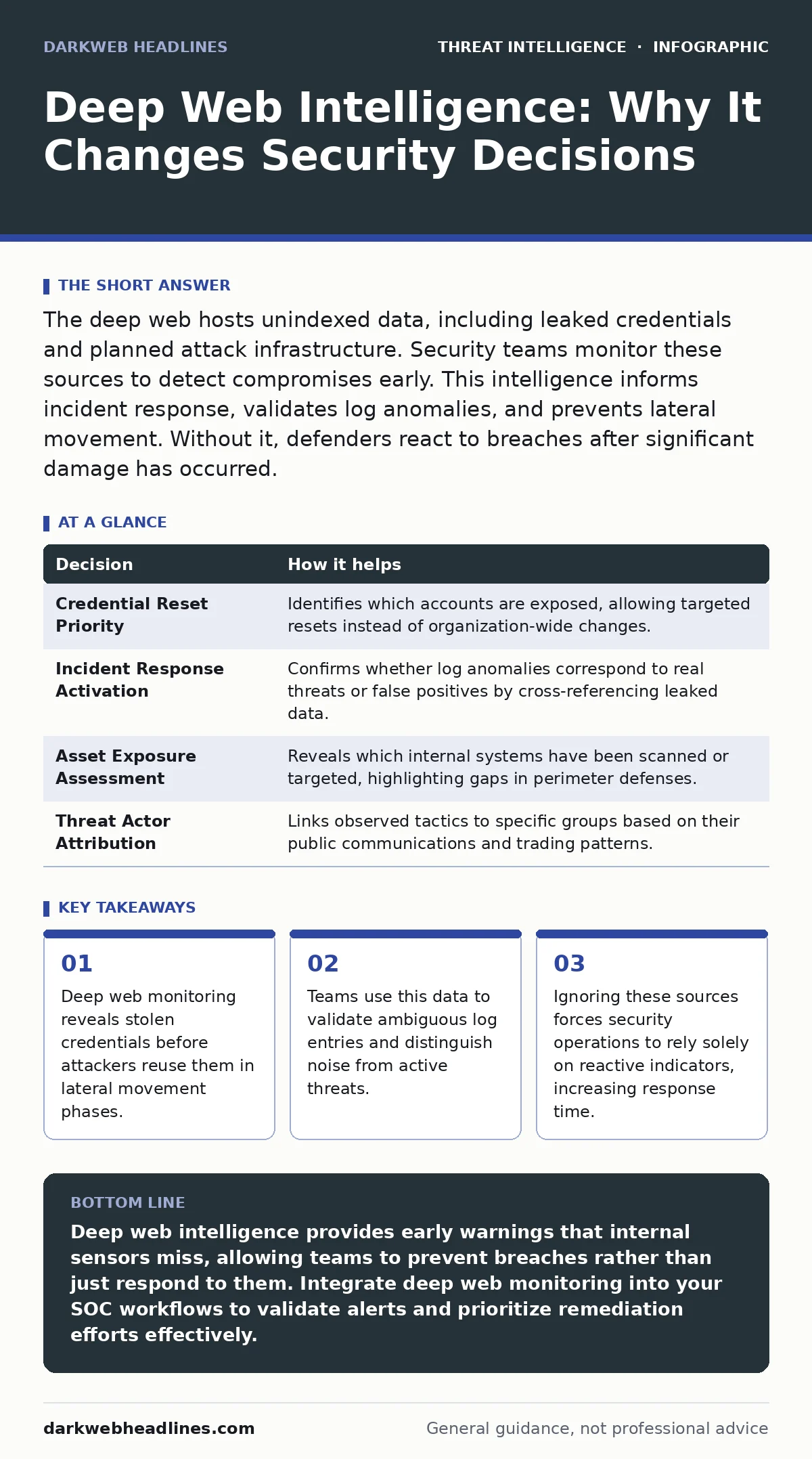
The deep web hosts unindexed data, including leaked credentials and planned attack infrastructure. Security teams monitor these sources to detect compromises early. This intelligence informs incident response, validates log anomalies, and prevents lateral movement. Without it, defenders react to breaches after significant damage has occurred.
Understanding the Deep Web Infrastructure
The deep web consists of web content not indexed by standard search engines. This includes private databases, internal corporate portals, and password-protected forums. It is distinct from the dark web, which requires specific software like Tor to access. The deep web is larger than the surface web and contains most of the internet’s data. Security professionals monitor specific sections of the deep web where data leaks and illicit trading occur. These sections often use standard HTTP protocols but reside behind authentication walls or dynamic content generation.
The Role of Proactive Monitoring
Monitoring the deep web provides early warning signals that internal sensors miss. When data leaks, it often appears on forums or paste sites before it reaches commercial breach markets. These platforms serve as clearinghouses for stolen information. Security teams scrape these sources for indicators of compromise such as email domains, IP addresses, and file hashes. This process transforms passive data into actionable intelligence. It allows defenders to see the threat actor’s inventory before the attack begins.
This proactive approach shifts the security posture from reactive to predictive. Defenders can identify which assets are exposed and prioritize remediation efforts. They can also track the lifecycle of stolen data. Understanding how data moves from initial theft to final sale helps teams anticipate the next phase of an attack. This visibility is critical for protecting high-value targets that attract persistent threat actors.
Decisions Informed by Deep Web Intelligence
Deep web intelligence informs several critical security decisions. It helps teams determine the scope of a potential breach. It guides the prioritization of patching and credential rotation. It also aids in assessing the effectiveness of existing security controls. The table below outlines specific decisions and how this intelligence supports them.
| Decision | How it helps |
|---|---|
| Credential Reset Priority | Identifies which accounts are exposed, allowing targeted resets instead of organization-wide changes. |
| Incident Response Activation | Confirms whether log anomalies correspond to real threats or false positives by cross-referencing leaked data. |
| Asset Exposure Assessment | Reveals which internal systems have been scanned or targeted, highlighting gaps in perimeter defenses. |
| Threat Actor Attribution | Links observed tactics to specific groups based on their public communications and trading patterns. |
What Goes Wrong Without Intelligence
Without deep web intelligence, security teams operate with blind spots. They rely solely on internal telemetry, which only shows activity that has already entered the network. This reactive stance means defenders always lag behind attackers. By the time an intrusion detection system alerts on malicious activity, the attacker has often established persistence. The window for containment shrinks dramatically.
Teams lacking this intelligence also struggle with context. Log entries showing failed login attempts might seem like brute force attacks. However, deep web data might reveal that these attempts use valid credentials stolen months ago. Without this context, responders might waste time blocking IPs instead of investigating compromised accounts. This misdirection delays containment and allows lateral movement to proceed unchecked.
How Teams Operationalize the Data
Security operations centers integrate deep web data into their workflows. They use automated tools to continuously scrape relevant sources. These tools filter noise and highlight indicators matching the organization’s digital footprint. The output feeds into security information and event management systems. This integration ensures that analysts see deep web alerts alongside internal logs.
Analysts use this data to validate hypotheses. When a suspicious process runs, they check if the associated hashes appear in recent leaks. This cross-referencing reduces false positives and focuses effort on genuine threats. Teams also use this intelligence to update their SOC playbooks. They refine detection rules based on new tactics observed in deep web communications. This continuous feedback loop improves detection accuracy over time.
See also: Cyber Espionage Myths: Why State Actors Fail and How They Actually Operate · Red Teaming vs Pentesting: Scope, Tactics, and Decision Criteria
Integration with Broader Security Practices
Deep web intelligence does not exist in isolation. It complements other security disciplines. For example, understanding PowerShell abuse helps analysts recognize post-exploitation techniques that threat actors discuss in forums. Knowledge of hacktivism allows teams to anticipate politically motivated attacks and adjust monitoring parameters accordingly. Honeypots can be configured to mimic assets found in deep web listings, attracting attackers and revealing their methods.
Effective log management is also critical. Deep web alerts are useless if internal logs are incomplete or poorly structured. Teams must ensure that logs capture sufficient detail to correlate with external intelligence. Red teaming exercises can simulate attacks using tactics observed in the deep web, testing the effectiveness of current defenses. This holistic approach ensures that intelligence translates into tangible security improvements.
Challenges and Limitations
Monitoring the deep web presents several challenges. The volume of data is immense, requiring sophisticated filtering to avoid alert fatigue. False positives are common, as generic terms may match internal assets by coincidence. Analysts must develop skills to distinguish relevant signals from noise. Additionally, the legal and ethical implications of accessing certain areas require careful consideration.
Teams must also manage the cost of monitoring. Automated tools require maintenance and tuning. Human analysts need training to interpret the data correctly. Despite these challenges, the benefits of early detection outweigh the costs. The key is to focus on high-value indicators and integrate monitoring into existing workflows. This ensures that the effort yields actionable insights rather than overwhelming the team.
Building a Sustainable Monitoring Program
A sustainable program starts with clear objectives. Teams should define what they are looking for and why. This focus prevents mission creep and ensures resources are used effectively. Automation handles the heavy lifting of data collection and initial filtering. Human analysts focus on investigation and response. Regular reviews of the program’s effectiveness help refine processes and improve outcomes.
Collaboration is also vital. Sharing insights with other teams enhances overall security posture. Threat intelligence feeds can provide context for deep web findings. SOC playbooks should include procedures for handling deep web alerts. By integrating deep web monitoring into the broader security strategy, teams create a resilient defense capable of adapting to new threats.
Key takeaways
- Deep web monitoring reveals stolen credentials before attackers reuse them in lateral movement phases.
- Teams use this data to validate ambiguous log entries and distinguish noise from active threats.
- Ignoring these sources forces security operations to rely solely on reactive indicators, increasing response time.
Deep web intelligence provides early warnings that internal sensors miss, allowing teams to prevent breaches rather than just respond to them. Integrate deep web monitoring into your SOC workflows to validate alerts and prioritize remediation efforts effectively.
Frequently asked questions
Is the deep web the same as the dark web?
No, the deep web includes all unindexed content, such as private databases, while the dark web requires specific software to access and is often associated with illicit activities.
How do teams access deep web data legally?
Teams use specialized monitoring services that aggregate data from public and semi-public sources, ensuring compliance with legal and ethical standards.
Can deep web monitoring detect zero-day exploits?
It can detect discussions or sales of zero-day exploits, providing early warning, but it does not directly identify the exploit code in use.
What is the main benefit of deep web monitoring?
It provides context for internal alerts and reveals compromised credentials before attackers reuse them, enabling proactive defense.
How this guide was produced: written by the DarkWeb Headlines editorial team with AI assistance, checked against the public references listed below, and reviewed when the facts change. See our editorial policy or report an error.