Log Management vs SIEM: Differences, Use Cases, and Selection Criteria
Centralized log collection provides raw data visibility, while security information and event management adds correlation logic to detect complex attack patterns across multiple sources.

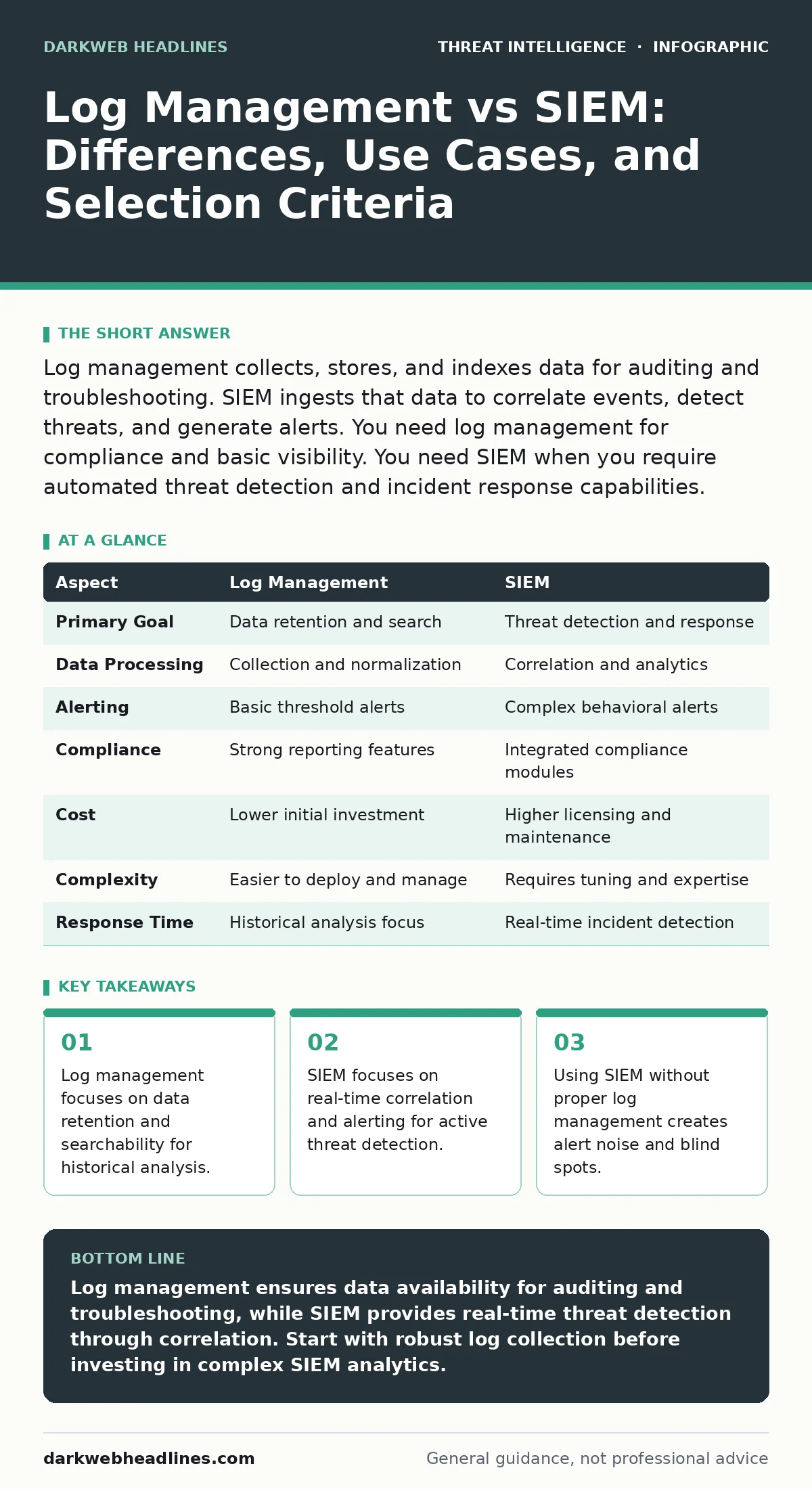
Log management collects, stores, and indexes data for auditing and troubleshooting. SIEM ingests that data to correlate events, detect threats, and generate alerts. You need log management for compliance and basic visibility. You need SIEM when you require automated threat detection and incident response capabilities.
Log Management vs SIEM: The Core Difference
Log management and security information and event management (SIEM) serve distinct but overlapping functions in cybersecurity operations. Log management is the foundational process of collecting, normalizing, storing, and indexing log data from various sources. It ensures that raw event data is preserved for auditing, compliance, and troubleshooting. SIEM builds upon this foundation by ingesting logs to correlate events across different systems. It uses predefined rules and behavioral analytics to identify potential security incidents in real time. Log management answers what happened and when. SIEM answers whether what happened is malicious.
What Is Log Management?
Log management handles the lifecycle of log data from generation to archival. Systems generate logs that record user actions, system errors, and network traffic. Log management solutions aggregate these disparate data streams into a central repository. They normalize the data formats so that different systems can be compared. This process enables you to search through historical data efficiently. You can retrieve specific events for forensic analysis or compliance reporting. The primary goal is data integrity and availability. Without effective log management, you lose the ability to reconstruct past events. This limits your capacity to investigate breaches or audit system changes.
What Is SIEM?
Security information and event management combines log management with security analytics. A SIEM solution collects log data and applies correlation engines to detect anomalies. It looks for patterns that indicate an attack, such as multiple failed login attempts followed by a successful one. SIEM tools often include threat intelligence feeds to enrich log data with context.
They provide dashboards that highlight active threats and potential vulnerabilities. The system generates alerts when suspicious activity is detected. This allows security teams to respond to incidents quickly. SIEM transforms raw data into actionable security intelligence. It reduces the time required to identify and contain threats.
Point-by-Point Comparison
| Aspect | Log Management | SIEM |
|---|---|---|
| Primary Goal | Data retention and search | Threat detection and response |
| Data Processing | Collection and normalization | Correlation and analytics |
| Alerting | Basic threshold alerts | Complex behavioral alerts |
| Compliance | Strong reporting features | Integrated compliance modules |
| Cost | Lower initial investment | Higher licensing and maintenance |
| Complexity | Easier to deploy and manage | Requires tuning and expertise |
| Response Time | Historical analysis focus | Real-time incident detection |
When to Choose Log Management
Choose log management when your primary needs are compliance and operational visibility. You should implement this solution if you require long-term storage of audit logs. It is suitable for organizations that need to troubleshoot system issues efficiently. Log management provides a single source of truth for all system events.
It allows you to search through vast amounts of data quickly. This is critical for meeting regulatory requirements that mandate data retention. You also benefit from reduced storage costs compared to full SIEM solutions. Log management is the right choice when threat detection is not the immediate priority. It ensures you have the data necessary for future investigations.
See also: Command and Control Traffic Myths That Blind Defenders · CVE Monitoring Mistakes: 7 Errors That Blind Your Security Team
When to Choose SIEM
Choose SIEM when you need active threat detection and incident response capabilities. This solution is necessary for organizations facing sophisticated cyber threats. SIEM correlates events across multiple sources to identify complex attack patterns. It provides real-time alerts that enable rapid response to security incidents.
You should choose SIEM if you have a dedicated security operations center. The tool supports operational threat intelligence by integrating external data feeds. It helps you detect insider threats and advanced persistent threats. SIEM is essential when you need to automate parts of the incident response process. It reduces the manual effort required to monitor security events.
Overlap and Integration
Log management and SIEM often overlap in modern security architectures. Many SIEM solutions include built-in log management capabilities. However, specialized log management tools may offer better performance for large data volumes. You might use a dedicated log management system for long-term storage. Then you feed recent data into the SIEM for real-time analysis. This hybrid approach balances cost and performance. It ensures you have historical data for compliance without overloading the SIEM. Integration between the two systems is critical for effective security operations. You need seamless data flow to maintain visibility and detection capabilities.
Strategic Considerations for Selection
Selecting between log management and SIEM depends on your security maturity. Start with log management to establish a baseline of visibility. Ensure you collect logs from all critical systems and applications. Once you have reliable data collection, evaluate your need for threat detection. Implement SIEM when you have the resources to tune and manage alerts. Consider the complexity of your environment and the sophistication of threats you face. Review security metrics to measure the effectiveness of your current tools. Understand that both solutions require ongoing maintenance and optimization.
Key takeaways
- Log management focuses on data retention and searchability for historical analysis.
- SIEM focuses on real-time correlation and alerting for active threat detection.
- Using SIEM without proper log management creates alert noise and blind spots.
Log management ensures data availability for auditing and troubleshooting, while SIEM provides real-time threat detection through correlation. Start with robust log collection before investing in complex SIEM analytics.
Frequently asked questions
Can I use log management for threat detection?
Basic log management can detect simple anomalies, but it lacks the correlation capabilities needed for complex threat identification.
Does SIEM replace the need for log management?
No, SIEM relies on high-quality log data. Effective log management is a prerequisite for successful SIEM deployment and operation.
How do I handle log volume growth?
Implement data retention policies and tiered storage. Archive older logs to cheaper storage while keeping recent data accessible for analysis.
Is SIEM suitable for small organizations?
SIEM can be complex and costly. Small organizations may benefit from managed detection and response services or cloud-based SIEM solutions.
How this guide was produced: written by the DarkWeb Headlines editorial team with AI assistance, checked against the public references listed below, and reviewed when the facts change. See our editorial policy or report an error.