SIEM vs SOAR: How to Choose the Right Security Tool
SIEM detects anomalies while SOAR executes responses, meaning you need detection logic before automation can safely act on alerts.

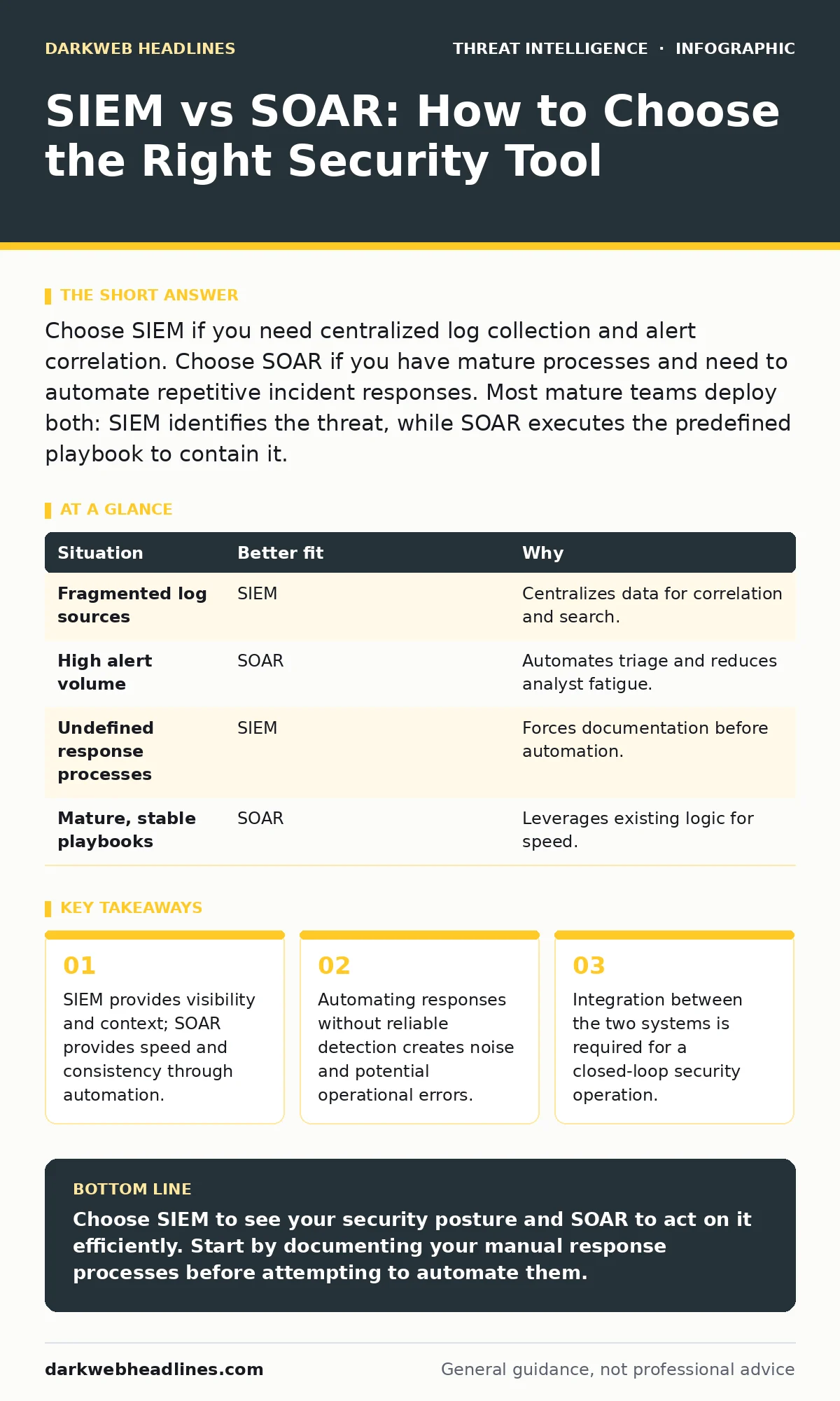
Choose SIEM if you need centralized log collection and alert correlation. Choose SOAR if you have mature processes and need to automate repetitive incident responses. Most mature teams deploy both: SIEM identifies the threat, while SOAR executes the predefined playbook to contain it.
Does your team need visibility or velocity?
Security Information and Event Management (SIEM) aggregates data from diverse sources to identify security incidents. It answers the question of what happened and when. Security Orchestration, Automation, and Response (SOAR) focuses on the actions taken after an alert is generated. It answers the question of what to do next.
If your primary struggle is seeing across your infrastructure, you need visibility. You cannot automate what you cannot see. If your team is overwhelmed by the volume of alerts and spends hours on repetitive tasks, you need velocity.
Suppose you receive hundreds of login failure alerts daily. A SIEM correlates these logs to identify a brute-force attack. A SOAR platform can automatically lock the targeted account and notify the administrator. Without the SIEM, the SOAR has no context. Without the SOAR, the analyst must manually lock every account.
Can you define standard operating procedures?
Automation requires rigid logic. You cannot automate a decision that requires human intuition or complex judgment. Before considering SOAR, you must have documented SOC playbooks for common scenarios. These are step-by-step instructions for handling specific types of incidents.
If your response to a malware detection varies depending on the time of day or the user’s role, automation is risky. You must first stabilize your processes. This often involves reviewing security metrics to understand which tasks consume the most time.
Imagine a scenario where a phishing email is detected. If your playbook says "quarantine the email and block the sender," this is a good candidate for SOAR. If your playbook says "investigate the sender and decide," automation is not appropriate.
Is your data normalized and integrated?
SIEM systems require data normalization. This means converting logs from different vendors into a common format. If your data is messy or incomplete, your alerts will be inaccurate. SOAR relies on APIs (Application Programming Interfaces) to connect with various security tools.
If your security stack consists of point solutions that do not talk to each other, SOAR will be difficult to implement. You need a baseline of integration. This often involves understanding network enumeration techniques to ensure all assets are accounted for in your logging strategy.
Consider the cost of maintaining these integrations. Every API connection requires testing and updates. If your infrastructure changes frequently, the maintenance burden of SOAR can outweigh the benefits. You must weigh the time saved in response against the time spent maintaining connections.
| Situation | Better fit | Why |
|---|---|---|
| Fragmented log sources | SIEM | Centralizes data for correlation and search. |
| High alert volume | SOAR | Automates triage and reduces analyst fatigue. |
| Undefined response processes | SIEM | Forces documentation before automation. |
| Mature, stable playbooks | SOAR | Leverages existing logic for speed. |
Do you understand the threat context?
Detection relies on context. You must know what normal behavior looks like to identify anomalies. This often involves consuming operational threat intelligence to enrich your alerts. For example, knowing that an IP address is associated with command and control traffic changes the priority of an alert.
SOAR can consume this intelligence to make faster decisions. If an alert matches a high-confidence threat feed, the SOAR can escalate the incident immediately. However, if the intelligence is noisy, the SOAR will generate false positives.
Imagine a situation where a legitimate service triggers an alert. If your SIEM lacks context, it flags it as malicious. If your SOAR acts on this, it may block critical business operations. The quality of your detection logic dictates the safety of your automation.
When to deploy both systems together
Most organizations eventually need both. SIEM acts as the brain, identifying threats. SOAR acts as the hands, executing responses. The combination creates a closed loop where detection triggers action, and action feeds back into detection.
This integration reduces mean time to respond. It also ensures consistency. This is particularly useful for handling credential dumping attempts, where speed is critical to prevent lateral movement.
However, this setup increases complexity. You must manage the data flow between the two systems. Errors in one system can cascade into the other. Regular testing is required to ensure that the automation behaves as expected under stress.
See also: Threat Actors Defined: Who They Are and How They Operate · Patch Tuesday Mechanics: What It Is and How It Works
The hidden cost of integration
The initial purchase price is not the only cost. The true expense lies in the ongoing maintenance of rules, playbooks, and integrations. As your environment grows, you must update your SIEM rules and SOAR scripts.
This requires specialized skills. Analysts must understand both security operations and basic scripting or configuration. Training costs can be significant. You must budget for the time required to keep the system effective.
Suppose you add a new cloud service. You must update your SIEM to ingest its logs and your SOAR to interact with its API. If you neglect this step, you create blind spots. The system becomes less effective over time if not actively managed.
Key takeaways
- SIEM provides visibility and context; SOAR provides speed and consistency through automation.
- Automating responses without reliable detection creates noise and potential operational errors.
- Integration between the two systems is required for a closed-loop security operation.
Choose SIEM to see your security posture and SOAR to act on it efficiently. Start by documenting your manual response processes before attempting to automate them.
Frequently asked questions
Can I use SOAR without a SIEM?
Yes, but you will lack centralized correlation. You will need another source for alerts and context, which may reduce the effectiveness of automation.
Is SIEM enough for small teams?
SIEM is often sufficient for smaller teams that lack standardized playbooks. It provides visibility without the complexity of automation.
How do I measure ROI for SOAR?
Track the time saved per incident and the reduction in manual errors. Compare these metrics against the cost of licenses and maintenance.
Do I need both for compliance?
Compliance often requires logging and monitoring, which SIEM provides. Automation is not usually a compliance requirement but can help enforce policies.
How this guide was produced: written by the DarkWeb Headlines editorial team with AI assistance, checked against the public references listed below, and reviewed when the facts change. See our editorial policy or report an error.