How Operational Threat Intelligence Works in Practice
Operational threat intelligence transforms raw data into automated blocking rules, but its true value lies in filtering noise to protect specific internal assets from active campaigns.

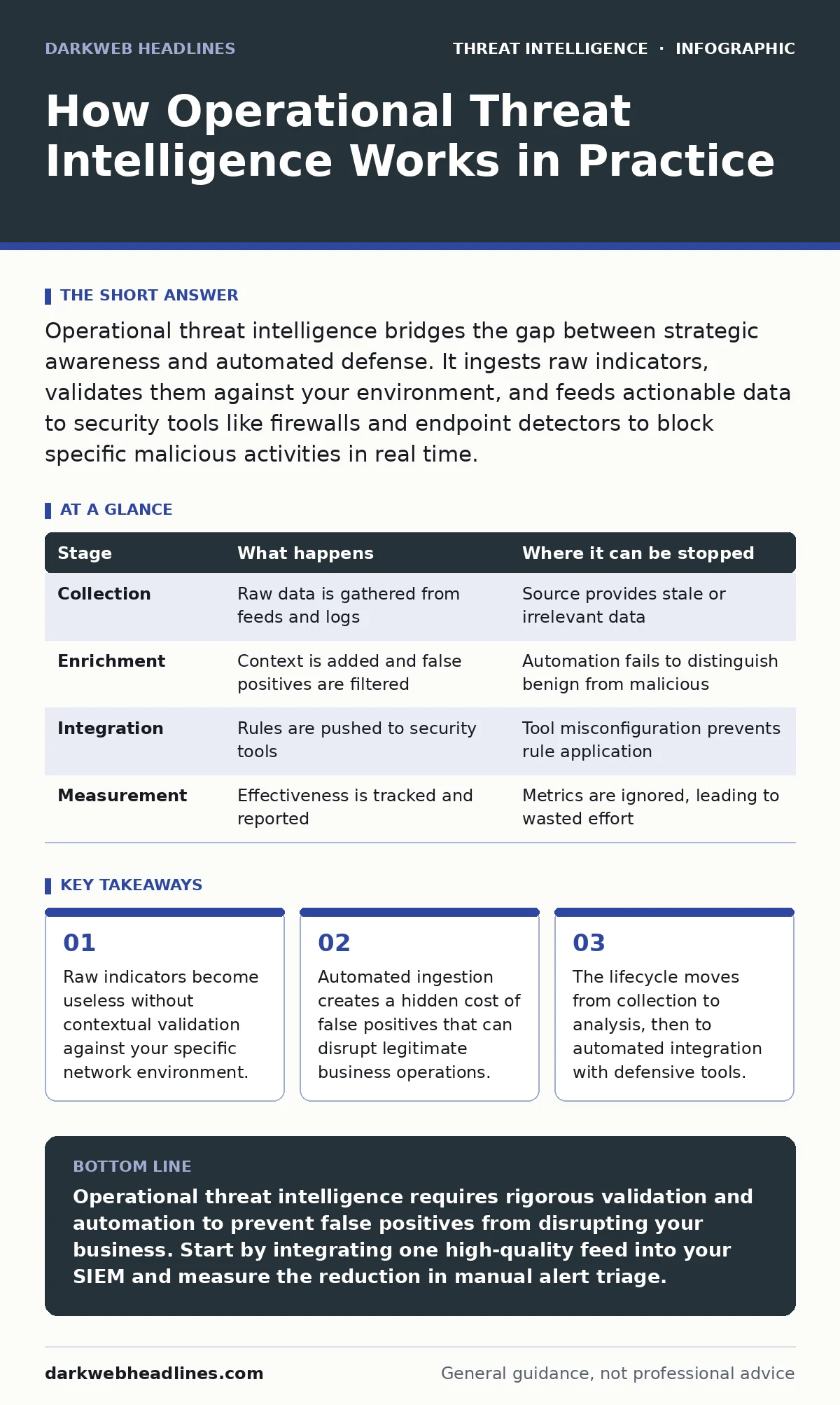
Operational threat intelligence bridges the gap between strategic awareness and automated defense. It ingests raw indicators, validates them against your environment, and feeds actionable data to security tools like firewalls and endpoint detectors to block specific malicious activities in real time.
The Purpose of Operational Data
Operational threat intelligence focuses on the immediate present. It provides the specific details needed to detect and respond to an attack happening right now. Unlike strategic intelligence, which helps you plan budget and policy, operational intelligence tells you which IP addresses are currently scanning your perimeter. It tells you which file hashes are being used by malware targeting your industry sector.
You use this data to configure your security tools. It allows you to block a known malicious domain before it communicates with your servers. It enables you to hunt for a specific artifact that indicates an intruder is already inside your network. The goal is not just to know that a threat exists, but to stop its specific mechanics from succeeding in your environment.
This type of intelligence relies heavily on automation. Humans cannot process the volume of new indicators generated daily. You must integrate this data into your Security Information and Event Management (SIEM) system or your Endpoint Detection and Response (EDR) platform. These systems use the intelligence to trigger alerts or automatic blocking actions.
The Lifecycle of an Indicator
The journey of a threat indicator follows a strict path. It begins as raw data, often collected from open sources, commercial feeds, or internal sensors. This raw data is noisy and often inaccurate. It contains false positives and outdated information that no longer poses a risk.
The next phase is enrichment and validation. Analysts or automated systems check the indicator against known good lists. They verify if the IP address belongs to a cloud provider that hosts legitimate traffic. They check if the domain was recently registered and if it matches patterns of command and control traffic. This step separates signal from noise.
Once validated, the indicator is integrated into defensive controls. This might mean adding a domain to a blocklist on your proxy server. It could involve creating a signature for your intrusion detection system. The final stage is measurement. You track how many times the indicator was seen and how many blocks occurred. This feedback loop helps you refine your sources.
| Stage | What happens | Where it can be stopped |
|---|---|---|
| Collection | Raw data is gathered from feeds and logs | Source provides stale or irrelevant data |
| Enrichment | Context is added and false positives are filtered | Automation fails to distinguish benign from malicious |
| Integration | Rules are pushed to security tools | Tool misconfiguration prevents rule application |
| Measurement | Effectiveness is tracked and reported | Metrics are ignored, leading to wasted effort |
Reading the Context
An indicator without context is dangerous. An IP address alone tells you little. You must know what that IP address does. Is it hosting a phishing page? Is it distributing ransomware? Is it part of a botnet? This context determines how you respond.
You also need to know the relevance. If an indicator targets a software version you do not use, it is irrelevant. If it targets a region where you have no presence, it may be low priority. You must map the intelligence to your own assets. This mapping process is often overlooked. It requires a clear understanding of your network enumeration results. You must know what you have to know what needs protection.
Consider the difference between a hash and a domain. A file hash is unique to a specific binary. It is highly accurate but has a short lifespan. Attackers can change the hash by adding a single byte. A domain is more persistent. It is used for command and control traffic and phishing. Blocking a domain stops communication for many victims. Blocking a hash only stops that specific file on that specific machine.
Integration and Automation
The value of operational intelligence is realized only when it is automated. Manual entry of indicators is too slow. You must use APIs to push data to your security tools. This requires careful engineering. You need to handle rate limits, format conversions, and error handling.
You must also manage the lifecycle of the rules. Indicators expire. An IP address may stop being malicious after a week. If you do not remove it, you create a false positive. You may block legitimate traffic from that IP in the future. This is a hidden cost of poor hygiene. It erodes trust in your security tools.
Integration points vary. You might feed indicators to a firewall, a DNS sinkhole, or an email gateway. Each has different requirements. A firewall needs IP addresses and ports. An email gateway needs domains and sender addresses. You must tailor the output to the input requirements of each tool. This adds complexity to your pipeline.
The Cost of Noise
Noise is the enemy of operational intelligence. False positives consume analyst time. They cause alert fatigue. When your tools alert on every minor anomaly, you miss the real threats. You must tune your sources. You must prioritize quality over quantity.
One common mistake is using too many feeds. Each feed adds noise. They often overlap. You may receive the same indicator from five different sources. This redundancy does not add value. It adds processing overhead. You must deduplicate your data. You must score your sources based on their accuracy for your specific environment.
Another cost is the maintenance of the integration. APIs change. Formats change. Your pipeline may break without warning. You need monitoring for your monitoring tools. This is a recursive problem. You must ensure the system that protects you is itself protected and functioning. This requires dedicated effort and resources.
See also: Java Deserialization Response: Immediate Containment and Recovery Steps · Isolating Infected Devices: 7 Mistakes That Spread Malware
Advanced Application Techniques
Basic blocking is only the start. You can use operational intelligence for proactive hunting. You can search your logs for indicators that were active in the past. This helps you identify if an attacker was already inside your network before you knew about them.
You can also use intelligence to improve your log management strategy. If you know which artifacts are important, you can ensure they are being collected and stored. You can adjust your retention policies to keep relevant data longer. This makes forensic analysis easier.
Consider the role of process injection techniques. Attackers often use legitimate processes to hide their activities. Operational intelligence can provide the command-line arguments or parent-child process relationships associated with these techniques. You can create rules to detect these specific patterns. This moves your defense from signature-based to behavior-based.
Measuring Effectiveness
You must measure the impact of your operational intelligence. How many blocks did it cause? How many false positives did it generate? How much time did it save your analysts? These metrics help you justify the investment. They help you improve the process.
Use security metrics to track performance. Look at the time from indicator creation to integration. Look at the accuracy of your sources. Look at the reduction in mean time to detect. These numbers tell you if your program is working.
Do not rely on volume metrics. The number of indicators processed is not a measure of success. The number of successful blocks is. The number of avoided incidents is. Focus on outcomes, not activities. This keeps your program aligned with business goals.
Connecting to Broader Security
Operational intelligence does not exist in a vacuum. It supports other security functions. It informs your threat intelligence feeds strategy by validating which sources are useful. It guides your credential dumping detection efforts by providing known tool signatures.
It also relates to PowerShell abuse detection. Attackers frequently use PowerShell for lateral movement. Operational intelligence can provide the specific scripts or obfuscation patterns used in current campaigns. You can update your detection rules to catch these variants.
By integrating operational intelligence into your broader security metrics framework, you create a cohesive defense. You move from reactive patching to proactive prevention. You build a system that learns and adapts. This is the true value of operational threat intelligence. It turns data into defense.
Key takeaways
- Raw indicators become useless without contextual validation against your specific network environment.
- Automated ingestion creates a hidden cost of false positives that can disrupt legitimate business operations.
- The lifecycle moves from collection to analysis, then to automated integration with defensive tools.
Operational threat intelligence requires rigorous validation and automation to prevent false positives from disrupting your business. Start by integrating one high-quality feed into your SIEM and measure the reduction in manual alert triage.
Frequently asked questions
How do I choose between commercial and open-source feeds?
Commercial feeds often provide better context and support, while open-source feeds are free but require more manual validation and filtering.
Can I automate the blocking of all indicators?
You should avoid blocking all indicators automatically. High-confidence indicators can be blocked, but low-confidence ones should be monitored to prevent accidental outages.
How often should I update my threat intelligence rules?
Update rules as frequently as your tools allow, ideally in real-time or hourly, to stay ahead of fast-moving attacks.
What is the biggest risk of using threat intelligence?
The biggest risk is false positives, which can block legitimate traffic and disrupt business operations if not properly validated.
How this guide was produced: written by the DarkWeb Headlines editorial team with AI assistance, checked against the public references listed below, and reviewed when the facts change. See our editorial policy or report an error.