Command and Control Traffic Myths That Blind Defenders
C2 channels often look like routine cloud traffic, proving that volume and protocol choice are poor indicators of malicious activity.
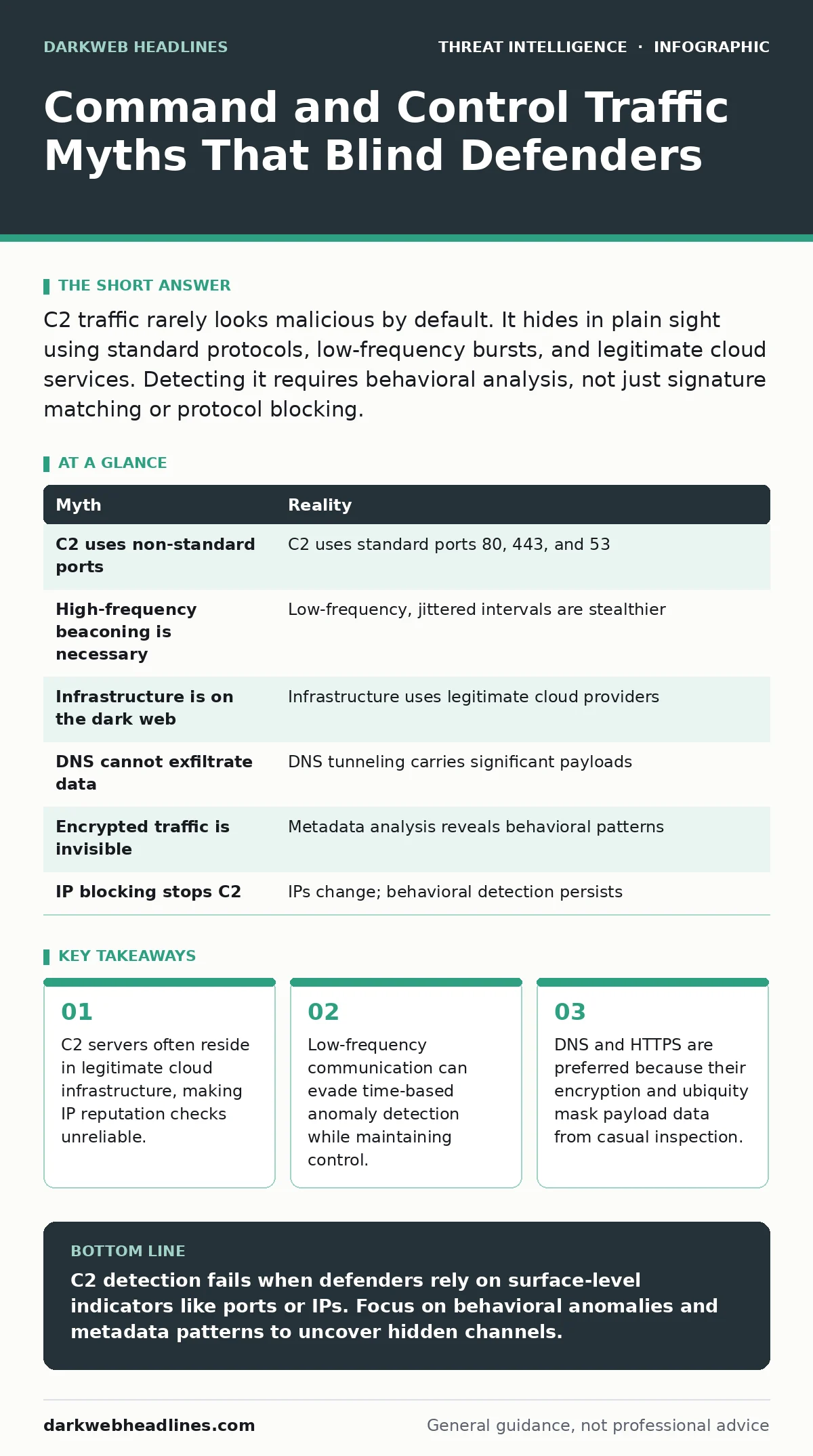
C2 traffic rarely looks malicious by default. It hides in plain sight using standard protocols, low-frequency bursts, and legitimate cloud services. Detecting it requires behavioral analysis, not just signature matching or protocol blocking.
Myth: C2 traffic always appears on non-standard ports
Reality: Attackers rarely use obscure ports because modern firewalls block them by default. Instead, they use ports 80, 443, and 53. These ports allow traffic to pass through most perimeter defenses without triggering immediate alerts.
Using standard ports is a tactic known as camouflage. If a beacon uses port 443, it looks like a standard HTTPS request to a web server. This forces defenders to inspect the payload, not just the header.
Many organizations configure their security information and event management systems to ignore standard port traffic to reduce noise. This creates a blind spot. The attacker relies on this assumption to maintain access.
Myth: High-frequency beaconing is required for C2
Reality: Frequent check-ins create predictable patterns that anomaly detection systems easily flag. Sophisticated actors use low-frequency or jittered intervals. They might check in once every few hours or days.
This technique reduces the data footprint. Less data means fewer logs to analyze. It also makes it harder to distinguish the traffic from legitimate background updates or slow-moving IoT devices.
The trade-off is latency. The attacker cannot issue real-time commands. However, for tasks like credential harvesting or data staging, immediate response is unnecessary. They prioritize stealth over speed.
Myth: C2 infrastructure is always hosted on dark web domains
Reality: Most command and control servers run on legitimate cloud providers. These include major commercial hosting services that power billions of legitimate sites. Using these services provides anonymity through the sheer volume of tenants.
This is often called living off the land. The attacker rents a virtual machine or uses a free tier. When you block an IP, you might be blocking a news site or a small business.
The difficulty lies in attribution. The cloud provider has no incentive to police a single compromised instance immediately. The infrastructure remains available until the provider receives a specific takedown request.
Myth: DNS traffic cannot carry large payloads
Reality: DNS is designed to be lightweight, but it is also resilient. Attackers use DNS tunneling to encode data in subdomain labels. Each query can carry a small amount of data.
By chaining thousands of queries, significant amounts of data can exfiltrate. The DNS protocol does not inspect the content of the subdomain name. It only cares about the structure.
This method bypasses firewalls that allow DNS out. It also avoids deep packet inspection tools that focus on HTTP or FTP. The traffic looks like normal domain lookups, even if the volume is slightly higher than usual.
Myth: Encrypted C2 traffic is impossible to detect
Reality: While you cannot read the payload of HTTPS traffic, you can analyze the metadata. This includes the size of the packets, the timing of the connection, and the server name indication.
These features create a fingerprint. A C2 beacon often has a consistent packet size and interval. Legitimate browsing behavior is more chaotic. Machine learning models can spot these rigid patterns.
The limitation is that this requires advanced behavioral analytics. Simple signature-based tools fail here. You must monitor for deviations in network behavior, not just known bad hashes.
See also: ARP Spoofing vs IP Spoofing: Key Differences, Risks, and Defenses · How ARP Spoofing Works: The Step-by-Step Attack Lifecycle
Myth: Blocking known bad IPs stops C2
Reality: IP addresses are transient. Attackers use fast-flux networks or bulletproof hosting. They change IPs as soon as they are blocked.
Relying on blocklists is a reactive measure. By the time an IP is on a list, the attacker has likely moved. This approach creates a constant game of whack-a-mole.
The focus should shift to behavior. Instead of asking if the IP is bad, ask if the traffic pattern is suspicious. This remains effective even when the infrastructure changes.
| Myth | Reality |
|---|---|
| C2 uses non-standard ports | C2 uses standard ports 80, 443, and 53 |
| High-frequency beaconing is necessary | Low-frequency, jittered intervals are stealthier |
| Infrastructure is on the dark web | Infrastructure uses legitimate cloud providers |
| DNS cannot exfiltrate data | DNS tunneling carries significant payloads |
| Encrypted traffic is invisible | Metadata analysis reveals behavioral patterns |
| IP blocking stops C2 | IPs change; behavioral detection persists |
Understanding these nuances helps in building better detection logic. For instance, when analyzing internal processes, understanding process injection techniques can reveal how the C2 agent was loaded into memory. Similarly, recognizing that credential dumping often precedes the need for C2 can help prioritize investigation efforts.
Key takeaways
- C2 servers often reside in legitimate cloud infrastructure, making IP reputation checks unreliable.
- Low-frequency communication can evade time-based anomaly detection while maintaining control.
- DNS and HTTPS are preferred because their encryption and ubiquity mask payload data from casual inspection.
C2 detection fails when defenders rely on surface-level indicators like ports or IPs. Focus on behavioral anomalies and metadata patterns to uncover hidden channels.
Frequently asked questions
How can I detect C2 if it uses HTTPS?
You cannot inspect the payload, but you can analyze packet sizes, timing intervals, and certificate details for anomalies.
Does using a CDN hide C2 traffic?
Yes, CDNs mask the origin IP and blend malicious traffic with legitimate content delivery, complicating attribution.
What is the difference between C2 and data exfiltration?
C2 is the channel for commands; exfiltration is the act of stealing data, which may use the same C2 channel or a separate one.
Can DNS queries be used for C2?
Yes, DNS tunneling encodes commands in subdomain queries, allowing control over standard DNS ports without triggering firewalls.
How this guide was produced: written by the DarkWeb Headlines editorial team with AI assistance, checked against the public references listed below, and reviewed when the facts change. See our editorial policy or report an error.