Patch Tuesday Mechanics: What It Is and How It Works
Patch Tuesday is a predictable monthly release cycle that standardizes software updates, creating a known window for both defenders to apply fixes and attackers to exploit unpatched systems.

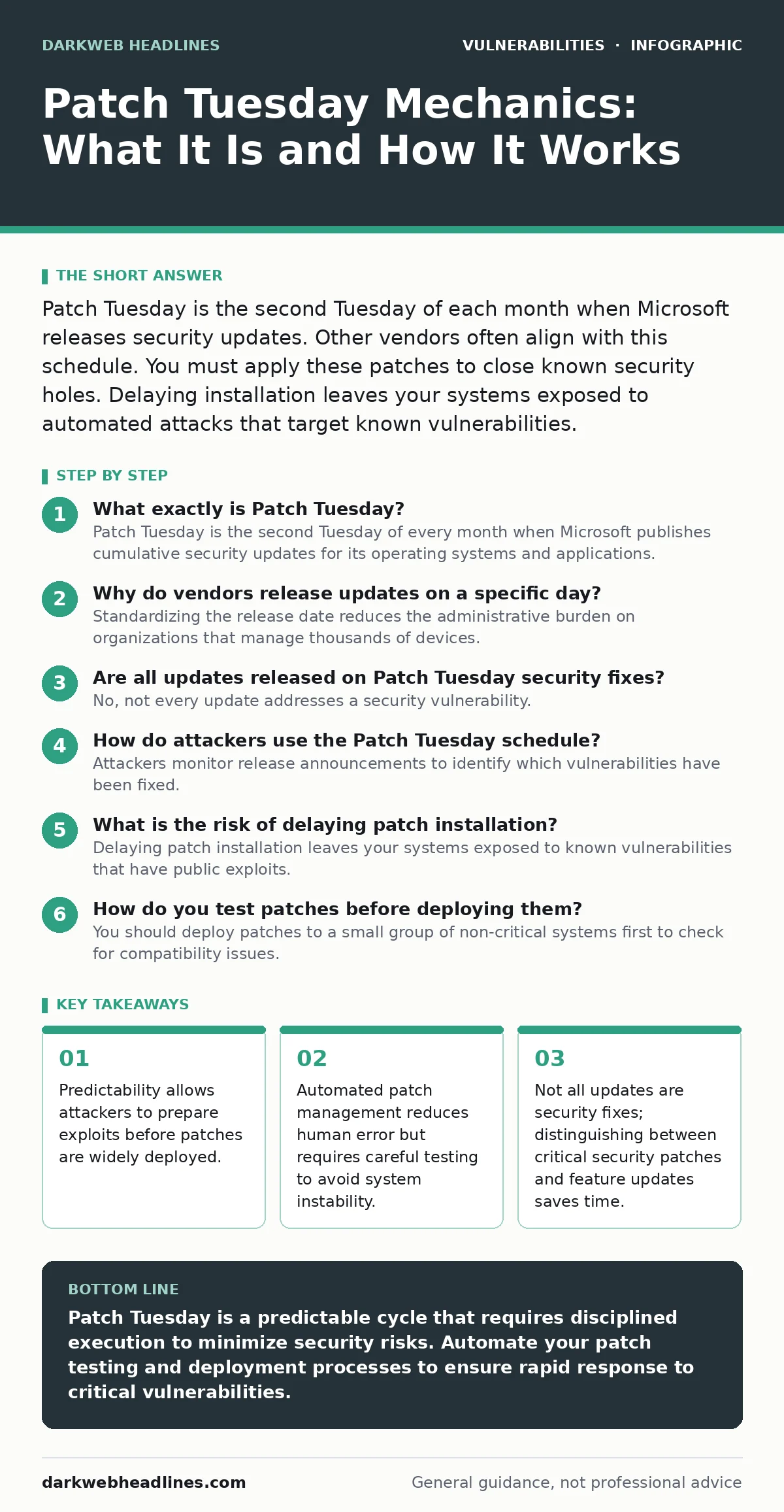
Patch Tuesday is the second Tuesday of each month when Microsoft releases security updates. Other vendors often align with this schedule. You must apply these patches to close known security holes. Delaying installation leaves your systems exposed to automated attacks that target known vulnerabilities.
What exactly is Patch Tuesday?
Patch Tuesday is the second Tuesday of every month when Microsoft publishes cumulative security updates for its operating systems and applications. This schedule was established to provide a predictable rhythm for IT administrators to plan maintenance windows. Other major software vendors often release their updates on the same day to simplify the workload for system administrators. This synchronization means you can address multiple vendor updates in a single maintenance cycle.
Why do vendors release updates on a specific day?
Standardizing the release date reduces the administrative burden on organizations that manage thousands of devices. If every vendor released updates randomly, security teams would face constant, unpredictable maintenance windows. A fixed schedule allows for better resource planning and testing procedures. It also helps users understand when to expect system restarts or temporary service interruptions.
Are all updates released on Patch Tuesday security fixes?
No, not every update addresses a security vulnerability. Some updates contain bug fixes, performance improvements, or new features. Security updates are typically labeled with specific identifiers that distinguish them from general maintenance patches. You must review the release notes to determine which updates are critical for security. Applying only security patches reduces the risk of introducing bugs from non-security changes.
How do attackers use the Patch Tuesday schedule?
Attackers monitor release announcements to identify which vulnerabilities have been fixed. They then search for proof-of-concept exploits that demonstrate how to bypass those specific security controls. This creates a window of vulnerability between the release of the patch and the time it takes for organizations to apply it. This period is often called the "patch gap" and is a prime target for automated malware. Understanding this timeline helps you prioritize the installation of critical security updates.
What is the risk of delaying patch installation?
Delaying patch installation leaves your systems exposed to known vulnerabilities that have public exploits. The longer you wait, the higher the likelihood that an attacker will target your unpatched software. Automated scanning tools constantly probe networks for systems missing recent security updates. Even a few days of delay can be enough for a sophisticated attacker to gain initial access. Rapid deployment of critical patches is the most effective defense against these automated attacks.
See also: CVE Monitoring Mistakes: 7 Errors That Blind Your Security Team · Log Management vs SIEM: Differences, Use Cases, and Selection Criteria
How do you test patches before deploying them?
You should deploy patches to a small group of non-critical systems first to check for compatibility issues. This process is known as pilot testing and helps identify software conflicts or system instability. Monitor these systems for a period to ensure that the updates do not break existing functionality. Only after successful testing should you roll out the patches to the wider organization. This staged approach balances security needs with operational stability.
What is the role of vulnerability management programs?
Vulnerability management programs provide a structured approach to identifying, prioritizing, and remediating security weaknesses. These programs go beyond simple patching by assessing the risk of each vulnerability in the context of your specific environment. They help you decide which patches to apply immediately and which can wait for the next maintenance window. Integrating patch management into a broader vulnerability management strategy ensures that you address the most critical risks first. For more on assessing risk, see our guide on attack vectors in CVSS.
How does Patch Tuesday relate to other security frameworks?
Patch Tuesday is a component of a larger security strategy that includes configuration management and access controls. It aligns with industry standards that emphasize regular maintenance and risk reduction. Organizations often use security advisories to understand the severity of each update. These advisories provide detailed information about the vulnerability, the affected software, and the recommended mitigation steps. Reviewing these documents helps you make informed decisions about patch deployment. For a deeper understanding of weakness classifications, refer to CWE weakness categories.
What happens if a patch causes a system failure?
If a patch causes a system failure, you must have a rollback plan to restore the system to its previous state. This typically involves using system backups or restore points created before the patch was applied. Testing patches in a non-production environment helps identify potential failures before they impact users. Documenting the failure and reporting it to the vendor can help improve future updates. Having a clear incident response plan for patch-related issues minimizes downtime and data loss.
| Update Type | Primary Purpose | Risk Level | Deployment Priority |
|---|---|---|---|
| Security Patch | Fixes known vulnerabilities | High | Immediate |
| Feature Update | Adds new functionality | Medium | Scheduled |
| Bug Fix | Resolves software errors | Low | As needed |
| Driver Update | Improves hardware compatibility | Variable | Tested first |
How do you handle third-party software updates?
Third-party software vendors often have different release schedules than Microsoft. Some third-party applications are critical to business operations and require careful testing before deployment. Integrating third-party patch management into your overall security strategy ensures that all software on your network is up to date. Neglecting third-party software can leave significant security gaps that attackers can exploit.
What is the impact of zero-day vulnerabilities on Patch Tuesday?
Zero-day vulnerabilities are security flaws that are unknown to the vendor and have no available patch. Patch Tuesday cannot address zero-day vulnerabilities until the vendor discovers and fixes them. In the meantime, you must rely on other security controls such as firewalls and intrusion detection systems to mitigate the risk. Once a patch becomes available, it is usually released as an out-of-band update outside the regular Patch Tuesday schedule. Staying informed about emerging threats helps you respond quickly to zero-day incidents.
How do you measure the effectiveness of your patch management?
This metric helps you identify bottlenecks in your patch deployment process. You should also monitor the number of security incidents related to unpatched vulnerabilities. A decrease in these incidents indicates that your patch management strategy is effective. Regularly reviewing these metrics allows you to continuously improve your security posture. For more on tracking weaknesses, see our guide on vulnerability management programs.
Key takeaways
- Predictability allows attackers to prepare exploits before patches are widely deployed.
- Automated patch management reduces human error but requires careful testing to avoid system instability.
- Not all updates are security fixes; distinguishing between critical security patches and feature updates saves time.
Patch Tuesday is a predictable cycle that requires disciplined execution to minimize security risks. Automate your patch testing and deployment processes to ensure rapid response to critical vulnerabilities.
Frequently asked questions
Can I skip Patch Tuesday updates if my system is isolated?
No, isolated systems can still be compromised through removable media or other indirect attack vectors. Keeping all systems updated is a fundamental security practice.
Do all Microsoft products update on Patch Tuesday?
Most Microsoft products follow this schedule, but some specialized products may have different release cycles. Always check the specific release notes for each product.
How long should I wait before applying a new patch?
Critical security patches should be applied as soon as possible. Non-critical updates can be delayed for testing, but security updates should not wait more than a few days.
What is the difference between a hotfix and a patch?
A hotfix is a specific update for a particular issue, often released outside the regular schedule. A patch is a broader update that may include multiple fixes and is typically released on Patch Tuesday.
How this guide was produced: written by the DarkWeb Headlines editorial team with AI assistance, checked against the public references listed below, and reviewed when the facts change. See our editorial policy or report an error.