Threat Actors Defined: Who They Are and How They Operate
Understanding threat actors requires looking past the label to identify the specific motivations and resource constraints that dictate their technical choices.

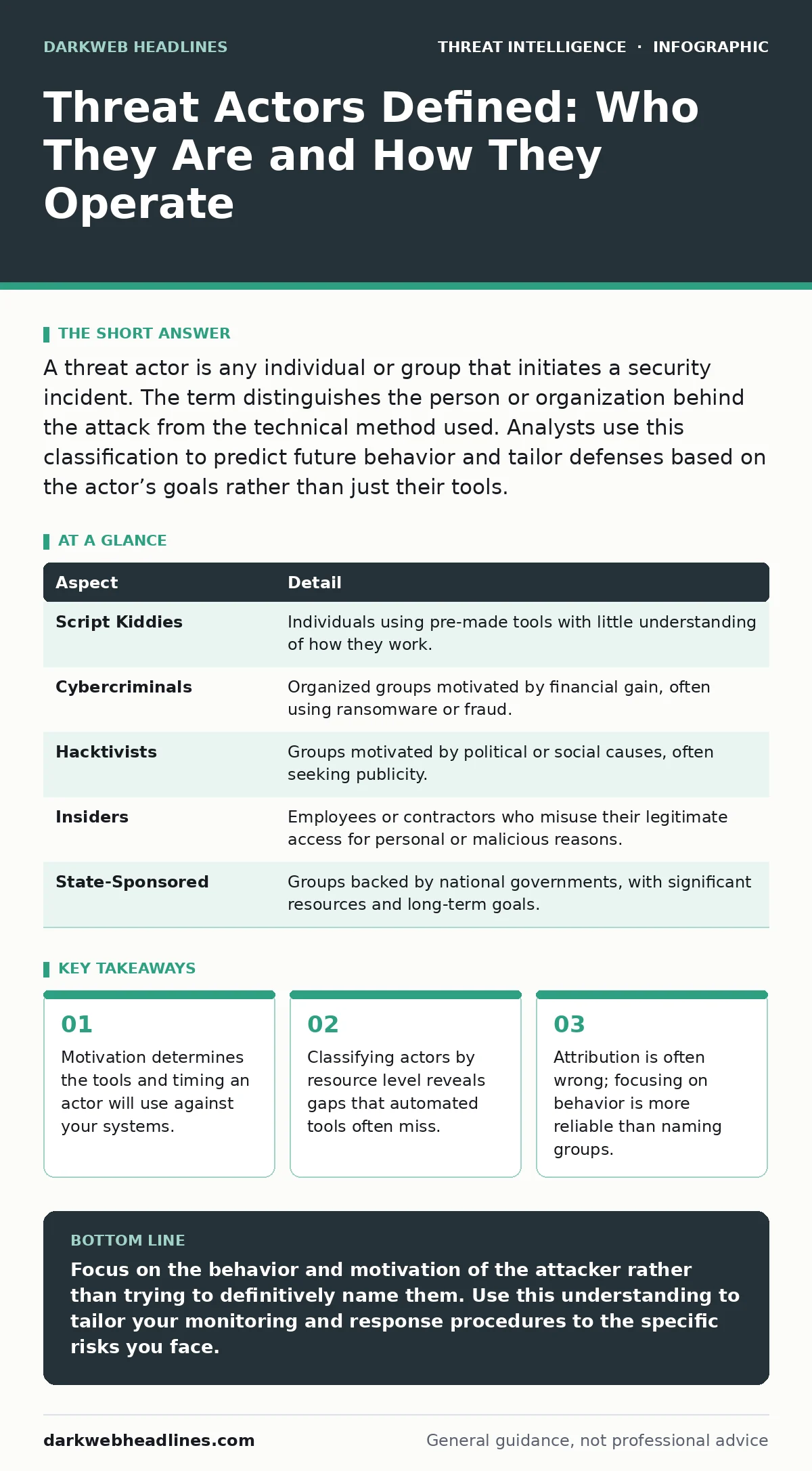
A threat actor is any individual or group that initiates a security incident. The term distinguishes the person or organization behind the attack from the technical method used. Analysts use this classification to predict future behavior and tailor defenses based on the actor’s goals rather than just their tools.
The Human Element Behind the Code
Imagine a locked door. You can study the lock mechanism, the metal strength, and the key shape. That is technical analysis. A threat actor is the person standing on the other side, deciding whether to pick the lock, break the window, or convince you to open it.
In cybersecurity, we often fixate on the "how." We analyze malware code, network packets, and exploit chains. However, the "who" matters just as much. The term threat actor refers to the entity responsible for a security breach. This entity can be a single person, a criminal organization, a state-sponsored group, or even an accidental insider.
The distinction between the actor and the technique is subtle but significant. A technique is a repeatable method, like phishing or brute-forcing. The actor is the intelligence behind the choice. By separating the two, you can predict what happens next. If you know the actor is profit-driven, they will likely move quickly to monetize data. If the actor is state-sponsored, they may wait months to exfiltrate sensitive plans.
Where the Term Comes From
The phrase emerged from intelligence communities rather than technical engineering. Traditional spies and military analysts needed a neutral way to describe adversaries without committing to unproven attribution. Calling someone a "threat actor" allows analysts to discuss capabilities and intent without making political statements about nationality or affiliation.
This neutrality became standard in the private sector. Companies needed a way to categorize risks without relying on often-flawed public attribution. It also helped bridge the gap between legal teams and security engineers. Legal teams care about liability and jurisdiction. Engineers care about patching and blocking. The concept of a threat actor provides a common language for both groups.
In practice, this term appears in threat intelligence feeds. These feeds provide data about known bad actors, their tactics, and their infrastructure. When you consume these feeds, you are not just getting a list of IP addresses. You are getting context about who is likely to use them and why.
How Analysts Use the Term Daily
Security operations centers (SOCs) use threat actor classifications to prioritize alerts. Not all alerts are created equal. An alert triggered by a known, high-value target requires immediate attention. An alert from a low-resource script kiddie might be lower priority if it is easily blocked by standard firewalls.
Analysts map observed behaviors to known actor profiles. This process helps in writing effective SOC playbooks. A playbook is a set of instructions for responding to specific incidents. If the playbook knows the actor is likely to use credential dumping to move laterally, the response team will focus on checking for stolen hashes rather than just looking for new network connections.
This classification also drives security metrics. You might track how many incidents were caused by external actors versus internal mistakes. This data helps leadership understand where to invest resources. If most damage comes from social engineering, training becomes a higher priority than buying new firewall hardware.
The Resource Spectrum
Not all actors have the same capabilities. You can categorize them by their resources and sophistication. This helps you understand what they can realistically achieve.
| Aspect | Detail |
|---|---|
| Script Kiddies | Individuals using pre-made tools with little understanding of how they work. |
| Cybercriminals | Organized groups motivated by financial gain, often using ransomware or fraud. |
| Hacktivists | Groups motivated by political or social causes, often seeking publicity. |
| Insiders | Employees or contractors who misuse their legitimate access for personal or malicious reasons. |
| State-Sponsored | Groups backed by national governments, with significant resources and long-term goals. |
Understanding this spectrum prevents over-engineering your defenses. If you build defenses against state-sponsored actors, you might ignore the simpler, more frequent attacks from script kiddies. Conversely, focusing only on simple attacks leaves you vulnerable to sophisticated, stealthy operations.
What People Usually Get Wrong
The most common error is assuming that the tool defines the actor. Just because a group uses a specific ransomware variant does not mean they are the only ones who can use it. Tools are often shared, sold, or leaked. Relying on tool-based attribution leads to false conclusions.
Another mistake is assuming that all threat actors are external. Insiders pose a unique challenge because they already have legitimate access. They do not need to bypass firewalls or crack passwords. They simply use their existing privileges in unauthorized ways. This makes their actions harder to detect with traditional perimeter defenses.
People also tend to overestimate the technical sophistication of every actor. Many successful attacks rely on basic social engineering rather than complex code. A well-crafted email can bypass even the most advanced technical controls. Focusing solely on technical patches ignores the human element that many actors exploit.
See also: Deep Web Intelligence: Why It Changes Security Decisions · Cyber Espionage Myths: Why State Actors Fail and How They Actually Operate
The Hidden Cost of Attribution
Trying to definitively name a threat actor is expensive and often inaccurate. Adversaries use techniques to hide their true identity. They use proxy servers, compromised infrastructure, and false flags to mislead investigators. This is known as OSINT investigations when done publicly, but even private attribution is fraught with error.
The cost of wrong attribution is high. If you believe an attack is from a specific country or group, you might tailor your defenses to counter that specific style. If the attribution is wrong, your defenses may be ineffective against the actual attacker’s methods. It is safer to focus on the behavior and the impact.
Focus on what the actor did, not who they claim to be. Did they steal data? Did they disrupt services? Did they install backdoors? These actions determine the response. The name on the door matters less than the damage inside the house.
Moving Beyond the Label
Classifying threat actors is not an end goal. It is a means to improve your defensive posture. By understanding who is attacking you and why, you can make better decisions about risk. You can prioritize patches, adjust monitoring rules, and train staff more effectively.
This approach integrates with log management and network enumeration. You need good data to identify behavior patterns. You need to know what your network looks like to spot anomalies. The concept of the threat actor ties these technical tasks together into a coherent strategy.
Remember that actors adapt. If you block their preferred method, they will find another. Your defenses must be flexible. Focus on reducing the surface area they can exploit. Limit access, monitor for unusual behavior, and respond quickly. The identity of the attacker is less important than your ability to stop the attack.
Key takeaways
- Motivation determines the tools and timing an actor will use against your systems.
- Classifying actors by resource level reveals gaps that automated tools often miss.
- Attribution is often wrong; focusing on behavior is more reliable than naming groups.
Focus on the behavior and motivation of the attacker rather than trying to definitively name them. Use this understanding to tailor your monitoring and response procedures to the specific risks you face.
Frequently asked questions
How do I tell if an attack is from a state-sponsored group?
State-sponsored groups often have long dwell times, use custom malware, and target specific strategic assets. They rarely seek immediate financial gain.
Are insiders considered threat actors?
Yes. Insiders are classified as threat actors because they initiate security incidents, even if they have legitimate access to the system.
Why is attribution so difficult?
Attackers use proxies, stolen infrastructure, and false flags to hide their identity. Tools are also shared, making it hard to link a specific tool to a specific group.
Does knowing the actor help with patching?
Indirectly. Knowing the actor’s goals helps you prioritize which vulnerabilities to patch first, based on what the actor is likely to exploit.
How this guide was produced: written by the DarkWeb Headlines editorial team with AI assistance, checked against the public references listed below, and reviewed when the facts change. See our editorial policy or report an error.