How Honeypots Work: The Mechanics of Deceptive Defense
Honeypots capture attack data by offering a target that provides no business value, turning every interaction into pure intelligence for your security team.

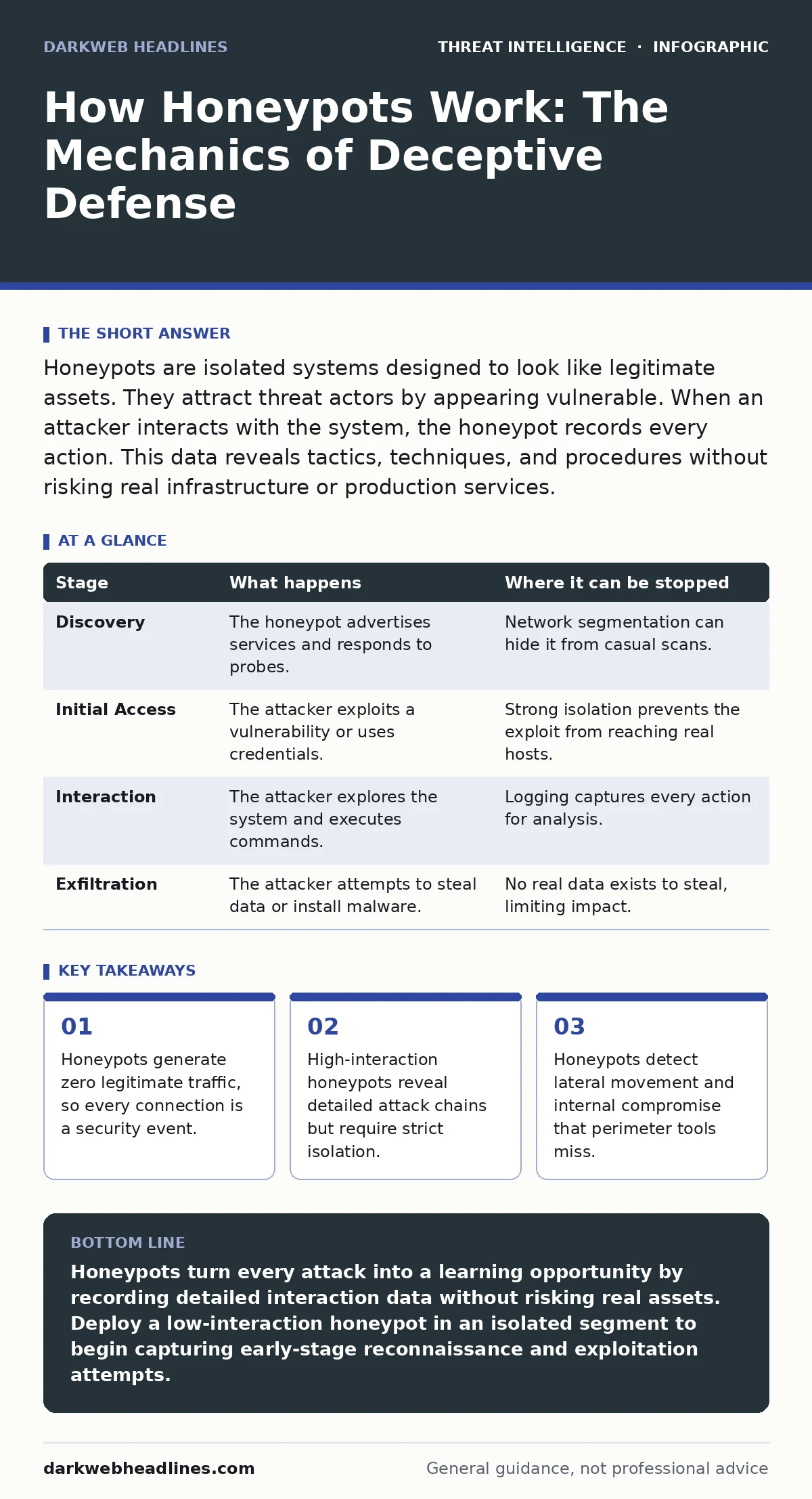
Honeypots are isolated systems designed to look like legitimate assets. They attract threat actors by appearing vulnerable. When an attacker interacts with the system, the honeypot records every action. This data reveals tactics, techniques, and procedures without risking real infrastructure or production services.
The Core Principle of Deception
Honeypots operate on a simple logical premise: no legitimate user has a reason to interact with a decoy system. Real servers handle web requests, database queries, or file transfers for business purposes. A honeypot serves none of these functions. It exists solely to be attacked. This absence of legitimate traffic creates a high signal-to-noise ratio. Security teams can alert on every connection attempt. This allows for immediate detection of scanning activity, brute-force attempts, or exploitation efforts. The system does not protect data. It observes behavior.
Imagine a bank vault with a fake door. Real customers enter through the main lobby. Anyone trying to force open the fake door is clearly an intruder. The bank does not care if they open it. The bank cares about the tools they use and the methods they employ. The honeypot acts as that fake door. It invites intrusion to study the intruder. This approach complements traditional defenses by providing visibility into actions that bypass firewalls or exploit zero-day vulnerabilities.
Stage 1: Attraction and Discovery
The first phase involves making the honeypot visible to potential attackers. This often requires the system to advertise services on standard ports. A honeypot might mimic a Windows file share, a Linux SSH server, or an IoT device. It responds to network probes like ping or port scans. The goal is to appear as a viable target. Many threat actors use automated tools to find open ports. The honeypot must respond correctly to these probes to seem real. It may also appear in search engine results or directory listings to attract human-led attacks.
| Stage | What happens | Where it can be stopped |
|---|---|---|
| Discovery | The honeypot advertises services and responds to probes. | Network segmentation can hide it from casual scans. |
| Initial Access | The attacker exploits a vulnerability or uses credentials. | Strong isolation prevents the exploit from reaching real hosts. |
| Interaction | The attacker explores the system and executes commands. | Logging captures every action for analysis. |
| Exfiltration | The attacker attempts to steal data or install malware. | No real data exists to steal, limiting impact. |
The Mechanics of Interaction
Once an attacker connects, the honeypot begins recording. Low-interaction honeypots simulate services without running a full operating system. They mimic the behavior of a service at the protocol level. This is safe and easy to manage. High-interaction honeypots run a real operating system. They allow attackers to install software, modify files, and execute commands. This provides deeper insight into the attacker's behavior. It reveals the specific tools and scripts they use. However, high-interaction honeypots require rigorous containment. If the attacker escapes the honeypot, they could access the real network.
Behind the Scenes: Logging and Analysis
The value of a honeypot lies in its logging capabilities. Every keystroke, command, and file transfer is recorded. This includes failed attempts, which provide early warning of reconnaissance. Security analysts review these logs to understand the attacker's intent. They look for patterns in the commands executed. They identify the malware variants installed. This intelligence feeds into broader security strategies. It helps update detection rules for intrusion prevention systems. It also aids in understanding the tactics of specific threat actors. The data is raw and unfiltered, providing a clear view of the attack chain.
Limits and Operational Risks
Honeypots have significant limitations. They do not protect production systems. An attacker who compromises a real server will not necessarily hit the honeypot. Honeypots are reactive, not preventive. They detect activity after it begins. They also require maintenance. High-interaction honeypots need patches and updates to remain realistic. If the honeypot behaves oddly, experienced attackers may detect it and leave. This is known as "honeypot detection." Attackers may also use the honeypot as a launchpad for further attacks if isolation fails. This risk requires careful network design and strict access controls.
Integration with Broader Security
Honeypots work best when integrated with other security measures. They complement command and control traffic detection by revealing initial access methods. They provide context for OSINT investigations by identifying active scanning sources. When combined with red teaming exercises, they help validate detection capabilities. They also support security metrics by quantifying the volume and type of attacks. This data helps justify security investments and improve incident response plans. Honeypots do not replace firewalls or antivirus software. They add a layer of visibility that traditional tools cannot provide.
See also: Cyber Espionage Myths: Why State Actors Fail and How They Actually Operate · Red Teaming vs Pentesting: Scope, Tactics, and Decision Criteria
Designing for Deception
Effective honeypot design requires attention to detail. The system must look like a real asset. This includes using realistic file names, user accounts, and network configurations. It should have some vulnerabilities that are known and monitored. It should not have any sensitive data. The network placement is critical. It should be isolated from production networks. Use virtualization or containerization to contain the environment. Monitor the network traffic between the honeypot and the rest of the network. Alert on any outbound connections that deviate from expected behavior. This ensures that any escape is detected immediately.
Maintaining Realism and Safety
Keeping a honeypot realistic is an ongoing process. Attackers evolve their techniques. They look for signs of deception, such as empty directories or generic file names. Regularly update the honeypot's content to reflect changes in the real environment. Rotate credentials and update software to match production systems. Monitor for signs of honeypot detection. If an attacker spends too little time on the system, they may have identified it as a decoy. Adjust the configuration to improve realism. Balance the need for realism with the need for safety. Do not introduce unnecessary complexity that could lead to security gaps.
The Value of Passive Intelligence
Honeypots provide passive intelligence that is difficult to obtain elsewhere. They reveal the initial steps of an attack chain. They show how attackers move laterally within a network. They identify the tools and techniques used by different groups. This information is valuable for improving overall security posture. It helps prioritize patching efforts and strengthen detection rules. It also provides evidence for legal action or attribution. While honeypots do not stop attacks, they make them more visible. This visibility allows security teams to respond faster and more effectively. The intelligence gathered can inform broader strategies against threat actors and hacktivism campaigns.
Key takeaways
- Honeypots generate zero legitimate traffic, so every connection is a security event.
- High-interaction honeypots reveal detailed attack chains but require strict isolation.
- Honeypots detect lateral movement and internal compromise that perimeter tools miss.
Honeypots turn every attack into a learning opportunity by recording detailed interaction data without risking real assets. Deploy a low-interaction honeypot in an isolated segment to begin capturing early-stage reconnaissance and exploitation attempts.
Frequently asked questions
Can a honeypot prevent a data breach?
No, a honeypot does not prevent breaches. It detects and records attack activity, providing intelligence that can help improve defenses and response times for future incidents.
How do I know if my honeypot is being detected?
Look for rapid disconnections, unusual command sequences, or attackers probing for signs of virtualization. If attackers leave quickly without engaging, they may have identified the system as a decoy.
Should I use high or low-interaction honeypots?
Start with low-interaction honeypots for safety and ease of management. Use high-interaction honeypots only if you have the resources to maintain strict isolation and detailed logging.
Do honeypots work against internal threats?
Yes, honeypots can detect internal threats by identifying unauthorized access or lateral movement. Place them in segments where legitimate users have no reason to interact.
How this guide was produced: written by the DarkWeb Headlines editorial team with AI assistance, checked against the public references listed below, and reviewed when the facts change. See our editorial policy or report an error.