Cyber Espionage Myths: Why State Actors Fail and How They Actually Operate
Cyber espionage relies on patience and access rather than Hollywood-style speed, using legitimate tools to hide in plain sight within normal network traffic patterns.

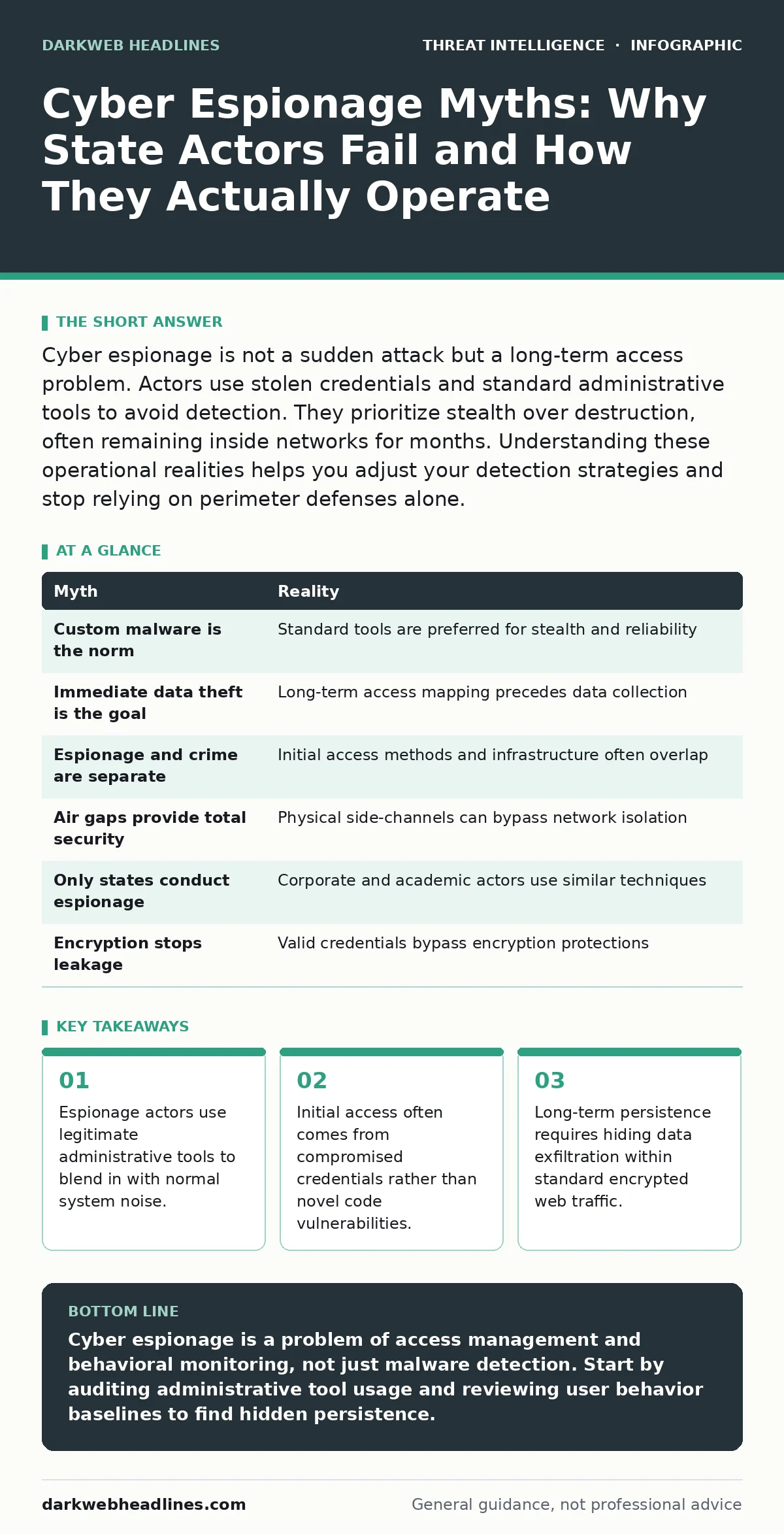
Cyber espionage is not a sudden attack but a long-term access problem. Actors use stolen credentials and standard administrative tools to avoid detection. They prioritize stealth over destruction, often remaining inside networks for months. Understanding these operational realities helps you adjust your detection strategies and stop relying on perimeter defenses alone.
Myth: Espionage actors use only custom, zero-day malware
Reality: Custom exploit code is expensive, fragile, and leaves unique digital fingerprints that analysts can track. Most sophisticated groups rely on commercial software and open-source tools that are already present on the target systems. They configure these standard tools to perform malicious tasks, making the activity look like routine system administration. This approach reduces the risk of detection by signature-based scanners.
Using standard tools creates a specific operational security trade-off. The attacker gains reliability and ease of use but must carefully manage the tool's default behaviors. If a standard configuration utility logs its actions to a central server, the attacker must disable or redirect those logs. This requirement for log manipulation often leaves subtle artifacts in system event histories. Analysts reviewing these logs might notice a legitimate process running at an unusual time or connecting to an unexpected external IP address.
Myth: The goal is always to steal sensitive data immediately
Reality: Rapid data theft triggers alarms and forces the target to reset credentials, ending the actor's access. Espionage operations prioritize maintaining presence over immediate harvest. Actors map the network, identify high-value targets, and establish multiple backup access points before touching sensitive files. This phase, known as lateral movement, can last for months or even years. The objective is to build a reservoir of access that survives password changes and system patches.
This patience creates a hidden cost for defenders. Security teams often look for large data transfers or unusual file downloads. They miss the small, slow exfiltration of data that occurs over long periods. An actor might compress and encrypt a small amount of data, then send it as part of a normal HTTPS request to a cloud storage service. The volume is too low to trigger bandwidth alerts, and the encryption prevents content inspection. The theft happens in silence, below the threshold of standard monitoring tools.
Myth: Espionage is distinct from financial cybercrime
Reality: The infrastructure and initial access methods for espionage and financial crime often overlap. State-sponsored groups may rent access from criminal syndicates or use the same phishing campaigns to compromise users. The distinction lies in the end goal, not the entry method. A compromised email account provides the same foothold whether the attacker wants trade secrets or banking credentials. This convergence means that defenses against financial fraud also protect against espionage.
Imagine a scenario where a phishing email compromises an executive's email account. A financial criminal would use this to request wire transfers. An espionage actor would use it to read calendar invites and meeting notes to understand the organization's structure. The initial breach is identical. Defenders who treat these threats as separate categories miss the opportunity to share intelligence. Indicators of compromise from financial crimes can predict espionage targets, and vice versa.
Myth: Air-gapped systems are completely safe from remote access
Reality: Physical isolation does not prevent data transfer via non-network channels. Attackers use acoustic signals, electromagnetic emissions, or even power line fluctuations to transmit data from isolated machines. These methods are slow and require specialized hardware, but they bypass network-based security controls entirely. The myth of the air gap creates a false sense of security that leads to reduced monitoring on critical infrastructure.
Suppose a server in a secure facility has no network connection. An attacker could use a malware variant that modulates the fan speed or LED indicators to send binary data. A sensor outside the room captures these signals and decodes them. This technique, known as covert channel communication, exploits the physical properties of the hardware. It demonstrates that security must extend beyond network boundaries to include physical environment monitoring. Relying solely on network segmentation leaves these physical attack vectors open.
Myth: Only nation-states conduct cyber espionage
Reality: Corporate competitors, academic institutions, and activist groups also engage in espionage. The tools and techniques are often similar, differing mainly in resources and persistence. A small group can achieve significant results by targeting a single high-value employee. They do not need a massive budget if they have precise intelligence about the target's habits. This democratization of threat capability means that defenders must assume any actor could be watching.
This reality complicates the attribution process. When an intrusion occurs, it is difficult to determine if the actor is state-sponsored or privately motivated. The operational security measures used by both types of actors are increasingly sophisticated. Defenders should focus on the behavior of the intrusion rather than the identity of the attacker. Detecting unauthorized access is more valuable than guessing the source. Misidentifying the actor can lead to wasted resources on irrelevant countermeasures.
See also: Deep Web Intelligence: Why It Changes Security Decisions · Red Teaming vs Pentesting: Scope, Tactics, and Decision Criteria
Myth: Encryption alone prevents data leakage
Reality: Encryption protects data in transit and at rest, but it does not prevent an attacker from accessing it on an authorized device. If an actor has valid credentials, they can view and copy encrypted files just like a legitimate user. The encryption keys are available to the system when the user is logged in. This means that endpoint security and user behavior monitoring are more critical than network encryption for espionage defense.
Consider a scenario where an employee works from a compromised laptop. The actor uses a keylogger to capture the user's password and then accesses the company's secure portal. The data remains encrypted during transmission, satisfying compliance requirements, but the actor successfully steals it. This highlights the limitation of technical controls without procedural safeguards. Multi-factor authentication and conditional access policies can block unauthorized access even if credentials are stolen.
| Myth | Reality |
|---|---|
| Custom malware is the norm | Standard tools are preferred for stealth and reliability |
| Immediate data theft is the goal | Long-term access mapping precedes data collection |
| Espionage and crime are separate | Initial access methods and infrastructure often overlap |
| Air gaps provide total security | Physical side-channels can bypass network isolation |
| Only states conduct espionage | Corporate and academic actors use similar techniques |
| Encryption stops leakage | Valid credentials bypass encryption protections |
Key takeaways
- Espionage actors use legitimate administrative tools to blend in with normal system noise.
- Initial access often comes from compromised credentials rather than novel code vulnerabilities.
- Long-term persistence requires hiding data exfiltration within standard encrypted web traffic.
Cyber espionage is a problem of access management and behavioral monitoring, not just malware detection. Start by auditing administrative tool usage and reviewing user behavior baselines to find hidden persistence.
Frequently asked questions
How can I detect if standard tools are being abused?
Look for processes running at unusual hours, connecting to unexpected external IP addresses, or executing commands from user directories rather than system paths.
Does multi-factor authentication stop espionage actors?
MFA prevents access with stolen passwords alone, but actors may use session hijacking or phishing for the second factor, so it is not a complete solution.
Why do espionage actors stay in networks for so long?
They need time to map the environment, establish backup access points, and avoid triggering alarms before collecting high-value data.
Can honeypots help detect espionage attempts?
Honeypots can attract attackers and reveal their tools and techniques, providing early warning and intelligence for operational threat intelligence teams.
How this guide was produced: written by the DarkWeb Headlines editorial team with AI assistance, checked against the public references listed below, and reviewed when the facts change. See our editorial policy or report an error.